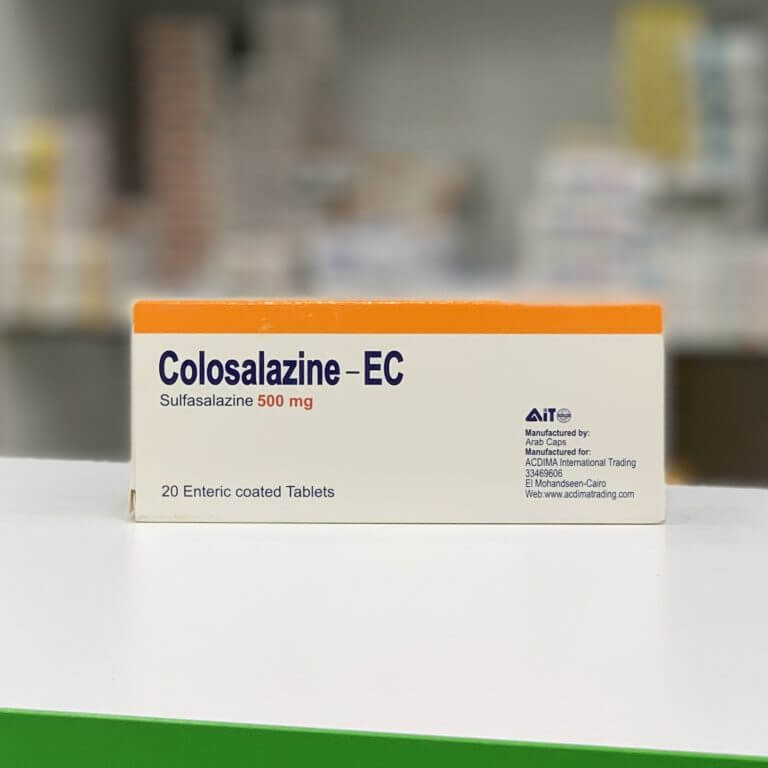
Colosalazine EC 500 mg 20 tablets
Composition:
Active ingredients:
Sulfasalazine 500mg
Inactive ingredients:
Avicel PH 101, Povidone k 25, AC-Di-Sol, Colloidal silicon dioxide, Magnesium stearate, Enteric coat, Eudragit L 100, Talc, Titanium Dl oxide, PEG 6000, Ethyl alcohol , Sun Set yellow
Properties:
The mode of action of Sulfasalazine or its metabolites, 5-aminosalicylic acid and sulfapyridine may be related to the anti-inflammatory and/or immunomodulatory properties that have been observed in animal and in vitro models, to its affinity for connective tissue.
Indication:
- the treatment of mild to moderate ulcerative colitis, and as adjunctive therapy in severe ulcerative colitis
- for the prolongation of the remission period between acute attacks of ulcerative colitis
Dosage and administration:
The dosage of sulfasalazine tablets should be adjusted to each individual’s response and tolerance.
Initial therapy:
1)Adults 3 to 4 g daily in evenly divided doses with dosage intervals not exceeding eight hours. In some cases it is advisable to initiate therapy with a smaller dosage to reduce possible gastrointestinal intolerance. If daily doses exceeding 4 g are required to achieve desired effects, the increased risk of toxicity should be kept in mind.
2)Children, six years of age and older:
40 to 60 mg/kg body weight in each 24 hour period, divided into 3 to 6 doses.
Maintenance therapy:
1)Adults 2 g daily
2)Children six years of age and older: 30 mg/kg body weight in each 24 hour period, divided into 4 doses.
If symptoms of gastric intolerance (anorexia, nausea, vomiting, etc.) occur after the first few doses of Sulfasalazine, they are probably due to increased serum levels of total sulfapyridine and may be alleviated by halving the daily dose of Sulfasalazine and subsequently increasing it gradually over several days.
Some patents may be sensitive to treatment with Sulfasalazine. Various desensitization-like regimens have been reported to be effective These regimens suggest starting with a total daily dose of 50 to 250 mg Sulfasalazine initially, and doubling it every 4 to 7 days until the desired therapeutic level is achieved.
Side effects:
Stomach upset, nausea, vomiting, loss of appetite, headache, dizziness, or unusual tiredness may occur.
This medication may cause your skin and urine to turn orange-yellow. This effect is harmless and will disappear when the medication is stopped.
Hearing changes (such as ringing in the ears), mental/mood changes, signs of kidney problems (such as change in the amount of urine, painful urination, blood in the urine), new lump/growth in the neck (goiter), numbness/tingling of the hands/feet, signs of low blood sugar (such as hunger, cold sweat, blurred vision, weakness, fast heartbeat).
Rarely: allergic reactions (such as Stevens-Johnson syndrome), blood disorders (such as agranulocytosis, aplastic anemia), liver damage, nerve/muscle problems and infections. Skin rash/blisters/peeling, mouth sores, itching/swelling (especially of the face/tongue/throat), severe dizziness, trouble breathing, chest pain, signs of infection (such as fever, chills, persistent sore throat, cough), swollen lymph nodes, easy bruising/bleeding, severe tiredness, muscle pain/weakness (especially with fever and unusual tiredness), pale or blue skin/lips/nails, new/worsening joint pain, confusion, persistent/severe headache, unexplained neck stiffness, seizures, signs of liver problems (such as persistent nausea/vomiting, severe stomach/abdominal pain, yellowing eyes/skin, dark urine).
Contraindications:
-Intestinal or urinary obstruction
-Porphyria
-Hypersensitivity to sulfasalazine, its metabolites, sulfonamides or salicylate.
Warnings and precautions:
-Only after critical appraisal should Sulfasalazine tablets be given to patients with hepatic or renal damage or blood dyscrasias.
– Deaths associated with the administration of Sulfasalazine have been reported from hypersensitivity reactions, agranulocytosis, aplastic anemia, other blood dyscrasias, renal and liver damage, irreversible neuromuscular and central nervous system changes, and fibrosing alveolitis.
– The presence of clinical signs such as sore throat, fever, pallor, purpura, or jaundice may be indications of serious blood disorders.
– Complete blood counts, as well as urinalysis with careful microscopic examination, should be done frequently in patients receiving Sulfasalazine.
– Oligospermia and infertility have been observed in men treated with Sulfasalazine; however, withdrawal of the drug appears to reverse these effects.
– Sulfasalazine tablets should be given with caution to patients with severe allergy or bronchial asthma.
– Adequate fluid intake must be maintained in order to prevent crystalluria and stone formation.
– Patients with glucose-6 phosphate dehydrogenase deficiency should be observed closely for signs of hemolytic anemia. This reaction is frequently dose
related. If toxic or hypersensitivity reactions occur the drug should be discontinued immediately.
Storage:
Store at a temperature not exceeding 30°C in a dry place.
Package:
The carton box contains 2 strips each of 10 enteric coated tablets and inner leaflet.
 Русский
 English
 عربي
عربي