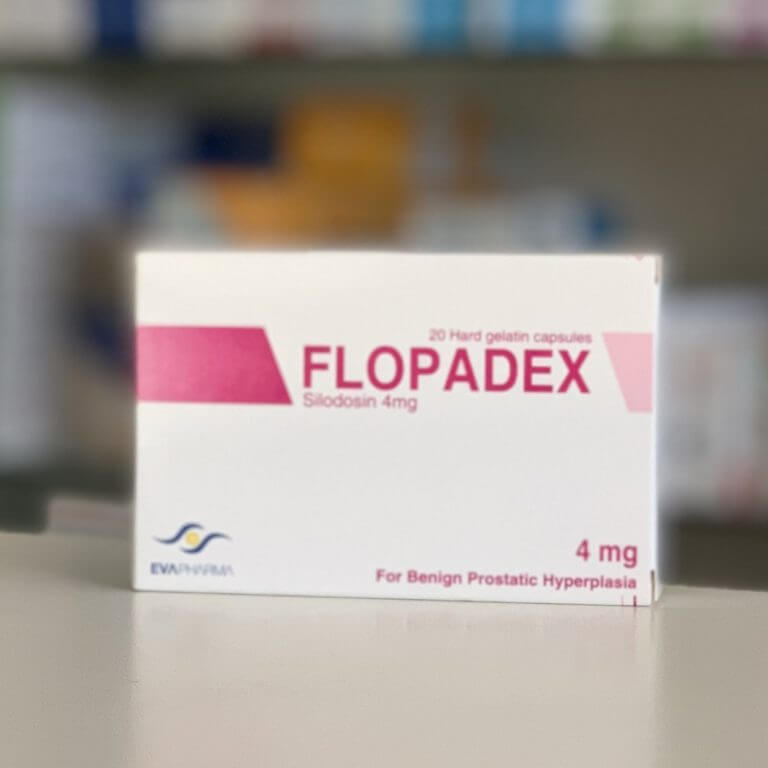
Flopadex 4 mg 20 capsules
Composition:
Each 4 mg capsule contains:
Silodosin 4mg
Inactive ingredients:
Mannitol, pregelatinized starch, maize starch, sodium lauryl sulfate, magnesium stearate, gelatin, titanium dioxide, brilliant blue, erythrosine.
Properties:
Silodosin is uroselective antagonist of postsynaptic alpha-1 adrenoreceptors, which are located in the human prostate, bladder base, bladder neck, prostatic capsule, and prostatic urethra. Blockade of these alpha-1 adrenoreceptors can cause smooth muscle in these tissues to relax, resulting in an improvement in urine flow and a reduction in BPH symptoms, An in vitro study examining binding affinity of Silodosin to the three subtypes of the alpha-1 adrenoreceptors (alpha-1A. alpha-1B, and alpha-1D) was conducted. The results of the study demonstrated that Silodosin binds with high affinity to the alpha-1A subtype.
Indications:
Silodosin, a selective alpha-1 adrenergic receptor antagonist, is indicated for the treatment of the signs and symptoms of benign prostatic hyperplasia (BPH). Silodosin is not indicated for the treatment of hypertension. Can be used in distal ureteral stones or after ESWL.
Dosage and administration:
-The recommended dose is 8 mg orally once daily with a meal.
-Renal impairment: Silodosin is contraindicated in patients with severe renal impairment (CCr < 30 mL/min). In patients with moderate renal impairment (CCr 30-50 mL/min), the dose should be reduced to 4 mg once daily taken with a meal. No dosage adjustment is needed in patients with mild renal impairment (CCr 50-80 mL/min).
-Hepatic impairment: Silodosin has not been studied in patients with severe hepatic impairment and is therefore contraindicated in these patients.
No dosage adjustment is needed in patients with mild or moderate hepatic impairment.
Side effects:
Retrograde ejaculation, dizziness, diarrhea, hypotension, headache, orthostatic nasopharyngitis, nasal congestion, insomnia, PSA observed increased, sinusitis, abdominal pain, asthenia and rhinorrhea.
Very rare adverse reactions: Syncope, priapism, intraoperative floppy iris syndrome (IFIS).
Contraindications:
-Severe renal impairment (CCr < 30 mL/min);
-Severe hepatic impairment;
-Concomitant administration with strong Cytochrome P450 3A4 (CYP3A4) inhibitors (e.g., ketoconazole, clarithromycin, itraconazole, ritonavir).
Warnings and precautions:
- Orthostatic Effects: Postural hypotension, with or without symptoms (e.g.. dizziness) may develop when beginning Silodosin treatment. As with other alpha-blockers, there is potential for syncope. Patients should be cautioned about diving, operating machinery, or performing hazardous tasks when initiating therapy.
- Renal impairment: In clinical pharmacology study, plasma concentrations of Silodosin were approximately three times higher in subjects with moderate renal impairment compared with subjects with normal renal function, while half-lives of Silodosin doubled in duration. The dose of Silodosin should be reduced to 4 mg in patients with moderate renal impairment. Exercise caution and monitor such patients for adverse events. Silodosin is contraindicated in patients with severe renal impairment.
Silodosin has not been tested in patients with severe hepatic impairment, and therefore, should not be prescribed to such patients.
- Carcinoma of the Prostate: Carcinoma of prostate and BPH cause many of the same symptoms. These two diseases frequently co-exist. Therefore, patients thought to have BPH should be examined prior to starting therapy with Silodosin to rule out the presence of carcinoma of the prostate.
- Intraoperative Floppy Iris Syndrome: Intraoperative Floppy Iris Syndrome has been observed during cataract surgery in some patients on alpha-1 blockers or previously treated with alpha-1 blockers. This variant of small pupil syndrome is characterized by the combination of a flaccid iris that billows in response to intraoperative irrigation currents; progressive intraoperative miosis despite preoperative dilation with standard mydriatic drugs; and potential prolapse of the iris toward the phacoemulsification incisions. Patients planning cataract surgery should be told to inform their ophthalmologist that they are taking Silodosin.
- Laboratory Test Interactions: No laboratory test interactions were observed during clinical evaluations. Treatment with Silodosin for up to 52 weeks had no signíficant effect on prostate-specific antigen.
- Pregnancy: Silodosin is not indicated for use in Women.
- Pediatric use: Silodosin is not indicated for use in pediatric patients. Safety and effectiveness in pediatric patients have not been established.
- Geriatric use: There are no significant differences in safety or effectiveness between older and younger patients.
- Drug interactions:
-CYP3A4 inhibitors such as itraconazole or ritonavir may cause plasma concentrations of Siilodosin to increase. Concomitant administration of strong CYP3A4 inhibitors and Silodosin is contraindicated.
-Strong P-glycoprotein (P-gp) Inhibitors: In vitro studies indicated that Silodosin is a P-gp substrate. Ketoconazole, a CYP3A4 inhibitor that also inhibits P-gp, caused a significant increase in exposure to silodosin.
-Alpha-Blockers: The pharmacodynamic interactions between Silodosin and other alpha-blockers have not been determined. However, interactions may be expected, and Silodosin should not be used in combination with other alpha-blockers. -PDE5 Inhibitors: No events of symptomatic orthostasis or dizziness were reported in subjects receiving Silodosin with a PDE5 inhibitor.
-Antihypertensives: Exercise caution during concomitant use with antihypertensives and monitor patents for possible adverse events.
Storage:
Store in a dry place, at a temperature not exceeding 30°C
Package:
Carton box contains 2 strips each of 10 capsules and an insert leaflet.
 Русский
 English
 عربي
عربي