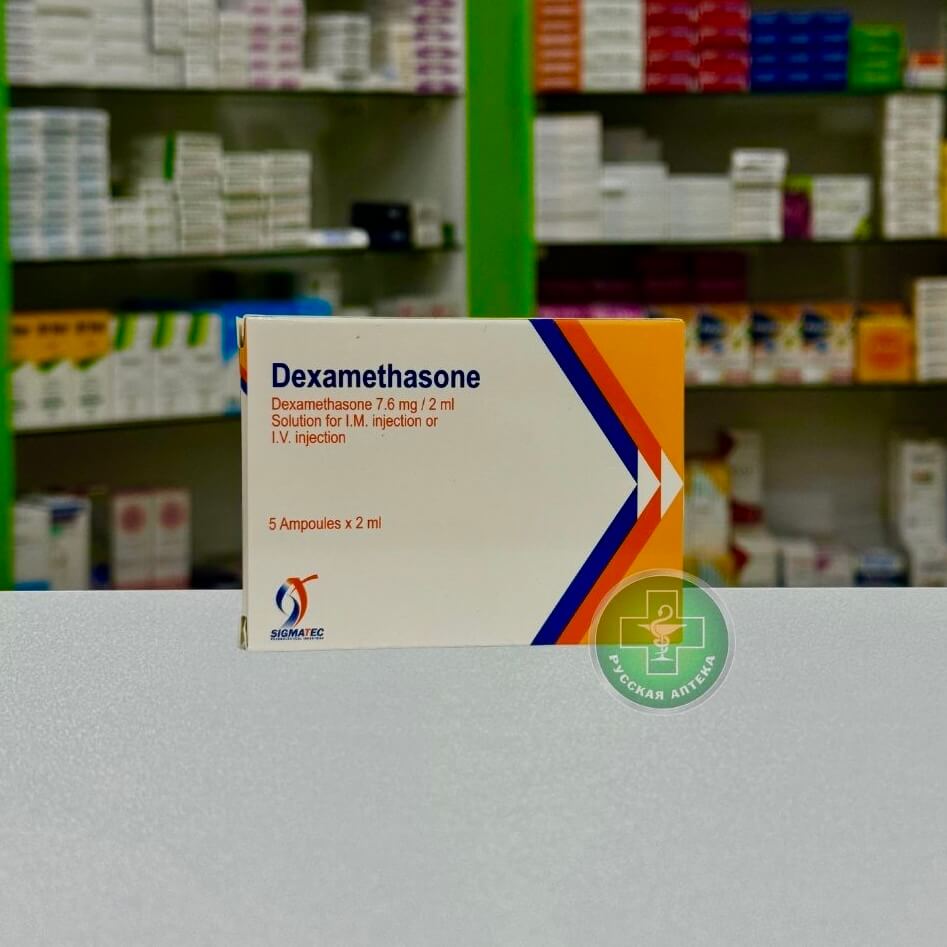
Dexamethasone 8 mg 5 ampoules 2 ml
Composition:
Each 2 ml contains: Active Ingredient:
Dexamethasone sodium phosphate equivalent to 7.6 mg/2ml Dexamethasone base 10 mg.
Indications:
Corticosteroid
For use in certain endocrine and non-endocrine disorders responsive to corticosteroid therapy Systemic (intravenous or intramuscular) administration.
Dexamethasone solution for injection is recommended for systemic administration by intravenous or intramuscular injection when oral therapy is not feasible or desirable in the following conditions:
- Endocrine disorders
Primary or secondary adrenocortical insufficiency.
- Non-endocrine disorders
Dexamethasone solution for injection may be used in the treatment of non-endocrine corticosteroid-responsive conditions, including:
• Allergy and anaphylaxis: Angioneurotic oedema and anaphylaxis
• Gastrointestinal disorders: Crohn's disease and ulcerative colitis
• Infection (with appropriate chemotherapy): Miliary tuberculosis and endotoxic shock
• Neurological disorders: Raised intracranial pressure secondary to cerebral tumours and infantile spasms.
-In addition, Dexamethasone for injection is used as an adjunct in the control of cerebral oedema caused by brain tumours or associated with neurosurgery, but not in those cases where the oedema is caused by head injury.
• Respiratory disorders: Bronchial asthma and aspiration pneumonitis.
• Skin disorders: toxic epidermal necrolysis.
•Shock: Adjunctive treatment where high pharmacological doses are needed. Treatment is an adjunct to and not a substitute for, specific and supportive measures the patient may require.
Posology and method of administration:
Dosage requirements are variable and must be individualized on the basis of the disease under treatment and response of the patient. In neonates, especially the premature infant, only preservative-free solutions should be administered.
Dosage:
Intravenous and Intramuscular Injection
Usually the parenteral dose is one-third to one half the oral dose, given every 12 hours. The usual initial dosage of dexamethasone solution for injection is 0.4 mg - 16.6 mg (0.1 ml - 4.4 ml) and varies depending on the specific disease entity being treated. In situations of less severity, lower doses will generally suffice. However, in certain overwhelming, acute, life-threatening situations, dosages exceeding the usual recommended dosages have been used. In these circumstances, the slower rate of absorption by intramuscular administration should be recognized.
Chronic dosage should preferably not exceed 500 micrograms dexamethasone daily. Close monitoring of the drug dosage is needed.
For the comfort of the patient, not more than 2 ml should be injected intramuscularly at any one site.
In emergencies, the usual dose is 3.3 mg to 16.6 mg (0.9 ml to 4.4 ml) I.V. or I.M. (in shock use only the I.V. route).
This dose may be repeated until adequate response is noted.
After initial improvement, single doses of 1.7 mg to 3.3 mg (0.4 ml to 0.9 ml) should be repeated as necessary. The total daily dosage usually need not exceed 66.4 mg (17.5 ml), even in severe conditions.
When constant maximal effect is desired, dosage must be repeated at three-hour or four-hour intervals.
Intravenous and intramuscular injections are advised in acute illness. When the acute stage has passed, substitute oral steroid therapy as soon as feasible.
Adults and Elderly:
Once the disease is under control the dosage should be reduced or tapered off to the lowest suitable level under continuous monitoring and observation of the patient.
-For acute life-threatening situations (e.g. anaphylaxis, acute severe asthma) substantially higher dosages may be needed.
-Shock (Of Haemorrhagic, Traumatic, or Surgical Origin)
The usual dose is 1.7 to 5 mg/kg (0.4 ml - 1.3 ml/kg) body weight given as a single intravenous injection. This may be repeated in 2 to 6 hours, if shock persists. As an alternative, this may be followed immediately by the same dose in an repeated in 2 to 6 hours, if shock persists.
Cerebral Oedema:
• Associated with primary or metastatic brain tumour, pseudotumor cerebri or preoperative preparation of patients with increased intracranial pressure secondary to brain tumour:
Initially 8.3 mg (2.2 mL) dexamethasone solution for injection intravenously followed by 3.3 mg (0.9 mL) intramuscularly every 6 hours until symptoms of cerebral oedema subside. Response is usually noted within 12 to 24 hours: dosage may be reduced after 2 to 4 days and High doses of dexamethasone solution for injection are recommended for initiating short-term intensive therapy for acute life-threatening cerebral oedema.
Following the high loading dose schedule of the first day of therapy, the dose is scaled down over the 7 to 10 day period of intensive therapy and subsequently reduced to zero over the next 7 to 10 days.
Special Populations Pediatric population:
Dosage requirements are variable and may have to be changed according to individual needs.
Dosage should be limited to a single dose on alternate days to lessen retardation of growth and minimise suppression of the hypothalamo-pituitary adrenal axis.
Use in the elderly
Treatment of elderly patients, particularly if long term, should be planned bearing in mind the more serious consequences of the common side effects of corticosteroids in old age, especially osteoporosis, diabetes, hypertension, hypokalaemia, susceptibility to infection and thinning of the skin.
Method of administration:
Dexamethasone solution for injection may be administered intravenously, intramuscularly. With intravenous administration high plasma levels can be obtained rapidly.
Rapid intravenous injection of massive doses of glucocorticoids may sometimes cause cardiovascular collapse; the injection should therefore be given slowly over a period of several minutes.
Contraindications:
-Systemic infection unless specific anti-infective therapy is employed.
-Hypersensitivity to the active substance or to any of the excipients listed in Composition.
-Local injection of a glucocorticoid is contraindicated in bacteraemia and systemic fungal infections, unstable joints, infection at the injection site e.g. septic arthritis resulting from gonorrhoea or tuberculosis.
Special warnings and precautions:
-Rare instances of anaphylactoid/anaphylactic reactions with a possibility of shock have occurred in patients receiving parenteral corticosteroid therapy. Appropriate precautionary measures should be taken with patients who have a history of allergic reactions to corticosteroids.
-Tumor lysis syndrome. In post-marketing experience tumour lysis syndrome (TLS) has been reported in patients with haematological malignancies following the use of dexamethasone alone or in combination with other chemotherapeutic agents. Patients at high risk of TLS, such as patients with high proliferative rate, high tumour burden, and high sensitivity to cytotoxic agents, should be monitored closely and appropriate precautions taken.
-Patients and/or carers should be warned that potentially severe psychiatric adverse reactions may occur with systemic steroids.
-Most reactions recover after either dose reduction or withdrawal, although specific treatment may be necessary.
-Patients/carers should be encouraged to seek medical advice it worrying psychological symptoms develop, especially if depressed mood or suicidal ideation is suspected.
-Particular care is required when considering the use of systemic corticosteroids in patients with existing or previous history of severe affective disorders in themselves or in their first degree relatives.
-Particular care is required when considering the use of systemic corticosteroids in patients with the following conditions and frequent patient monitoring is necessary:
a. Osteoporosis (post-menopausal females are particularly at risk)
b. Hypertension or congestive heart failure
c. Existing or previous history of severe affective disorders (especially previous steroid psychosis
d. Diabetes mellitus (or a family history of diabetes)
e. History of tuberculosis, since glucocorticoids may induce reactivation
f. Glaucoma (or a family history of glaucoma)
9. Previous corticosteroid-induced myopathy
h. Liver failure
i. Renal insufficiency
k. assintestinal ulceration
I. Migraine
m. Certain parasitic infestations in particular amoebiasis
n. Incomplete statura growth since glucocorticoids on prolonged administration may accelerate epiphyseal closure
o. Patients with Cushing's syndrome
In the treatment of conditions such as tendinitis or tenosynovitis care should be taken to inject into the space between the tendon sheath and the tendon as cases of ruptured tendon have been reported.
Pediatric population:
Corticosteroids cause dose-related growth retardation in infancy, childhood and adolescence, which may be irreversible.
Use in the Elderly:
The common adverse effects of systemic corticosteroids may be associated with more serious consequences in old age, especially osteoporosis, hypertension, hypokalaemia, diabetes, susceptibility to infection and thinning of the skin.
Close clinical supervision is required to avoid life-threatening reactions.
Fertility, pregnancy:
Pregnancy:
As with all drugs, corticosteroids should only be prescribed when the benefits to the mother and child outweigh the risks. When corticosteroids are essential however, patients with normal pregnancies may be treated as though they were in the non-gravid state.
Breast-feeding:
Corticosteroids may pass into breast milk, although no data are available for dexamethasone. Infants of mothers taking high doses of systemic corticosteroids for prolonged periods may have a degree of adrenal suppression.
Storage Method:
Store at a temperature not exceeding 30°C.
Keep out of reach of children.
Package:
A carton box contains 5 ampules* 2 ml and insert leaflet.
 Русский
 English
 عربي
عربي