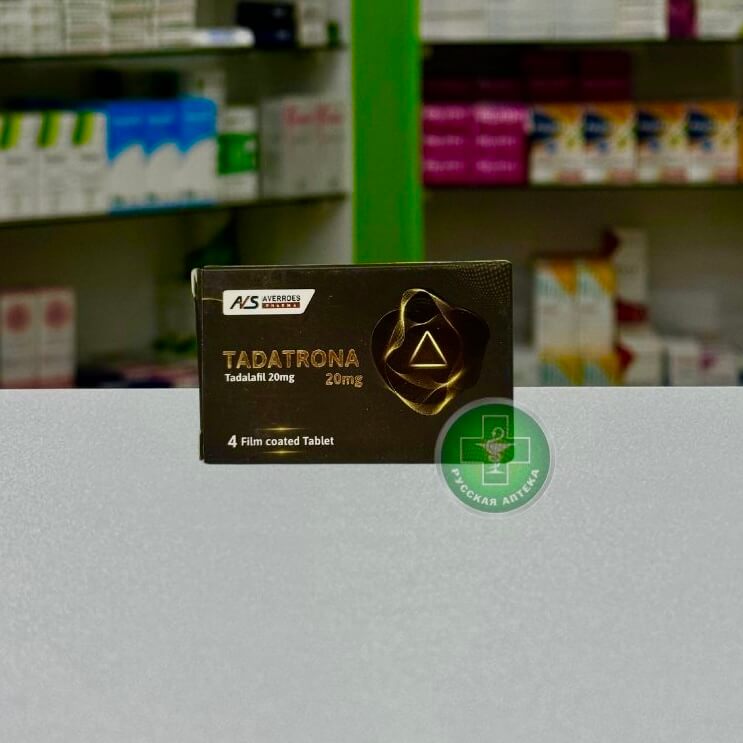
Tadatrona 20 mg 4 tablets
Composition:
Each 20 mg tablet contains 20 mg tadalafil.
Indications:
Treatment of erectile dysfunction in adult males.
In order for tadalafil to be effective for the treatment of erectile dysfunction, sexual stimulation is required. Tadatrona is not indicated for use by women.
Posology and Method of Administration:
Erectile dysfunction in adult men:
in general, the recommended dose is 10 mg taken prior to anticipated sexual activity and with or without food.
In those patients in whom tadalafil 10 mg does not produce an adequate effect, 20 mg might be tried. It may be taken at least 30 minutes prior to sexual activity.
The maximum dose frequency is once per day.
Tadalafil 10 and 20 mg is intended for use prior to anticipated sexual activity and it is not recommended for continuous daily use.
In patients who anticipate a frequent use of tadalfil (i.e., at least twice weekly) a once daily regimen with the lowest doses of tadalafil might be considered suitable, based on patient choice and the physician's judgement.
The appropriateness of continued use of the daily regimen should be reassessed periodically.
Special populations
Men with renal impairment
Dose adjustments are not required in patients with mild to moderate renal impairment. For patients with severe renal impairment, 10 mg is the maximum recommended dose
Once-a-day dosing of tadalafil is not recommended in patients with severe renal impairment.
Men with hepatic impairment
-or the treatment of erectile dysfunction using on-demand tadalafil the recommended dose of Tadalafil is 10 mg taken prior to anticipated sexual activity and with or without food.
Contraindications
- Hypersensitivity to the active substance or to any of the excipients listed in section List of excipients.
- Hypersensitivity reactions due to usage such as
1- stevens-johnson syndrome
2- exfoliative dermatitis
Tadalafil must not be used in men with cardiac disease for whom sexual activity is inadvisable.
Physicians should consider the potential cardiac risk of sexual activity in patients with pre-existing cardiovascular disease
The following groups use of tadalafil is contraindicated:
- Patients with myocardial infarction within the last 90 days,
- Patients with unstable angina or angina occurring during sexual intercourse,
- Patients with uncontrolled arrhythmias, hypotension (< 90/50 mm Hg), or uncontrolled hypertension,
- Patients with a stroke within the last 6 months
-Tadatrona is contraindicated in patients who have loss of vision in one eye because of non-arteritic anterior ischaemic optic neuropathy (NAION), regardless of whether this episode was in connection or not with previous PDE5 inhibitor exposure.
Special warnings and precautions for use
Before treatment with Tadatrona: -A medical history and physical examination should be undertaken to diagnose erectile dysfunction or benign prostatic hyperplasia and determine potential underlying causes, before pharmacological treatment is considered.
-Prior to initiating any treatment for erectile dysfunction, physicians should consider the cardiovascular status of their patients, since there is a degree of cardiac risk associated with sexual activity.
-Tadalafil has vasodilator properties, resulting in mild and transient decreases in blood pressure and as such potentiates the hypotensive effect of nitrates.
-The evaluation of erectile dysfunction should include a determination of potential underlying causes and the identification of appropriate treatment following an appropriate medical assessment.
-It is not known if Tadatrona is effective in patients who have undergone pelvic surgery or radical non-nerve-sparing prostatectomy.
-Cardiovascular:The combination of tadalafil and doxazosin is not recommended.
Vision: Analyses of observational data suggest an increased risk of acute NAION in men with erectile dysfunction following exposure to tadalafil or other PDE5 inhibitors. As this may be relevant for all patients exposed to tadalafi, the patient should be advised that in case of sudden visual defect, he should stop taking tadalafil and consult a physician immediately.
-Decreased or sudden hearing loss: Patients should be advised to stop taking tadalafil and seek prompt medical attention in the event of sudden decrease or loss of hearing.
-Priapism and anatomical deformation of the penis
Patients who experience erections lasting 4 hours or more should be instructed to seek immediate medical assistance. If priapism is not treated immediately, penile tissue damage and permanent loss of potency may result.
-Tadatrona, should be used with caution in patients with anatomical deformation of the penis (such as angulation, cavernosal fibrosis, or Peyronie's disease) or in patients who have conditions which may predispose them to priapism (such as sickle cell anaemia, multiple myeloma or leukaemia).
-Caution should be exercised when prescribing Tadatrona to patients using potent CYP3A4 inhibitors (ritonavir, saquinavir, ketoconazole, itraconazole, and erythromycin) as increased tadalafil exposure (AUC) has been observed if the medicinal products are combined.
-Lactose
Tadatrona contains lactose. Patients with rare hereditary problems of galactose intolerance, the Lapp lactase deficiency or glucose-galactose malabsorption should not take this medicinal product.
Pregnancy and Lactation:
Tadatrona is not indicated for use by women.
Pregnancy
There are limited data from the use of tadalafil in pregnant women. As a precautionary measure, it is preferable to avoid the use of Tadatrona during pregnancy.
Breastfeeding
A risk to the suckling child cannot be excluded. Tadatrona should not be used during breast feeding.
Side Effects:
The most commonly reported adverse reactions in patients taking tadalafil for the treatment of erectile dysfunction or benign prostatic hyperplasia were headache, dyspepsia, back pain and myalgia, in which the incidences increase with increasing dose of tadalafil. The adverse reactions reported were transient, and generally mild or moderate. The majority of headaches reported with tadalafil once-a-day dosing are experienced within the first 10 to 30 days of starting treatment.
Hypersensitivity reactions
Angioedema
Headache
Dizziness
Stroke' (including Haemorrhagic events), Syncope, Transient ischaemic attacks, Migraine, Seizures, Transient amnesia
Blurred vision, Sensations described as Eye pain
Visual field defect, Swelling of eyelids, Conjunctival hyperaemia, Nonarteritic
anterior ischaemic optic neuropathy (NAION)
Retinal vascular occlusion-
Tinnitus
Sudden hearing loss
Cardiac disorders
Tachycardia, Palpitations Myocardial infarction, Unstable angina pectoris, Ventricular arrhythmia
Flushing
Hypotension, Hypertension
Respiratory, thoracic and mediastinal disorders
Nasal congestion
Dyspnoea, Epistaxis
Dyspepsia
Abdominal pain, Vomiting, Nausea,
Gastro-oesophageal reflux
Rash
Urticaria, Stevens-Johnson syndrome-Musculoskeletal, connective tissue and bone disoriers
Exfoliative dermatitis®, Hyperhydrosis (sweating)
Back pain, Myalgia, Pain in extremity
Renal and urinary disorders
Haematuria
Prolonged erections
Priapism, Penile haemorrhage, Haematospermia
General disorders and administration site conditions
Chest pain, Peripheral oedema, Fatigue
Storage Method:
Store at a temperature not exceeding 30°C in dry place.
Package:
Carton box contain strip of 4 film coated tablets and inner leaflet.
 Русский
 English
 عربي
عربي