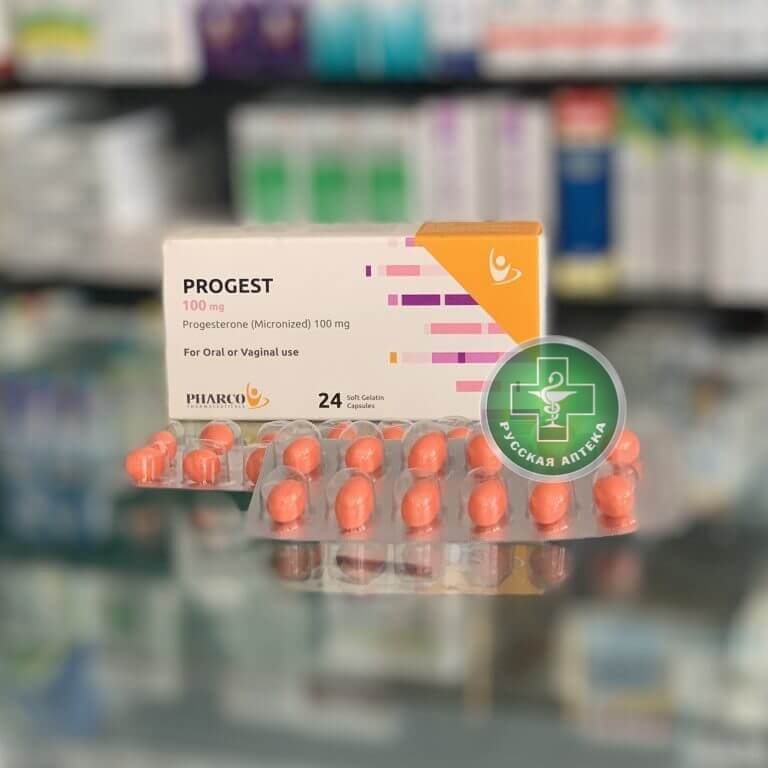
Progest 100 mg 24 capsules
Composition:
Each capsule contains:
Progesterone 100 mg
Auxiliary components:
Gelatin, glycerin, titanium dioxide, sodium ethyl hydroxybenzoate.
Properties:
The active ingredient of Progest@ is progesterone, which is identical to the natural hormone of the corpus luteum of the ovaries. By binding to receptors on the surface of cells of target organs, it penetrates into the nucleus, where, by activating DNA, it stimulates RNA synthesis.
Promotes the transition of the uterine mucosa from the proliferation phase caused by the follicular hormone estradiol into the secretory phase. After fertilization, it promotes the transition to a state necessary for the development of a fertilized egg. Reduces the excitability and contractility of the muscles the uterus and fallopian tubes. Promotes th formation of a normal endometrium. Stimulates the development of the terminal elements of the mammary gland, induces lactation.
By stimulating protein lipase, it increases fat stores, increases glucose utilization. By increasing the concentration of basal and stimulated insulin, it promotes the accumulation of glycogen in the liver, increases the production of pituitary gonadotropic hormones; reduces azotemia, increases the excretion of nitrogen in the urine.
Indications:
Progesterone deficiency conditions in women:
Oral route of administration:
- Threatened miscarriage or prevention of recurrent miscarriage due to progesterone deficiency;
- Infertility due to luteal phase deficiency;
- Premenstrual syndrome;
- Menstrual cycle disorders due to ovulation disorders or anovulation;
- Fibrocystic breast disease;
- Menopausal transition period;
- Menopausal (hormone replacement) therapy (HRT) in peri- and postmenopause (in combination with estrogen-containing medications).
Vaginal route of administration:
- Hormone replacement therapy (HRT) in case of progesterone deficiency with non-functioning (absent) ovaries (egg donation);
- Prevention of preterm birth in women at risk (with a shortened cervix and/or history of preterm birth and/or premature rupture of membranes);
- Support of the luteal phase during preparation for in vitro fertilization (IVF);
- Support of the luteal phase in spontaneous or induced menstrual cycles;
- Premature menopause;
- HRT (in combination with estrogen-containing medications);
- Infertility due to luteal phase deficiency;
- Threatened miscarriage or prevention of recurrent miscarriage due to progesterone deficiency.
Method of administration and dosage:
Oral route of administration
The drug is taken orally, in the evening before bedtime, with water.
In most cases, with progesterone deficiency, the daily dose of Progest@ is 200-300 mg, divided into 2 doses (200 mg in the evening before bedtime and 100 mg in the morning, if necessary).
In case of insufficiency of the luteal phase (premenstrual syndrome, fibrocystic breast disease, dysmenorrhea, the period of the menopausal transition), the daily dose of the
drug is 200 or 400 mg for 10 days (usually from the 17th to the 26th day of the cycle).
With MH T in perimenopause while taking estrogens, Progest@ is prescribed at 200 mg / day for 12 days.
With MH T in postmenopausal women in a continuous mode, the drug Progest@ is used at a dose of 100-200 mg from the first day of estrogen intake. Dose selection is carried out individually.
Vaginal route of administration
The capsules are inserted deep into the vagina.
In cases of threatened abortion or in order to prevent habitual abortion arising against the background of progesterone deficiency: 200400 mg / day in 2 doses daily in the first and second trimesters of pregnancy.
Contraindications:
- deep vein thrombosis, thrombophlebitis;
- thromboembolic disorders (pulmonary embolism, myocardial infarction, stroke), intracranial hemorrhage, or a history of these conditions / diseases;
- bleeding from the vagina of unknown origin;
-incomplete abortion;
-porphyria;
- established or suspected malignant neoplasms of the mammary glands and genitals;
- Severe liver diseases (including cholestatic jaundice, hepatitis, Dubin-Johnson, Rotor syndromes, malignant liver tumors) currently or in history;
- age up to 18 years (efficacy and safety have not been established);
-the period of breastfeeding;
-increased sensitivity to progesterone or any of the auxiliary components of the drug.
With care: diseases of the cardiovascular system, arterial hypertension, chronic renal failure, diabetes mellitus, bronchial asthma, epilepsy, migraine, depression, hyperlipoproteinemia, liver dysfunctions of mild and moderate severity, photosensitivity; Il and Ill trimesters of pregnancy.
Precautions:
The drug should not be used for contraception.
The drug should not be taken with food, because food intake increases the bioavailability of progesterone.
The drug should be taken with caution in patients with diseases and conditions that may be aggravated by fluid retention (arterial hypertension, cardiovascular diseases, chronic renal failure, epilepsy, migraine, bronchial asthma); in patients with diabetes mellitus; impaired liver function of mild to moderate severity; photosensitivity.
Side effects:
Menstrual irregularities
Amenorrhea
Acyclic bleeding
From the psyche
Depression
From the nervous system:
Headache
Drowsiness
Transient dizziness
From the digestive tract:
Bloating
For vaginal use:
It was reported about individual cases of the development of reactions of local intolerance to the components of the drug (in particular, soy lecithin) in the form of hyperemia of the vaginal mucosa, burning, itching, oily discharge.
Storage method:
At a temperature not higher than 30 degrees. In a dry place.
Packaging:
The cardboard box contains 2 blisters of 12 capsules.
 Русский
 English
 عربي
عربي