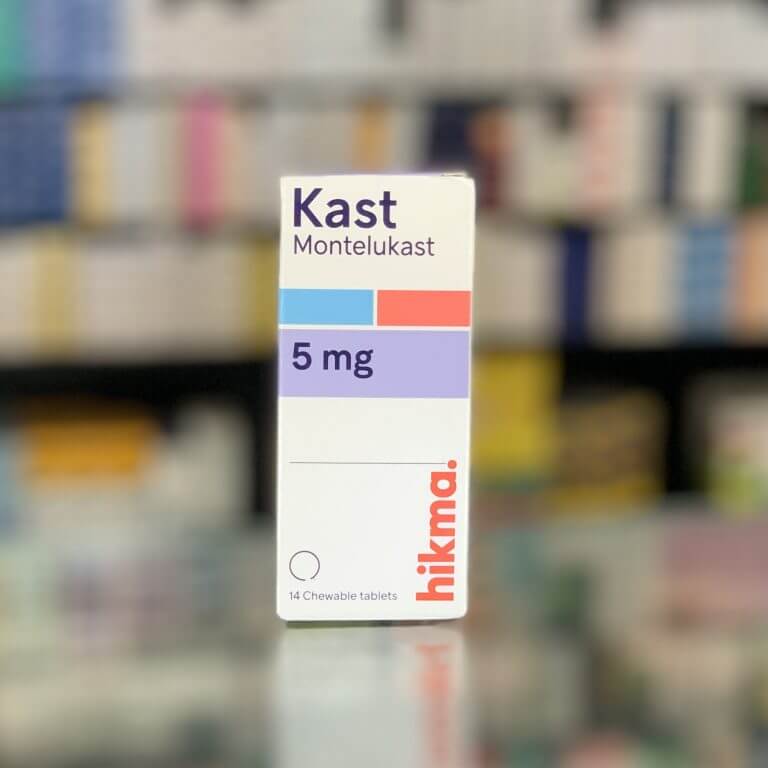
Kast 5 mg 14 chewable tablets
Composition:
Each tablet contains:
Montelukast 5 mg
Properties:
Leukotriene receptor antagonist. Montelukast binds with high selectivity and chemical affinity to CysLT1 receptors (instead of other pharmacologically important airway receptors such as prostaglandin, cholinergic or β-adrenergic receptors).
Montelukast inhibits the physiological effect of cisgenyl leukotrienes LTC4, LTD4 and LTE4 by binding to CysLT1 receptors without stimulating these receptors. Montelukast inhibits CysLT1 receptors of the airway epithelium, thereby simultaneously having the ability to inhibit bronchospasm caused by inhalation of LTD4 in patients with bronchial asthma.
A dose of 5 mg is sufficient to relieve LTD4-induced bronchospasm.
Indications:
Prevention and long-term treatment of bronchial asthma, including: prevention of day and night symptoms of the disease; treatment of bronchial asthma in patients with hypersensitivity to acetylsalicylic acid; prevention of exercise-induced bronchospasm.
Relief of day and night symptoms of seasonal allergic rhinitis.
Mode of application:
Inside. The dose and the regimen of administration are set individually, depending on the indications, the age of the patient and the dosage form used.
Montelukast can be added to treatment with bronchodilators and inhaled corticosteroids.
Contraindications:
Hypersensitivity to montelukast; children’s age – depending on the dosage form.
Precautionary measures:
The effectiveness of oral montelukast in the treatment of acute attacks of bronchial asthma has not been established. Therefore, oral montelukast is not recommended for the treatment of acute attacks of bronchial asthma. Patients should be instructed to always carry emergency medications for asthma attacks (short-acting inhaled beta2-agonists).
You should not stop taking montelukast during an exacerbation of asthma and the need to use emergency medications (short-acting inhaled beta2-agonists) to relieve attacks.
Side effects:
Infectious diseases: very often – upper respiratory tract infections.
From the side of the hematopoietic system: rarely – an increased tendency to bleeding; frequency unknown – thrombocytopenia.
From the immune system: infrequently – hypersensitivity reactions, incl. anaphylaxis; very rarely – eosinophilic liver infiltration.
From the digestive system: often – diarrhea, nausea, vomiting.
From the liver and biliary tract: often – an increase in the activity of ALT and ACT.
On the part of the skin and subcutaneous tissues: often – rash; infrequently – itching, urticaria, a tendency to form bruises.
Others: often – fever; infrequently – asthenia (weakness) / increased fatigue, edema, thirst.
Storage:
Store at a temperature not exceeding 30 degrees.
Package:
Cardboard box holds 2 blisters of 7 chewable tablets, paper instructions.
 Русский
 English
 عربي
عربي