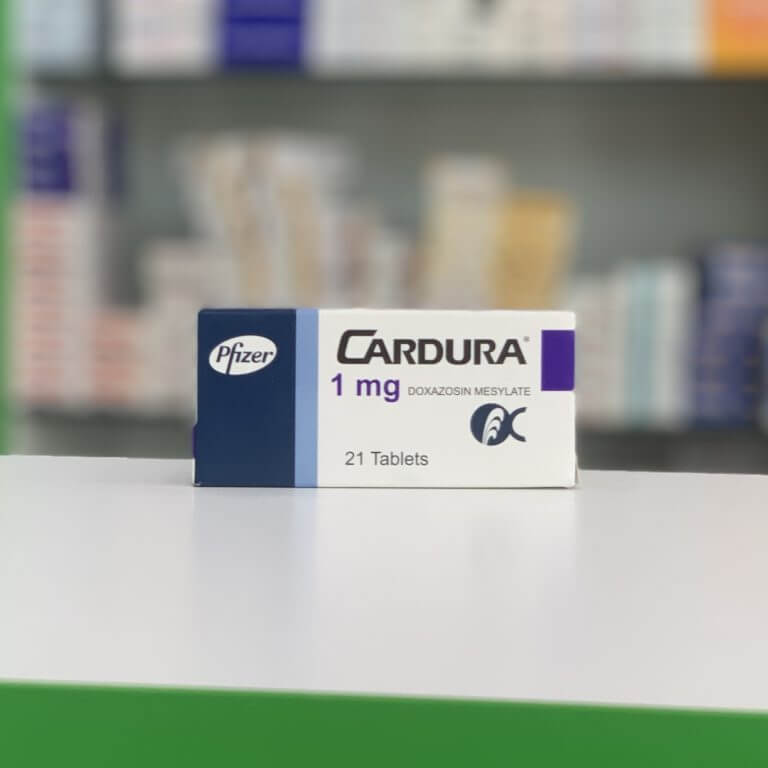
Cardura 1 mg 21 tablets
Composition:
Each tablet contains:
Doxazosin mesylate 1.213 mg,
which corresponds to the content of Doxazosin 1 mg
Inactive ingredients:
Sodium carboxymethyl starch, lactose monohydrate, microcrystalline cellulose, magnesium stearate, sodium lauryl sulfate.
Properties:
The appointment of doxazosin to patients with symptoms of benign prostatic hyperplasia (BPH) leads to a significant improvement in urodynamics and a decrease in the manifestations of symptoms of the disease. This action of the drug is associated with a selective blockade of α1-adrenergic receptors located in the stroma and capsule of the prostate and bladder neck.
It has been proven that doxazosin is a blocker of α1-adrenergic receptors subtype 1A, which make up approximately 70% of all α1-adrenergic receptor subtypes located in the prostate gland. This explains its effect in patients with BPH.
The maintenance effect of doxazosin treatment and its safety have been proven with long-term use of the drug (for example, up to 48 months).
The use of doxazosin in patients with arterial hypertension leads to a significant decrease in blood pressure as a result of a decrease in peripheral vascular resistance. The appearance of this effect is associated with selective blockade of α1-adrenergic receptors located in the vascular network.
Indications:
– benign of prostatic hyperplasia;
– for the treatment of urinary retention and other symptoms associated with BPH;
– arterial hypertension (as part of combination therapy).
Dosage and administration:
The drug is taken orally, in the morning or in the evening.
Benign prostatic hyperplasia:
The recommended initial dose of Cardura is 1 mg 1 time / day in order to minimize the possibility of developing postural hypotension and / or syncope. The dose can be increased to 2 mg, and then up to 4 mg and up to the maximum recommended dose of 8 mg. The recommended interval for increasing the dose is 1-2 weeks. Usually the recommended dose is 2-4 mg 1 time / day.
Arterial hypertension:
The dose varies from 1 to 16 mg / day. Treatment is recommended to start with 1 mg 1 time / day for 1 or 2 weeks in order to minimize the possibility of developing postural hypotension and / or syncope.
Contraindications:
– severe liver failure (due to lack of experience in this category of patients);
-urinary tract infections;
-anuria;
– progressive renal failure;
-hypotension and a tendency to orthostatic disorders (including history);
– concomitant obstruction of the upper urinary tract;
– stones in the bladder;
– age up to 18 years;
-lactase deficiency, lactose intolerance, glucose-galactose malabsorption;
– hypersensitivity to quinazolines, doxazosin or to auxiliary components of the drug.
Warnings and precautions:
Before starting the appointment of any alpha-blocker, the patient should be warned how to avoid symptoms of postural hypotension, in particular, it is necessary to refrain from rapid changes in body position.At the start of treatment with Cardura, the patient should be advised to be careful in the event of weakness or dizziness.
Cardura should be used with caution in elderly patients due to the possibility of orthostatic hypotension. With age, the risk of dizziness, visual impairment and fainting increases.
The patient should be informed of the increased risk of developing orthostatic hypotension with alcohol consumption, prolonged standing or exercise, and hot weather.
Side effects:
On the part of the organ of vision: often – a violation of color perception; infrequently – atonic iris syndrome.
From the digestive system: often – abdominal pain, diarrhea, dyspepsia, dryness of the oral mucosa; infrequently – flatulence, constipation, vomiting.
From the nervous system: often – paresthesia; infrequently – hypesthesia, tremor.
On the part of the psyche: often – agitation, anxiety, insomnia; infrequently – depression.
From the respiratory system: often – shortness of breath, rhinitis; infrequently – cough, nosebleeds; very rarely – exacerbation of existing bronchospasm.
On the part of the skin: infrequently – alopecia, pruritus, skin rash, purpura; very rarely – urticaria.
Storage:
Store at a temperature not exceeding 30°C.
Package:
Carton box contains 3 blisters of 7 tablets and paper leaflet
 Русский
 English
 عربي
عربي