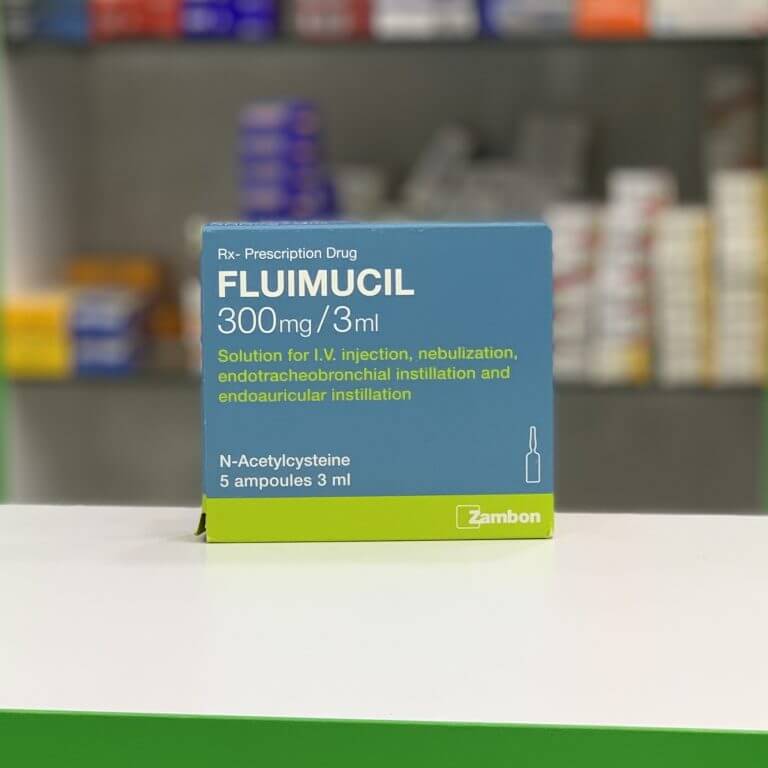
Fluimucil 300 mg/3 ml 5 ampoules
Composition:
Each 3 ml ampoule contains:
N-acetylcysteine 300 mg
Inactive ingredients:
Sodium hydroxide, edetate disodium, water for injections.
Properties:
Acetylcysteine s a cysteine derivative with a free SH-group. Both have mucolytic and antioxidant properties. The mucolytic effect of acetylcysteine is based on the property of SH- group to reduce the disulfide bridges of the mucoproteins of the mucous.
The antioxidant property of Fluimucil 10% is based on the fact that electrophilic and oxidizing compounds are neutralized by reduction. Acetylcysteine provides an essential precursor of glutathione production through cysteine, which increases endogenous glutathione stocks.
Glutathione is an important nucleophilic and antioxidant active principle if the organism and that’s why it is considered extremely important for protection of the organism. Glutathione can also inactivate the toxic, reactive, electrophilic metabolites arising f4omg certain poisoning, by forming inert complexes.
Fluimucil 10% does not affect the body’s defenses of the ciliary function if the mucous membrane of the respiratory tract and does not cause any dissolution of fibrin or blood clots.
Indications:
-For respiratory diseases that lead to form viscous secretion which can only be insufficient or not expectorated.
-Pulmonology : All Forms of Bronchitis,
Emphysema, Atelectasis, Bronchiectasis.
Mucoviscidosis.
-ORAL Diseases: Laryngitis, Sinusitis,
Pharyngitis, and also laryngectomy patients.
-Surgery: ProphylaxIs of bronchopulmonary Complícations with Mucostasis.
-Intoxication: Antidote for paracetamol-
poisoning.
-Pediatrics: Bronchitis, Mucoviscidosis.
Dosage and administration:
-intravenous administration (from paracetamol Intoxication): Initial dose of 150 mg/kg of body weight added to an equal volume of 5% glucose solution and intravenously injected in 15 minutes.
-Subsequent doses: 50 mg /kg administered in 4 hours by infusion with glucose solution 5% followed by a
further dose of 100 mg /kg by perfusing by venipuncture in 16 hours, always with glucose 5% solution.
-Aerosol administration: spray container for a vial each session, doing 1-2 sessions per day for 5-10 days.
Given the high tolerability of the preparation, the frequency of sessions and doses far each of them can be
modified by the physician, relating to the clinical form and to the therapeutic
effect, and without the need to clearly differentiate the doses for the ‘adult to pediatric.
-Installazione endobronchial: administering, with the chosen made Permanent catheters, bronchoscopy,
etc.), 1 vial per time 1-2 times a day or in relation to the needs.
- Instillations or washings ITE or other cavities: the average dose is 1/ 2-1 ampoule time.
Side effects
Anaphylactic shock, anaphylactic reactions, anaphylactoid reactions, hypersensitivity, tachycardia,
bronchospasm, dyspnea, vomiting, nausea, angioedema, urticaria, lushing. rash (rash], pruritus, facial edema, decreased blood pressure, prolonged prothrombin time.
In very rare cases, there was the appearance of serious adverse reactions affecting the skin such as
Stevens-Johnson syndrome and Lyell’s syndrome related to the assumption of N-acetylcysteine.
Contraindications:
-Hypersensitivity to the active substance or to any of the excipients.
-Children under the age of 2 years, as it blocks bronchi and prevents normal breathing.
Warnings and precautions:
- The intravenous Administration of Acetylcysteine must be carried out under strict medical supervision.
- For patients with a body weight less than
40 kg, the antidotes should be carefully
administered because of potential risks of
hypervolaemia (Fluid Overload) followed by Hyponatremia and seizures. Therefore, it is recommended to strictly adhere to dosing instructions.
- In direct intravenous administration of high doses (as an Antidote) anaphylaxis-like reactions shall be occasionally observed. Therefore patients should be monitored and appropriate therapeutic measures shall be
taken at the first signs of symptoms.
- In the aerosol therapy of asthma, it is advisable to administer Fluimucil 10% simultaneously with bronchodilators.
- Concurrent administration of antitussive
agent may cause a secretion with the risk of bronchospasm and respiratory infection through inhibition of cough reflex and physiological self-cleansing of the respiratory tract.
- Patients with bronchial asthma must be closely monitored during therapy.
If bronchospasm symptoms appeared,
acetylcysteine must be discontinued and
appropriate therapeutic measures must be taken.
- To be used with caution in patients at risk
of gastrointestinal bleeding, especially when prescribed concomitantly with other medicines that have an irritating effect on the gastric mucosa.
- Administration of Acetylcysteine may prolong prothrombin time in addition to the paracetamol.
- Inform your doctor or pharmacist If you have recently raken ay other medicines, including medicines obtained without a prescription.
- In case of treatment with nitroglycerine medications, consult your doctor. The concomitant use of nitroglycerin and N-acetylcysteine because in fact significant hypotension and determines temporal artery dilation, which may cause headache: it is therefore necessary to monitor the pressure.
- Antitussives medicines and Acetylcysteine must not be taken simultaneously as the decrease of the cough reflex may lead to an accumulation of bronchial secretions.
- Pregnancy and breastfeeding:
Ask your doctor or pharmacist before taking any medicine. Although Fluimucil Teratology studies with animals have shown no teratogenic effect, however, as with other drugs, Its administration during
pregnancy and during the lactation period should be carried out only it clearly needed under the direct
control of the doctor.
- Effects on ability to drive and use machines:
There is no evidence that the drug would affect the ability to drive or operate machinery.
- A Fluimucil vial contains 43 ml (1.9 mmol) of sodium: keep in mind that information in case of patients with impaired renal function or patients on a controlled sodium diet.
- Where the N-acetylcysteine solution was mixed with that of a bronchodilator of other medication, it must
be used in the shortest possıble time and can not be preserved.
- Keep out of reach of children.
Storage:
Open vials can be used only when stored in the refrigerator for a maximum of 24 hours. The preserved opened vials should not be used for injection.
Package:
Carton box holds a plastic container of 5 vials, each of 3 ml, and paper instructions.
 Русский
 English
 عربي
عربي