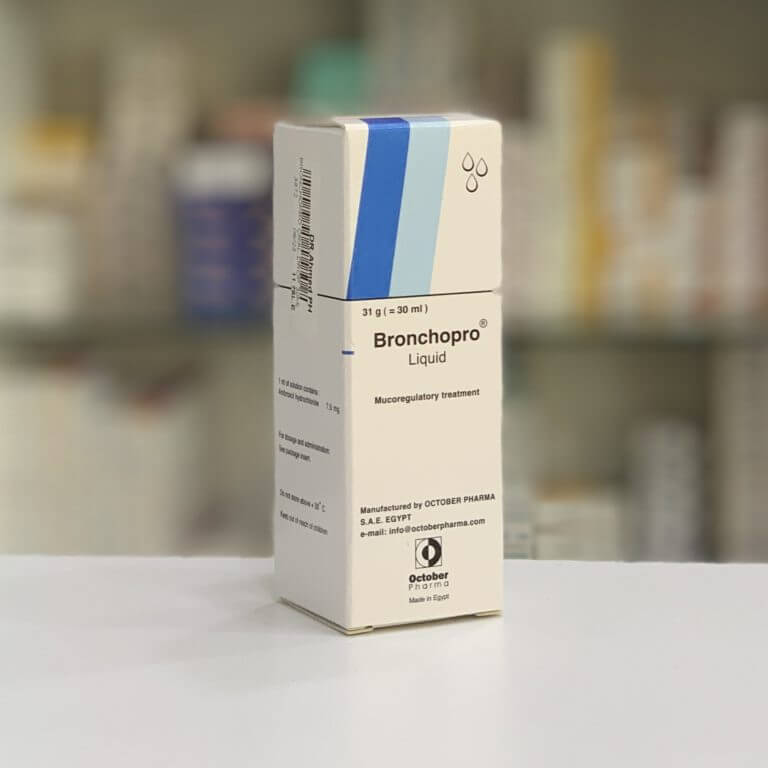
Bronchopro 7.5 mg/ml solution 30 ml
Compound:
Each 1 ml of solution contains:
Ambroxol hydrochloride 7.5 mg
Auxiliary components:
Methyl parahydroxybenzoate, sodium chloride, propylene glycol, purified water.
Properties:
- Mucolytic and expectorant, is an active N-demethylated metabolite of bromhexine.
- It has a secretomotor, secretolytic and expectorant action.
- Stimulates the serous cells of the bronchial mucosa, increases the motor activity of the ciliated epithelium by acting on type 2 pneumocytes in the alveoli and Clara cells in the bronchioles, enhances the formation of endogenous surfactant – a surfactant that ensures the sliding of bronchial secretions in the lumen of the respiratory tract.
- Ambroxol increases the proportion of the serous component in the bronchial secretion, improving its structure and helping to reduce the viscosity and thin the sputum; as a result of this, mucociliary transport improves and the removal of sputum from the bronchial tree is facilitated.
- When taking Ambroxol orally, the effect, on average, occurs after 30 minutes and lasts 6-12 hours, depending on the single dose.
Indications:
Diseases of the respiratory tract, accompanied by the release of viscous sputum and difficulty in expectoration of sputum:
acute and chronic bronchitis;
pneumonia;
bronchial asthma;
bronchiectasis;
COPD
Dosage and administration:
- The duration of treatment is determined by the doctor individually and depends on the severity of the disease.
- If it is necessary to use the drug for more than 4-5 days, a doctor’s consultation is required.
- For oral administration, the dose is set individually and depends on the age of the patient and the dosage form used.
- Adults take 4 ml 3 times a day.
- Children under 2 years of age take 1 ml 2 times a day.
- Children from 2-6 years old take 1 ml 3 times a day.
- Children over 6 years old take 2 ml 2-3 times a day.
Contraindications:
Hypersensitivity to ambroxol or auxiliary components of drugs;
I trimester of pregnancy;
lactation period (breastfeeding).
Precautionary measures:
- Ambroxol should not be taken concomitantly with antitussive drugs that can inhibit the cough reflex, such as codeine, because.
- This can make it difficult to remove liquefied sputum from the bronchi.
- Ambroxol should be used with caution in patients with a weakened cough reflex or impaired mucociliary transport due to the possibility of sputum accumulation.
- Patients taking Ambroxol are not recommended to perform breathing exercises due to difficulty in sputum discharge.
- In critically ill patients, thin sputum should be aspirated.
- Ambroxol should not be taken at bedtime.
- In patients with bronchial asthma, ambroxol may increase cough.
Side effects:
- Allergic reactions:
rarely – skin rash, urticaria, exanthema, swelling of the face, shortness of breath, itching, fever;
frequency unknown – anaphylactic reactions, including anaphylactic shock, angioedema, pruritus, allergic contact dermatitis. - From the digestive system:
often – nausea;
infrequently – vomiting, diarrhea, dyspepsia, abdominal pain. - From the nervous system:
often – dysgeusia. - From the skin and subcutaneous tissues:
very rarely – toxic epidermal necrolysis (Lyell’s syndrome), Stevens-Johnson syndrome;
frequency unknown – acute generalized eczematous pustulosis. - From the respiratory system:
often – decreased sensitivity in the oral cavity or pharynx;
rarely – dryness of the mucous membrane of the respiratory tract, rhinorrhea;
in isolated cases – dryness of the mucous membrane of the pharynx.
Storage method:
Store at a temperature not exceeding 30 degrees.
Package:
The cardboard box contains a 30 ml bottle, paper instructions.
 Русский
 English
 عربي
عربي