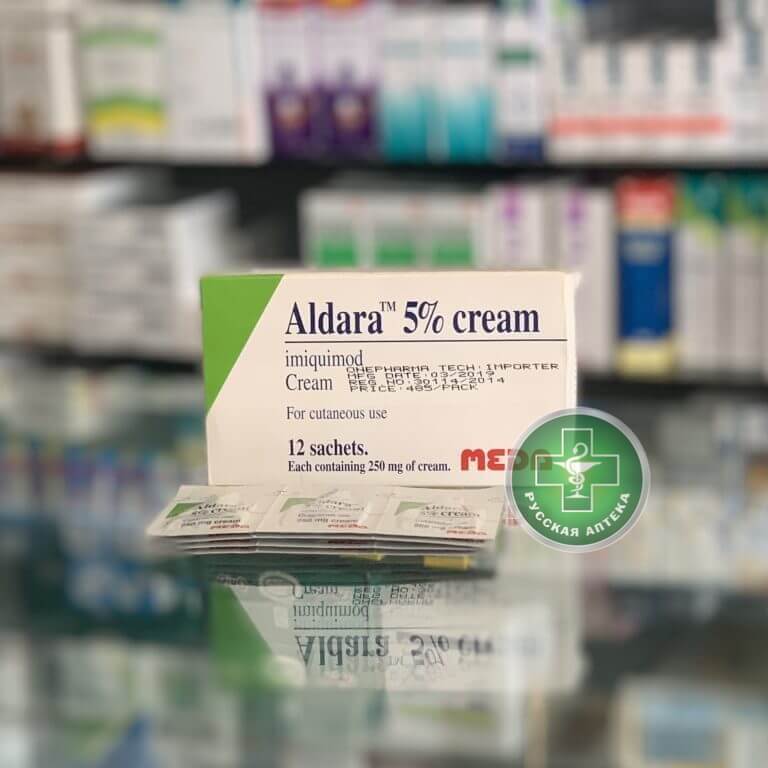
Aldara 5% Cream 12 sachets
Composition:
Each sachet (250 mg of cream) contains: Imiquimod 5 mg.
Excipients: isostearic acid, benzyl alcohol, cetyl alcohol, stearyl alcohol, soft white paraffin, polysorbate‑60, sorbitan stearate, glycerin, methylparahydroxybenzoate (E218), propylparahydroxybenzoate (E216), xanthan gum, purified water.
Product Description:
- Imiquimod is an immune response modifier.
- It is presumed that specific receptors on immune cell membranes interact with imiquimod.
- The drug does not possess direct antiviral activity.
- In experimental animal models, imiquimod demonstrates efficacy against viral infections and acts as an antitumor agent by inducing the synthesis of α‑interferon and other cytokines.
- Clinical studies have shown increased levels of α‑interferon and cytokines in tissues affected by genital warts, and pharmacokinetic data confirm systemic cytokine elevation following topical application.
- It is effective in the treatment of external genital warts, superficial basal cell carcinoma, and actinic keratosis.
Indications for Use:
- External genital and perianal warts (condylomata acuminata) in adults.
- Small superficial basal cell carcinomas (sBCC) in adults.
- Clinically typical, non‑hyperkeratotic, non‑hypertrophic actinic keratosis on the face or scalp in immunocompetent patients when cryotherapy is unsuitable or contraindicated.
Method of Administration and Dosage:
- Frequency and duration of treatment are determined individually by the physician.
- External genital warts:
- Apply the cream 3 times per week (e.g., Mon‑Wed‑Fri or Tue‑Thu‑Sat) before bedtime and leave on the skin for 6–10 hours.
- Continue treatment until the warts disappear, but not longer than 16 weeks per episode.
- Apply a thin layer to clean skin only on affected areas.
- Avoid showering or bathing for 6–10 hours after application.
- After the required time, wash the cream off with warm water and soap.
- Excessive application or prolonged contact may cause pronounced local reactions.
- One sachet is sufficient for an area up to 20 cm².
- Do not reuse an opened sachet.
- Wash hands before and after application.
Contraindications:
Hypersensitivity to imiquimod or any excipients.
Precautions:
- Avoid contact with the mucous membranes of the eyes, lips, and nose. Imiquimod may exacerbate inflammatory skin reactions.
- Use with caution in patients with autoimmune diseases — worsening of the condition is possible. Use with caution in patients after organ transplantation — risk of rejection or graft‑versus‑host reaction exists.
- Do not apply to skin that has not healed after previous medical or surgical treatment to avoid increased systemic absorption.
- Occlusive dressings are not recommended.
Adverse Reactions / Side Effects:
- Local reactions:
Very common — itching, pain at the application site.
Common — infection, erythema, erosion, excoriation/peeling, edema.
Uncommon — pruritus, dermatitis, folliculitis, erythematous rash, eczema, urticaria.
Rare — induration, ulceration, crusting, vesicles, local hypo‑ or hyperpigmentation.
- Central nervous system:
Common — headache, dizziness.
Uncommon — insomnia, depression, irritability, paresthesia, migraine, drowsiness, tinnitus.
- Gastrointestinal system:
Common — nausea.
Uncommon — abdominal pain, diarrhea, vomiting, anorexia, anal pain, rectal lesions.
- Reproductive system:
Uncommon — fungal and bacterial infections, herpes simplex, vaginitis, vulvitis, painful intercourse, genital pain, atrophic vaginitis.
- Hematologic system:
Very rare — decreased hemoglobin, leukopenia, neutropenia, thrombocytopenia.
- Musculoskeletal system:
Uncommon — lower back pain, arthralgia.
- Respiratory system:
Uncommon — pharyngitis, rhinitis.
- General reactions:
Common — infection, myalgia, fever, flu‑like symptoms, fatigue.
Uncommon — increased sweating, lymphadenopathy.
- If pronounced local reactions occur, wash the cream off with water and soap; treatment may be resumed once symptoms subside.
Pregnancy and Lactation:
Use only after a physician evaluates the benefit‑risk ratio.
Consultation with a healthcare professional is recommended.
Storage Conditions:
Store at temperatures not exceeding 25°C, in a dry place.
Packaging:
Carton box containing 12 sachets.
 Русский
 English
 عربي
عربي