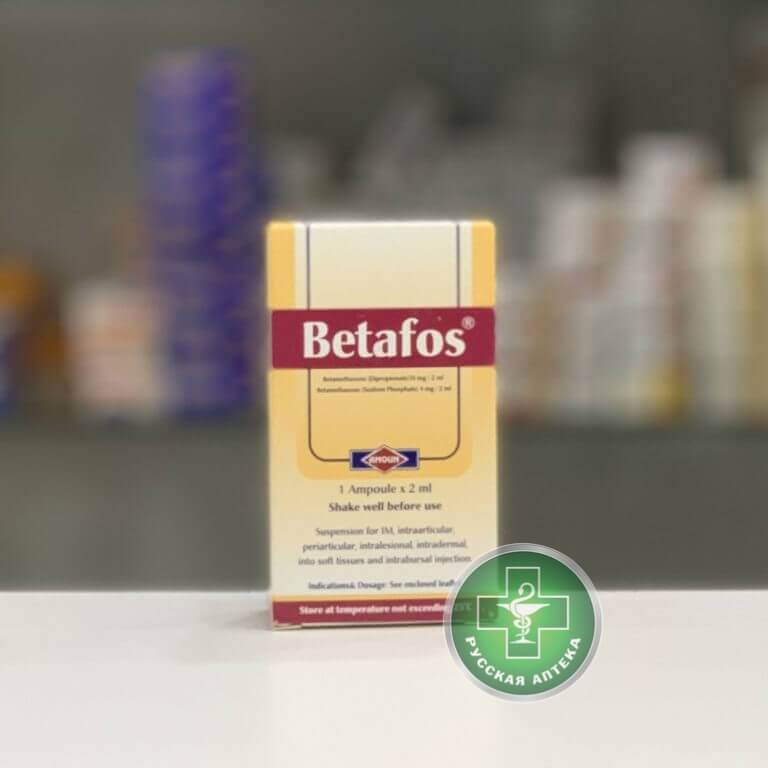
Betafos 2 ml 1 ampoule
Solution for i/m i/a p/a i/l i/d i/b use
Composition:
Each 2 ml contains:
Betamethasone dipropionate 12,86 mg eq.to Betamethasone 10 mg
Betamethasone sodium phosphate 4 mg
Properties:
Betafos belongs to a group of medicines known as corticosteroids. These medicines help to relieve parts of the body affected by inflammation. They act by reducing swelling, redness, itching and allergic reactions.
Indications:
Betafos ampoule is used for the treatment, control, prevention and improvement of the following diseases, conditions and symptoms:
-arthritis, bursitis, sciatica, lumbago or other conditions of the bones or deep tissues;
-allergic conditions, such as asthma, hay fever, bronchitis, drug allergy, insect bites or stings;
-skin conditions, such as inflammation, itching, urticaria, hair loss, psoriasis, scars or cystic acne;
Betafos ampoule may also be used for purposes not listed here
Contraindications:
Betafos suspension is contraindicated in patients with systemic fungal infections, in those with sensitivity reactions to betamethasone or to other corticosteroids, or to any component of this product.
Dosage and administration:
Dosing requirements are variable and must be individualized on the basis of the specific disease, its severity and the response of the patient. The initial dose should be maintained or adjusted until a satisfactory response is observed. If a satisfactory clinical response does not occur after a reasonable period of time, treatment with Betafos suspension should be discontinued and other appropriate therapy initiated.
Systemic administration:
For systemic therapy, treatment is initiated with 1 to 2 ml in most conditions and repeated as necessary. Administration is by deep intramuscular (IM) injection in the gluteal region.
Local Administration:
Concomitant use of a local anesthetic is rarely necessary. If coadministration of a local anesthetic is desired, Betafos suspension may be mixed (in the syringe, not the vial) with 1% or 2% procaine hydrochloride or lidocaine, using formulations which do not contain parabens. Similar local anesthetics may also be used. Anesthetics containing methylparaben, propylparaben, phenol, etc. should be avoided.
Warnings and precautions:
- Before using Betafos ampoule, inform your doctor about your current list of medications, over the counter products (e.g. vitamins, herbal supplements, etc.), allergies, pre-existing diseases, and current health conditions (e.g. pregnancy, upcoming surgery, etc.). Some health conditions may make you more susceptible to the side-effects of the drug. •Take as directed by your doctor or follow the direction printed on the product insert. Dosage is based on your condition. Tell your doctor if your condition persists or worsens. Important counseling points are listed below.
- Avoid contact with eyes
- Cautiously use in children
Pregnancy and lactation:
The use of Betafos during pregnancy or in women of child-bearing age requires that the possible benefits of the drug be weighed against potential hazards to mother and fetus. Infants born of mothers who have received substantial doses of corticosteroids during pregnancy should be observed carefully for signs of hypoadrenalism. Because of the potential for unwanted adverse effects from Betafos in nursing infants, a decision should be made whether to discontinue nursing or to discontinue therapy, taking into account the importance of the drug to the mother.
Side effects:
- Fluid and electrolyte disturbances: sodium retention, potassium loss, hypokalemic alkalosis; fluid retention; congestive heart failure in susceptible patients; hypertension.
- Musculoskeletal: muscle weakness, corticosteroid myopathy, loss of muscle mass; aggravation of myasthenic symptoms in myasthenia gravis; osteoporosis; vertebral compression fractures; aseptic necrosis of femoral and humeral heads; pathologic fracture of long bones; tendon rupture; joint instability (from repeated intra-articular injections). •Gastrointestinal: peptic ulcer with possible subsequent perforation and hemorrhage; pancreatitis; abdominal distention; ulcerative esophagitis.
- Dermatologic: impaired wound healing; skin atrophy; thin fragile skin; petechiae and ecchymoses; facial erythema; increased sweating; suppressed reactions to skin tests; reactions such as allergic dermatitis, urticaria, angioneurotic edema. •Neurologic: convulsions; increased intracranial pressure with papilledema (pseudotumor cerebri) usually after treatment; vertigo; headache.
- Endocrine: menstrual irregularities; development of cushingoid state; suppression of fetal intrauterine or childhood growth; secondary adrenocortical and pituitary unresponsiveness, particularly in times of stress, as in trauma, surgery or illness; decreased carbohydrate tolerance, manifestations of latent diabetes mellitus, increased requirements of insulin or oral hypoglycemic agents in diabetics. •Ophthalmic: posterior subcapsular cataracts; increased intraocular pressure, glaucoma; exophthalmos.
- Metabolic: negative nitrogen balance due to protein catabolism.
- Psychiatric: euphoria, mood swings; severe depression to frank psychotic manifestations; personality changes; insomnia.
- Other: anaphylactoid or hypersensitivity and hypotensive or shock-like reactions. Additional adverse reactions related to parenteral corticosteroid therapy include rare instances of blindness associated with intralesional therapy around the face and head, hyperpigmentation or hypopigmentation, subcutaneous and cutaneous atrophy, sterile abscess, postinjection flare (following intra-articular use) and charcot-like arthropathy.
Storage:
Store at a temperature not exceeding 30°C. Protect from light and freezing.
Package:
Carton box holds a plastic container with 1 vial 2 ml, paper instructions
 Русский
 English
 عربي
عربي