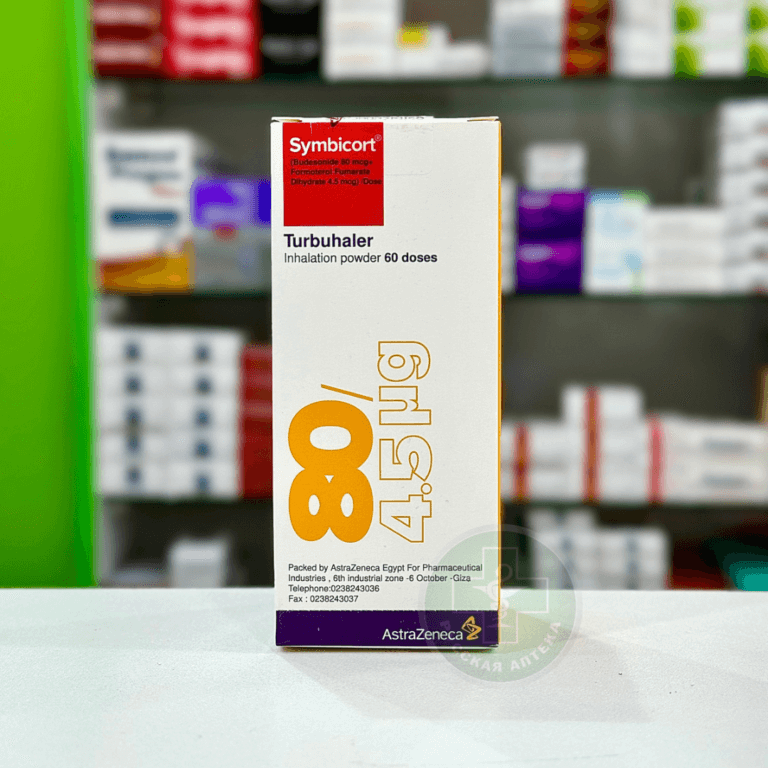
Symbicort 80/4.5 mcg/dose 60 doses
Composition and form of release:
Each dose contains: micronized budesonide 80 mcg, formoterol fumarate dihydrate 4.5 mcg.
Excipients: lactose monohydrate – 810 mcg.
Powder for inhalation, dosed in the form of granules from white to almost white.
Properties:
Combined drug for the treatment of bronchial asthma. Contains formoterol and budesonide, which have different mechanisms of action and exhibit an additive effect in reducing the frequency of exacerbations of bronchial asthma. The special properties of budesonide and formoterol make it possible to use their combination simultaneously as supportive therapy and to relieve attacks, or as a supportive therapy for bronchial asthma.
Budesonide – GCS, after inhalation has a quick (within a few hours) and dose-dependent antiinflammatory effect on the respiratory tract, reducing the severity of symptoms and the frequency of exacerbations of bronchial asthma. When prescribing budesonide in the form of inhalation, there is a lower incidence of serious adverse effects than when using systemic GCS. Reduces the severity of edema of the bronchial mucosa, mucus production, sputum formation and airway hyperresponsiveness.
Formoterol is a selective ß 2 -adrenoceptor agonist . After inhalation, it causes a rapid and prolonged relaxation of the smooth muscles of the bronchi in patients with reversible airway obstruction. The bronchodilator effect is dosedependent, occurs within 1-3 minutes after inhalation and persists for at least 12 hours after taking a single dose.
With the combined use of formoterol and budesonide, the severity of symptoms of bronchial asthma decreases, lung function improves and the frequency of exacerbatio of the disease decreases.
Indications:
- Bronchial asthma (insufficiently controlled by the use of inhaled GCS and short-acting beta 2 -adrenomimetics as therapy on demand, or adequately controlled by inhaled GCS and long-acting ß 2 -adrenomimetics). Symbicort Turbuhaler 80 / 4.5 mcg / dose and 160 / 4.5 mcg / dose can be used as maintenance therapy and to relieve seizures;
- COPD (symptomatic therapy in patients with severe COPD (FEV <50% of the estimated estimated level) and with a history of recurrent exacerbations, in the presence of severe symptoms of the disease, despite therapy with long-acting bronchodilators).
Contraindications:
- Children under 6 years of age (for all dosage forms);
- Children under 12 years of age (for a dosage form containing 320 mcg budesonide + 9 mcg formoterol);
- Hypersensitivity to budesonide, formoterol or inhaled lactose.
Symbicort Turbuhaler should be used with caution in patients with pulmonary tuberculosis (active or inactive form), with fungal, viral or bacterial respiratory infections, in patients with thyrotoxicosis, pheochromocytoma, diabetes mellitus, uncontrolled hypokalemia, idiopathic hypertrophic subaortic stenosis, aneurysm of any localization or other severe cardiovascular diseases (coronary artery disease, tachyarrhythmia or severe heart failure), with prolongation of the QT interval.
Application during pregnancy and lactation:
During pregnancy, Symbicort Turbuhaler should be prescribed only in cases where the expected benefit of therapy to the mother outweighs the potential risk to the fetus. Budesonide should be used at the lowest effective dose necessary to maintain adequate control of the symptoms of bronchial asthma.
It is not known whether budesonide and formoterol are excreted in human breast milk. Symbicort Turbuhaler can be prescribed to nursing women if the expected benefit of therapy to the mother outweighs the potential risk to the child.
Side effects:
Against the background of the joint appointment of the two drugs, there was no increase in the incidence of adverse reactions.
The most common adverse reactions associated with taking the drug are such undesirable side effects, pharmacologically expected for beta 2 -adrenomimetics, as tremor and tachycardia, which are usually moderate in severity and disappear a few days after the start of treatment.
During the use of budesonide for COPD, bruising and pneumonia occurred at a frequency of 10% and 6%, respectively, compared with 4% and 3% in the placebo group.
From the side of the central nervous system: often – headache; less often – psychomotor agitation, anxiety, nausea, dizziness, sleep disturbances; very rarely – depression, behavior disorders (mainly in children), taste disturbances.
From the side of the cardiovascular system: often – a feeling of palpitations; less often, tachycardia; rarely – atrial fibrillation, supraventricular tachycardia, extrasystole; very rarely – angina pectoris, fluctuations in blood pressure.
From the musculoskeletal system: often tremor; less often – muscle cramps.
From the respiratory system: often candidiasis of the mucous membrane of the mouth and pharynx, slight irritation in the throat, cough, hoarseness; rarely bronchospasm.
Dermatological reactions: less often, bruising; rarely – exanthema, itching, dermatitis.
Allergic reactions: rarely – urticaria, angioedema, anaphylactic reactions.
Metabolic disorders: rarely – hypokalemia; very rarely – hyperglycemia, symptoms of systemic action of GCS (including hypofunction of the adrenal glands).
The systemic effect of inhaled corticosteroi can be observed when taking the drug in high doses for a long time.
The use of beta 2 -adrenomimetics can lead to an increase in blood levels of insulin, free fatty acids, glycerol, ketone derivatives.
Special instructions:
It is recommended to gradually reduce the dose of the drug before stopping treatment and it is not recommended to abruptly stop therapy.
Symbicort Turbuhaler is not intended for the initial selection of therapy in the first stages of bronchial asthma treatment.
The patient’s attention should be drawn to the need to regularly take a maintenance dose of Symbicort Turbuhaler in accordance with the selected therapy, even in the absence of symptoms of the disease. Inhalation of Symbicort Turbuhaler for relief of seizures should be carried out only when symptoms occur, but the use of the drug is not indicated for regular preventive use, i.e. before physic activity.
Treatment with Symbicort Turbuhaler should not be started during an exacerbation or significant worsening of the course of bronchial asthma.
Dosing regimen:
Symbicort Turbuhaler is not intended for the initial treatment of bronchial asthma of intermittent and mild persistent course.
The selection of the dose of the drugs that make up Symbicort Turbuhaler is carried out individually and depending on the severity of the disease. This must be taken into account not only when starting treatment with combined drugs, but also when changing the dose of the drug.
In the event that individual patients require a different combination of doses of active substances than in Symbicort Turbuhaler, beta 2 -adrenomimetics and / or corticosteroids should be prescribed separately in separate inhalers.
Bronchial asthma
Symbicort Turbuhaler 80 / 4.5 mcg / dose and 160 / 4.5 mcg / dose
Patients should be under constant medical supervision for an adequate dose selection of Symbicort Turbuhaler. The dose should be reduced to the lowest, against which the optimal control of bronchial asthma symptoms is maintained. Upon achieving complete control over the symptoms of bronchial asthma against the background of the minimum recommended dose of the drug, at the next stage, you can try the appointment of monotherapy with inhaled GCS.
There are two approaches to prescribing therapy with Symbicort Turbuhaler:
- As a maintenance therapy, Symbicort
Turbuhaler is prescribed for continuous maintenance therapy in combination with a separate short-acting beta 2 adrenostimulant to relieve seizures;
As a maintenance therapy and to relieve seizures, Symbicort Turbuhaler is prescri both for continuous maintenance therapy
and on demand when symptoms appear. As supportive therapy
Adults (18 years and older) are prescribed
Symbicort Turbuhaler 80 / 4.5 pg / dose and 160 / 4.5 pg / dose, 1-2 inhalations 2 times / day. If necessary, it is possible to increase the dose up to 4 inhalations 2 times / day.
Adolescents (12-17 years old) are prescribed Symbicort Turbuhaler 80 / 4.5 mcg / dose and 160 / 4.5 mcg / dose, 1-2 inhalations 2 times / day.
Children over the age of 6 are prescribed Symbicort Turbuhaler 80 / 4.5 mcg / dose, 1-2 inhalations 2 times / day.
After achieving optimal control of the symptoms of bronchial asthma while taking the drug 2 times / day, it is recommended to titrate the dose to the lowest effective dose, up to taking 1 time / day, in cases where, according to the doctor, the patient needs maintenance therapy in combination with long-acting bronchodilators.
As supportive therapy and for relief of seizures
The patient must always have Symbicort Turbuhaler with him to relieve seizures.
In this case, the drug is especially indicated for patients with insufficient control over bronchial asthma and the need for frequent use of drugs to relieve attacks; with indications in the history of exacerbations of bronchial asthma, requiring medical intervention.
Adults (18 years and older) are prescribed Symbicort Turbuhaler 80 / 4.5 mcg / dose and 160 / 4.5 mcg / dose; the recommended dose is 2 inhalations per day: 1 inhalations in the morning and in the evening, or 2 inhalations 1 time / day only in the morning or only in the evening. Some patients may be prescribed a maintenance dose of Symbicort Turbuhaler 160 / 4.5 mcg / dose 2 inhalations 2 times / day. If symptoms occur, 1 additional inhalation is required. With a further increase in symptoms, 1 additional inhalation is prescribed for several minutes, but no more than 6 inhalations to stop 1 attack.
Usually, it is not required to prescribe more
than 8 inhalations per day, however, you can increase the number of inhalations to 12 per day for a short time. In patients who use more than 8 inhalations per day, a review of therapy is recommended.
Symbicort Turbuhaler 80 / 4.5 mcg / dose and 160 / 4.5 mcg / dose as maintenance therapy and for relief of seizures is not recommended for children and adolescents under the age of
18 .
Symbicort Turbuhaler 320/9 mcg / dose
For adults (18 years of age and older), the drug is prescribed 1 inhalation 2 times / day. If necessary, it is possible to increase the dose up to 2 inhalations 2 times / day. After achieving optimal control of the symptoms of bronchial asthma while taking the drug 2 times / day, it is recommended to titrate the dose to the lowest effective dose, up to 1 time / day.
Adolescents aged 12-17 years are prescribed 1 inhalation 2 times / day.
COPD
Adults are prescribed Symbicort Turbuhaler 160 / 4.5 mcg / dose 2 inhalations 2 times / day or Symbicort Turbuhaler 320/9 mcg / dose 1 inhalation 2 times / day.
There is no need for a special selection of the dose of the drug for elderly patients .
Storage:
At temperatures up to 30 0 C. Keep container tightly closed to protect against moisture penetration.
Packaging:
The cardboard box holds 60 or 120 doses of “turbuhaler” plastic inhalers.
 Русский
 English
 عربي
عربي