Русский
 English
 عربي
عربي
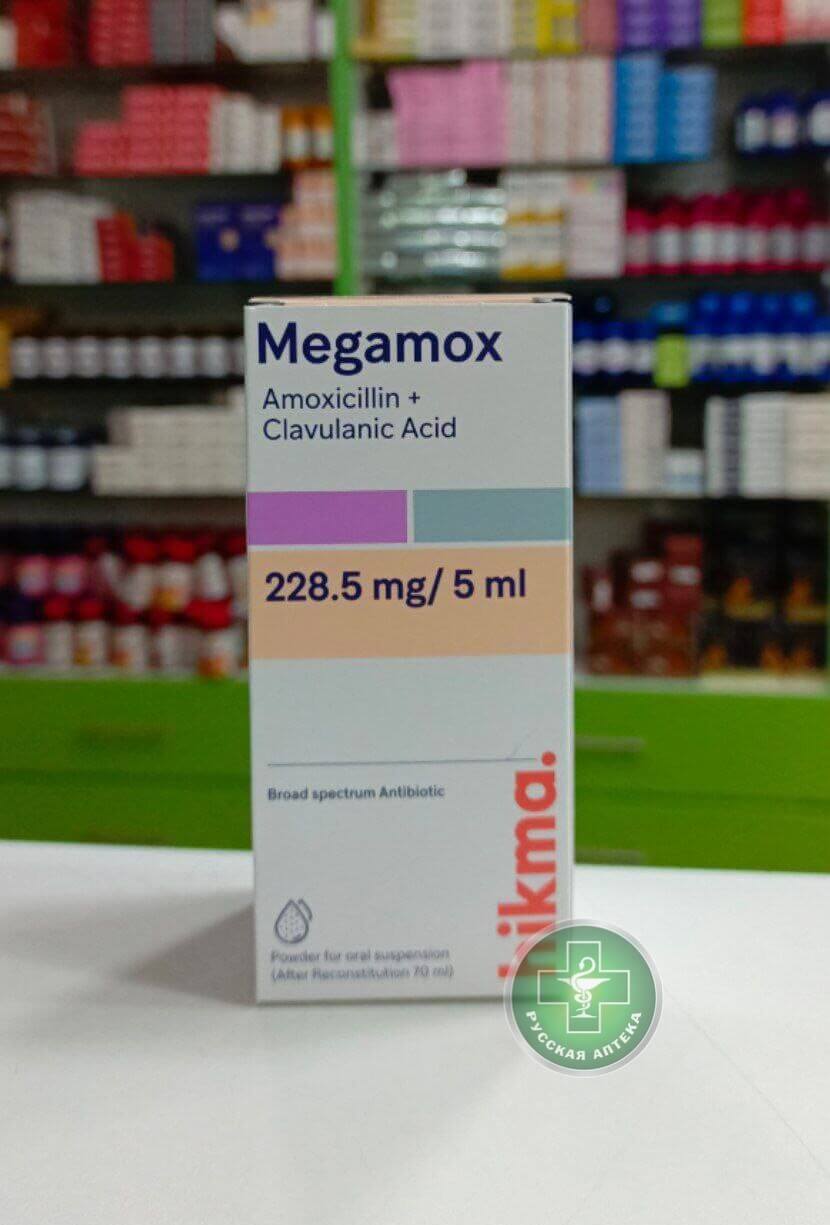
Megamox 228.5 mg/5 ml suspension 70 ml
70£
View analogsMEGAMOX is an oral antibacterial combination consisting of amoxicillin and the beta-lactamase inhibitor, clavulanate potassium (the potassium salt of clavulanic acid).
Buy
Product quantities
Form of Release: Suspension
Product Brand:
Hikma Pharmaceuticals
About the brand
Product Categories: Antibiotics • Broad spectrum antibiotics


Megamox 228.5 mg/5 ml suspension 70 ml
Composition:
Megamox 228 mg Suspension: Each 5 ml contains:
Amoxicillin 200 mg
Clavulanic Acid 28.5 mg
Description:
MEGAMOX is an oral antibacterial combination consisting of amoxicillin and the beta-lactamase inhibitor, clavulanate potassium (the potassium salt of clavulanic acid).
Indications and Usage:
To reduce the development of drug-resistant bacteria and maintain the effectiveness of MEGAMOX (amoxicillin/clavulanate potassium) and other antibacterial drugs, MEGAMOX should be used only to treat infections that are proven or strongly suspected to be caused by susceptible bacteria.
MEGAMOX is a combination penicillin-class antibacterial and beta-lactamase inhibitor indicated for the treatment of infections due to susceptible isolates of the designated bacteria in the conditions listed below:
-Lower Respiratory Tract Infections caused by beta-lactamase-producing isolates of Haemophilus influenzae and Moraxella catarrhalis.
-Acute Bacterial Otitis Media caused by beta-lactamase-producing isolates of H. influenzae and M. catarrhalis.
-Sinusitis caused by beta-lactamase-producing isolates of H. influenzae and M. catarrhalis.
-Skin and Skin Structure Infections caused by beta-lactamase-producing isolates of Staphylococcus aureus, Escherichia coli, and Klebsiella species.
-Urinary Tract Infections caused by beta-lactamase-producing isolates of E. coli, Klebsiella species, and Enterobacter species.
Limitations of Use:
When susceptibility test results show susceptibility to amoxicillin, indicating no beta-lactamase production, MEGAMOX should not be used.
Dosage and Administration:
MEGAMOX may be taken without regard to meals; however, absorption of clavulanate potassium is enhanced when MEGAMOX is administered at the start of a meal. To minimize the potential for gastrointestinal intolerance, MEGAMOX should be taken at the start of a meal.
-Adults
Adults who have difficulty swallowing may be given the 125 mg/5 mL or 250 mg/5 mL suspension in place of the 500-mg tablet. The 200 mg/5 mL or 400 mg/5 mL suspension may be used in place of the 875-mg tablet.
-Pediatric Patients:
Based on the amoxicillin component, MEGAMOX should be dosed as follows:
Neonates and Infants Aged <12 weeks (<3 months): The recommended dose is 30 mg/kg/day, divided every 12 hours. Limited experience with the 200 mg/5 mL formulation in this age group. Use of the 125 mg/5 mL oral suspension is recommended.
Patients Aged 12 weeks (3 months) and Older: See dosing regimens in the table below. The every 12-hour regimen is recommended as it is associated with significantly less diarrhea. However, the every 12-hour suspension (200 mg/5 mL and 400 mg/5 mL) contains aspartame and should not be used by phenylketonurics.
Table 1: Dosing in Patients Aged 12 weeks (3 months) and Older:
Otitis media, sinusitis, lower respiratory tract infections, and more severe infections:
45 mg/kg/day every 12 hours or 40 mg/kg/day every 8 hours
Less severe infections: 25 mg/kg/day every 12 hours or 20 mg/kg/day every 8 hours
Duration of therapy studied and recommended for acute otitis media is 10 days.
Patients Weighing 40 kg or More: Pediatric patients weighing 40 kg or more should be dosed according to adult recommendations.
Patients with Renal Impairment:
GFR <30 mL/min: Do not receive the 875 mg dose.
GFR 10-30 mL/min: 500 mg or 250 mg every 12 hours.
GFR <10 mL/min: 500 mg or 250 mg every 24 hours.
During Dialysis: Additional dose during and at the end of dialysis.
Directions for Mixing Oral Suspension:
Tap bottle until all powder flows freely.
Add approximately 2/3 of the total amount of water for reconstitution and shake well.
Contraindications:
Serious Hypersensitivity Reactions:
MEGAMOX is contraindicated in patients with a history of serious hypersensitivity reactions (e.g., anaphylaxis or Stevens-Johnson syndrome) to amoxicillin, clavulanate, or other beta-lactam antibacterial drugs (e.g., penicillins and cephalosporins).
Cholestatic Jaundice/Hepatic Dysfunction: Contraindicated in patients with a previous history of cholestatic jaundice/hepatic dysfunction associated with MEGAMOX.
Warnings and Precautions:
Hypersensitivity Reactions: Serious and occasionally fatal hypersensitivity reactions (anaphylactic reactions) may occur. Discontinue MEGAMOX immediately and initiate appropriate therapy.
Hepatic Dysfunction: Hepatic toxicity (e.g., hepatitis, cholestatic jaundice) has been reported. Hepatic function should be monitored in patients with hepatic impairment.
Clostridium difficile Associated Diarrhea (CDAD): May range from mild diarrhea to fatal colitis. Discontinue MEGAMOX if CDAD occurs.
Skin Rash in Patients with Mononucleosis: High percentage of patients with mononucleosis develop an erythematous rash. Do not administer MEGAMOX to these patients.
Potential for Microbial Overgrowth: Consider the possibility of superinfections. Discontinue MEGAMOX if superinfection occurs.
Adverse Reactions:
Gastrointestinal: Indigestion, gastritis, stomatitis, glossitis, black "hairy" tongue, mucocutaneous candidiasis, enterocolitis, hemorrhagic/pseudomembranous colitis.
Hypersensitivity Reactions: Pruritus, angioedema, serum sickness-like reactions, erythema multiforme, Stevens-Johnson syndrome, acute generalized exanthematous pustulosis, exfoliative dermatitis.
Liver: Hepatic dysfunction, increases in serum transaminases, serum bilirubin, alkaline phosphatase.
Renal: Interstitial nephritis, hematuria, crystalluria.
Hemic and Lymphatic Systems: Anemia, hemolytic anemia, thrombocytopenia, eosinophilia, leukopenia, agranulocytosis.
Central Nervous System: Agitation, anxiety, confusion, convulsions, dizziness, insomnia, hyperactivity.
Miscellaneous: Tooth discoloration in pediatric patients.
Pregnancy:
Should only be used during pregnancy if clearly needed.
Nursing Mothers:
Caution should be exercised when administering MEGAMOX to nursing women.
Storage:
Store at a temperature not exceeding 30°C, in a dry place. Use within 7 days after reconstitution when stored at temperatures between 2-8°C.
Packaging:
Carton box containing a 70 ml bottle of suspension after reconstitution and an inner leaflet.
Tags, Keywords:
Active Ingredients:
No comments yet. Be the first to write one.
Your comment will be published after moderation.
You’ll receive a notification to your email when someone replies.