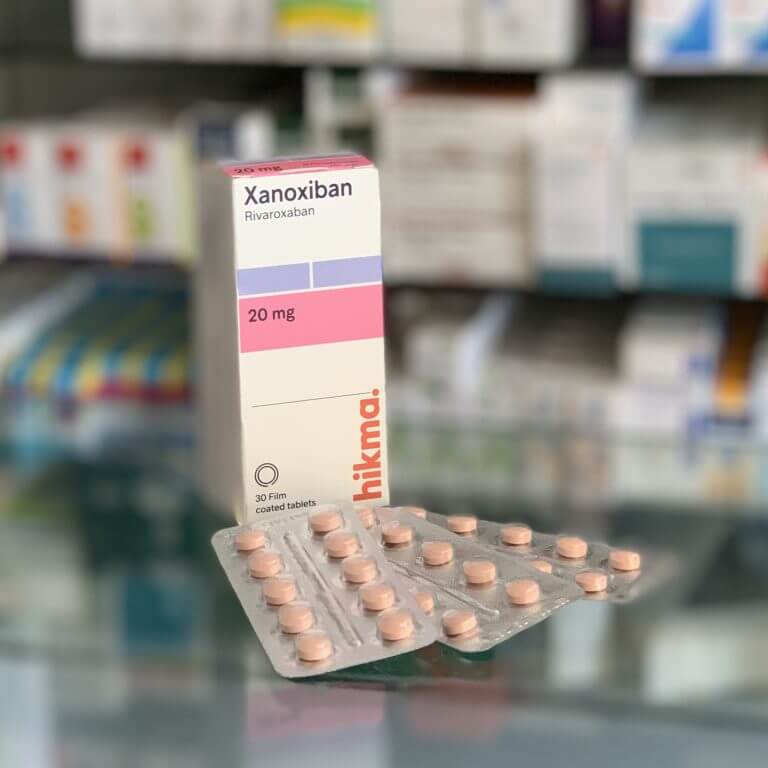
Xanoxiban 20 mg 30 tablets
Composition:
Each tablet contains:
Rivaroxaban 20 mg
Auxiliary components:
microcrystalline cellulose, croscarmellose sodium, hypromellose 5 CP (hydroxypropyl methylcellulose 2910), lactose monohydrate, magnesium stearate, sodium lauryl sulfate.
Properties:
Rivaroxaban is a highly selective direct factor Xa inhibitor with high oral bioavailability.
The activation of factor X to form factor Xa through the internal and external coagulation pathways plays a central role in the coagulation cascade. Factor Xa is a component of the forming prothrombinase complex, the action of which leads to the conversion of prothrombin to thrombin. As a result, these reactions lead to the formation of fibrin thrombus and platelet activation by thromb One molecule of factor Xacatalyzes the formation of more than 1000 thrombin molecules, which is called the “thrombin explosion”. The reaction rate of prothrombinase-bound factor Xa is increased 300,000-fold compared to that of free factor Xa, which provides a sharp jump in thrombin level. Selective factor Xa inhibitors can stop the thrombin burst. Thus,
Indications:
– prevention of stroke and systemic thromboembolism in patients with atrial fibrillation of non-valvular origin;
-treatment of deep vein thrombosis and pulmonary embolism and prevention of recurrent DVT and PE.
Method of administration and dosage:
Take the drug with meals.
Prevention of stroke and systemic thromboembolism in patients with nonvalvular atrial fibrillation
The recommended dose is 20 mg 1 time / d
For patients with impaired renal function (CC 30-49 ml / min), the recommended dose is 15 mg 1 time / day.
The recommended maximum daily dose is 20 mg.
Treatment of DVT and PE and prevention of recurrence of DVT and PE
The recommended initial dose for the treatment of acute DVT or PE is 15 mg 2 times / day for the first 3 weeks, followed by switching to a dose of 20 mg 1 time / day for further treatment and prevention of recurrence of DVT and PE.
After at least 6 months of DVT or PE treatment, the recommended dose of
Xanoxiban@ is 10 mg 1 time / day or 20 mg 1 time / day, depending on the individual ratio of the risk of recurrent DVT or PE and the risk of bleeding.
Contraindications:
- hypersensitivity to rivaroxaban or any excipients contained in the tablet;
-clinically significant active bleeding (eg, intracranial bleeding, gastrointestinal bleeding);
- injury or condition associated with an increased risk of major bleeding (for example, existing or recent gastrointestinal ulcer, presence of malignant neoplasms with a high risk of bleeding, recent brain or spinal cord injury, recent surgery on the brain, spinal cord, or eyes, recent intracranial hemorrhage, diagnosed or suspected varicose veins of the esophagus, arteriovenous malformations, vascular aneurysms or large anomalies in the structure of the vessels of the brain or spinal cord);
- concomitant therapy with any other anticoagulants, for example, unfractionated heparin (UFH), low molecular weight heparins (including enoxaparin, dalteparin), heparin derivatives (including fondaparinux), oral anticoagulants (including warfarin , apixaban, dabigatran), except when the patient is transferred from therapy or to therapy with Xanoxiban@, or when UFH is prescribed in doses to maintain patency of the central venous or arterial catheter;
- liver diseases occurring with coagulopathy, which causes a clinically significant risk of bleeding, including patients with class B and C liver cirrhosis according to the Child-Pugh classification;
-severe renal dysfunction with CC < 15 ml / min (there are no clinical data on the use of rivaroxaban in this category of patients);
-pregnancy;
-the period of breastfeeding;
-Children and adolescence up to 18 years (efficacy and safety for patients of this age group have not been established);
- hereditary lactose or galactose intolerance (for example, congenital lactase deficiency or glucose-galactose malabsorption), since the drug contains lactose.
Precautions:
The use of rivaroxaban is not recommende patients receiving concomitant systemic treatment with antifungal azoles (eg
ketoconazole) or HIV protease inhibitors (eg ritonavir). These drugs are potent inhibitors of CYP3A4 and P-glycoprotein. Thus, these drugs can increase the plasma concentration of rivaroxaban to clinically significant values (2.6 times on average), which can lead to an increased risk of bleeding.
However, the azole antifungal agent fluconazole, a mild CYP3A4 inhibitor, has a less pronounced effect on rivaroxaban exposure and can be used concomitantly.
Impaired renal function
Rivaroxaban should be used with caution in patients with moderate renal impairment (CC 30-49 ml / min) receiving concomitant medications that may lead to an increase in plasma rivaroxaban concentration.
Side effects:
anemia (including relevant laboratory parameters) – hemorrhage in the eye (including hemorrhage in the conjunctiva) – pain in th gastrointestinal tract, dyspepsia, nausea, constipation, diarrhea, vomiting, bleeding gums, gastrointestinal bleeding (including
rectal bleeding) – fever , peripheral edema, deterioration of general well-being (including weakness and asthenia) – hemorrhages after performed procedures (including postoperative anemia and bleeding from a wound), bruising increased transaminase levels – pain in the extremities. – dizziness, headache – bleeding from the urogenital tract (including hematuria and nameorrhagia), renal failure (including increased creatinine levels, increased urea levels) – nosebleeds, hemoptysis – itching (including infrequent cases of generalized itching), rash, ecchymosis,skin and subcutaneous hemorrhages – arterial hypotension, hematoma.
Storage method:
At a temperature not higher than 30 degrees. In a dry place.
Packaging:
The cardboard box holds 1, 2 or 3 blisters of 10 tablets.
 Русский
 English
 عربي
عربي