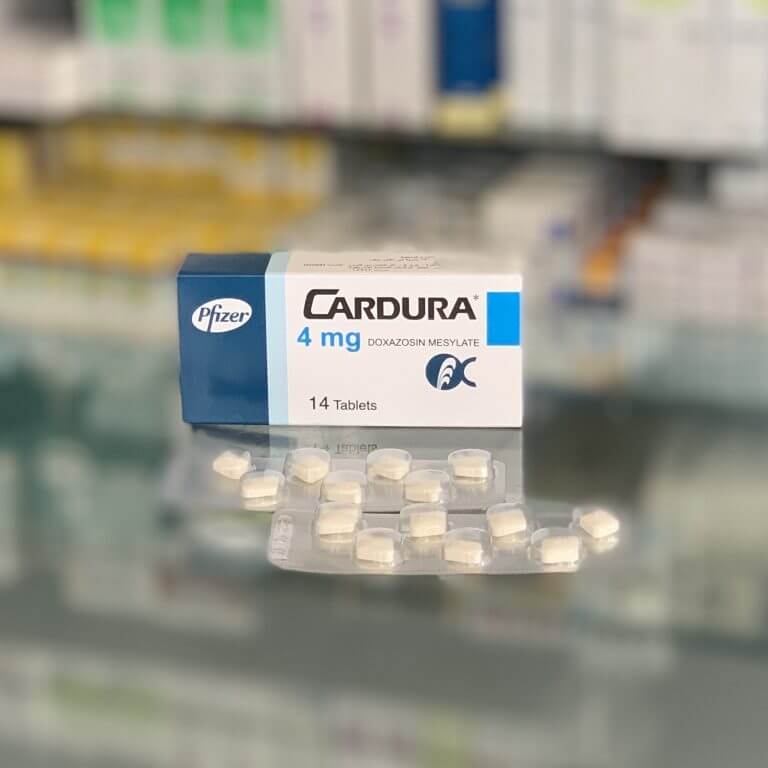
Cardura 4 mg 14 tablets
Composition:
Doxazosin mesylate 4 mg
Auxiliary components:
lactose monohydrate (milk sugar), microcrystalline cellulose, sodium carboxymethyl starch, povidone K25, magnesium stearate, sodium lauryl sulfate.
Properties:
Selective competitive blocker of postsynaptic al-adrenergic receptors. It causes the expansion of peripheral vessels, which leads to a decrease in OPSS and a decrease in blood pressure. Promotes an increase in the HDL / total cholesterol ratio, a decrease in the total level of triglycerides and cholesterol.
With prolonged use, regression of left ventricular hypertrophy is observed, platelet aggregation is suppressed and the content of plasminogen activator in tissues increases. The blockade of al-adrenergic receptors located in the stroma and capsule of the prostate gland in the bladder neck leads to a decrease in resistance and pressure in the urethra, a decrease in resistance in its internal opening.
Improves urodynamics and reduces the manifestations of benign prostatic hyperplasia (BPI-I).
Indications:
Benign prostatic hyperplasia (BPH); arterial hypertension (including symptomatic) as part of combination therapy.
Method of administration and dosage:
Inside. The dose and the regimen are determined individually, depending on the indications and the clinical situation.
For BPH, the recommended starting dose is 1 mg / day. Depending on the clinical situation, the dose can be increased to achieve the optimal therapeutic effect. The average daily dose is 2-4 mg. The maximum daily dose is 8 mg.
With arterial hypertension, the dose varies from 1 to 16 mg / day. It is recommended to start treatment with a dose of 1 mg 1 time / day. To achieve the desired decrease in blo pressure, if necessary, the daily dose shoul increased gradually, observing uniform intervals up to 4 mg, 8 mg and up to a maximum of 16 mg, depending on the severity of the patient’s response to taking doxosazin. The average daily dose is 2-4 mg.
Contraindications:
Hypersensitivity to doxazosin and other quinazoline derivatives; severe hepatic impairment (in the absence of experience with this category of patients); urinary tract infections; anuria; progressive renal failure; arterial hypotension and a tendency to orthostatic disorders (including in the anamnesis); concomitant obstruction of the upper urinary tract; stones in the bladder; overflow incontinence (paradoxical ischuria); children and adolescents up to 18 years old.
With care: pulmonary edema caused by mitral stenosis or aortic stenosis; heart failure with increased cardiac output; right ventricular failure due to pulmonary embolism or exudative pericarditis; left ventricular failure with low filling pressure; disorders of cerebral circulation; age over 65 due to the risk of orthostatic symptoms (fainting, dizziness); simultaneous use with phosphodiesterase t 5 inhibitors (PDE-5) (the threat of symptomatic arterial hypotension); liver dysfunction;
pregnancy; when performing an operation for cataracts.
Precautions:
After taking doxazosin at the initial dose, orthostatic hypotension may develop (the phenomenon of the first dose), especially in the standing position. More often this condition is observed in patients with hypovolemia, sodium deficiency, in the elderly. In this regard, the initial dose is recommended to be taken before bedtime.
Doxazosin should be used with caution in elderly patients due to the possibility of orthostatic hypotension. The risk of dizziness, visual impairment and fainting increases with age.
The patient should be informed of the increased risk of orthostatic hypotension with alcohol consumption, prolonged standing or exercise, and in hot weather.
In patients with BPH, doxazosin can be prescribed both in the presence of arterial hypertension and in normal blood pressure. When used in patients with BPH with normal
blood pressure, the change in the latter is insignificant. Moreover, in patients with a combination of arterial hypertension and BPH, it is possible to use it in monotherapy.
Side effects:
From the side of the psyche: often – agitation, anxiety, insomnia; infrequently – depression.
From the nervous system: very often dizziness, headache; often – paresthesia, postural dizziness (after taking the first dose, a pronounced decrease in blood pressure is possible, which can lead to orthostatic dizziness, in severe cases, especially with a quick transition from a “lying” position to a “standing” position or to a “sitting” position to fainting ), drowsiness; infrequently hypesthesia, fainting, tremor.
Infectious and parasitic diseases: often respiratory tract infections, urinary tract infections.
From the side of the organ of vision: often violation of color perception; infrequently atonic iris syndrome.
On the part of the organ of hearing and labyrinth disorders: often – vertigo; infrequently – tinnitus.
From the side of the cardiovascular system: often – tachycardia; infrequently – rush of blood to the skin of the face, a marked decrease in blood pressure, postural hypotension; rarely angina pectoris, myocardial infarction, heart rhythm disturbances; very rarely – bradycardia, arterial hypertension.
From the respiratory system: often – shortness of breath, rhinitis; infrequently – cough, nosebleeds; very rarely – exacerbation of existing bronchospasm.
From the digestive system: often – nausea, abdominal pain, diarrhea, dyspepsia, dryness of the oral mucosa; infrequently – flatulence, constipation, gastroenteritis, vomiting; frequency unknown – taste disturbance.
From the liver and biliary tract: very rarely cholestasis, hepatitis, jaundice, increased activity of liver transaminases.
Storage method:
At a temperature not higher than 30 degrees. In a dry place.
Packaging:
The cardboard box contains 2 or 3 blisters of 7 tablets.
 Русский
 English
 عربي
عربي