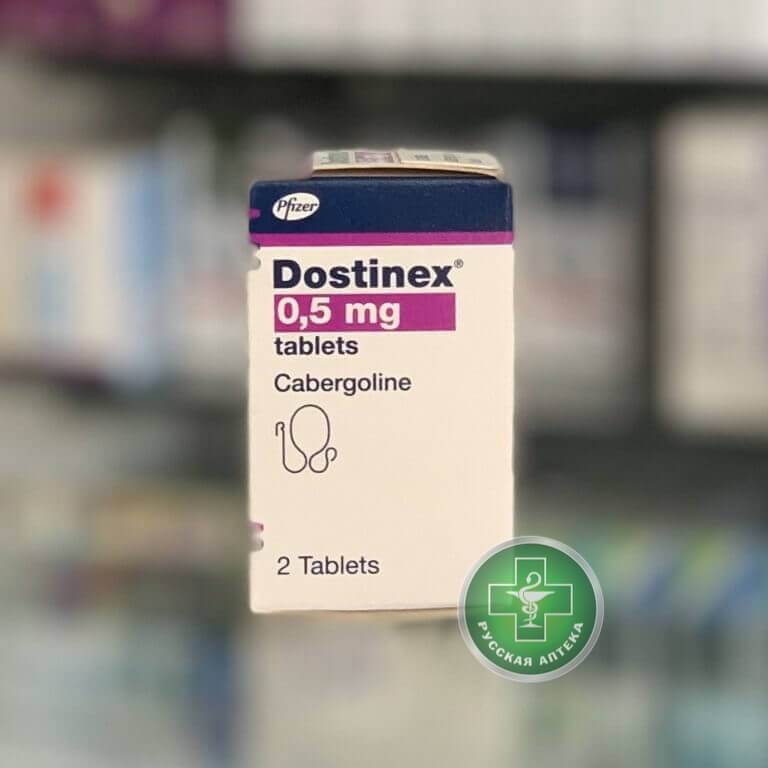
Elonda 0.5 mg 2 tablets
Compound:
Each tablet contains:
Cabergoline 0.5 mg
Auxiliary components:
lactose, magnesium starate, leucine.
Properties:
Cabergoline is a dopaminergic derivative of ergoline, characterized by a pronounced and prolonged prolactin-lowering effect due to direct stimulation of dopamine D2 receptors of lactotropic pituitary cells. In addition, when taken at doses in excess of those to reduce plasma prolactin concentration, cabergoline has a central dopaminergic effect due to stimulation of dopamine D2 receptors.
A decrease in the concentration of prolactin in the blood plasma is observed within 3 hours after taking the drug and persists for 7-28 days in healthy volunteers and patients with hyperprolactinemia, and up to 14-21 days in women in the postpartum period.
Cabergoline has a strictly selective effect, does not affect the basal secretion of other pituitary hormones and cortisol. The prolactin-lowering effect of cabergoline is dose-dependent, both in terms of severity and duration of action.
Indications:
– prevention of physiological lactation after childbirth;
– suppression of established postpartum lactation;
– treatment of disorders associated with hyperprolactinemia, including amenorrhea, oligomenorrhea, anovulation and galactorrhea;
-prolactin-secreting pituitary adenomas (micro- and macroprolactinomas), idiopathic hyperprolactinemia.
Dosage and administration:
Taken orally, during meals.
Prevention of lactation: 1 mg (2 tablets of 0.5 mg) once on the first day after childbirth (preferably with the first meal after childbirth).
Suppression of established lactation: 0.25 mg (1/2 tab.) 2 times / day every 12 hours for 2 days (total dose is 1 mg). In order to reduce the risk of orthostatic arterial hypotension in a woman, a single dose of cabergoline should not exceed 0.25 mg.
Treatment of disorders associated with hyperprolactinemia: the recommended initial dose is 0.5 mg per week in 1 dose (1 tab. 0.5 mg) or 2 doses (1/2 tab. 0.5 mg, for example, on Monday and Thursday). Increasing the weekly dose should be carried out gradually – by 0.5 mg with an interval of 1 month until the optimal therapeutic effect is achieved. The therapeutic dose is usually 1 mg per week, but may range from 0.25 mg to 2 mg per week. The maximum dose for patients with hyperprolactinemia is 4.5 mg per week.
Contraindications:
– hypersensitivity to cabergoline and / or any excipient in the preparation, as well as to any ergot alkaloids;
– fibrotic changes in the lungs, pericardium or retroperitoneal space in history;
– with long-term therapy: anatomical signs of pathology of the valvular apparatus of the heart (such as thickening of the valve leaflet, narrowing of the valve lumen, mixed pathology – narrowing and stenosis of the valve), confirmed by an echocardiographic study conducted before the start of therapy;
– lactose intolerance, lactase deficiency, glucose-galactose malabsorption;
-children and adolescents under 16 years of age (safety and effectiveness of use have not been established);
-pregnancy (due to the lack of clinical data on the efficacy and safety of cabergoline);
– the period of breastfeeding (due to the lack of clinical data on the efficacy and safety of cabergoline).
Precautionary measures:
As with other ergot derivatives, cabergoline should be used with caution in the following conditions and/or diseases:
– arterial hypertension that developed during pregnancy, for example, preeclampsia or postpartum arterial hypertension (cabergoline is prescribed only in cases where the potential benefit from the use of the drug significantly outweighs the possible risk);
– severe cardiovascular diseases, Raynaud’s syndrome;
– peptic ulcer, gastrointestinal bleeding;
severe liver failure (lower doses are recommended);
– severe psychotic or cognitive impairment (including history);
-simultaneous use with drugs that have a hypotensive effect (due to the risk of developing orthostatic hypotension).
Side effects:
Mental disorders: often – depression; infrequently – increased libido.
From the nervous system: very often – headache, dizziness / vertigo; often – drowsiness; infrequently – transient hemianopsia, syncope (short-term fainting with loss of consciousness), paresthesia; the frequency is unknown – attacks of sudden falling asleep, tremor.
On the part of the organ of vision: the frequency is unknown – visual impairment.
From the side of the cardiovascular system: very often – damage to the heart valves (valvulopathy), incl. regurgitation, and related disorders (pericarditis and pericardial effusion); often – with prolonged use, cabergoline usually has a hypotensive effect, in some cases orthostatic arterial hypotension, “hot flashes” may occur.
From the digestive system: very often – nausea, dyspepsia, gastritis, abdominal pain; often – constipation, vomiting; rarely – pain in the epigastric region.
From the side of the liver and biliary tract: the frequency is unknown – impaired liver function.
Storage method:
Store at a temperature not exceeding 30 degrees, in a dry place.
Package:
The carton box holds a glass bottle of 2 tablets.
 Русский
 English
 عربي
عربي