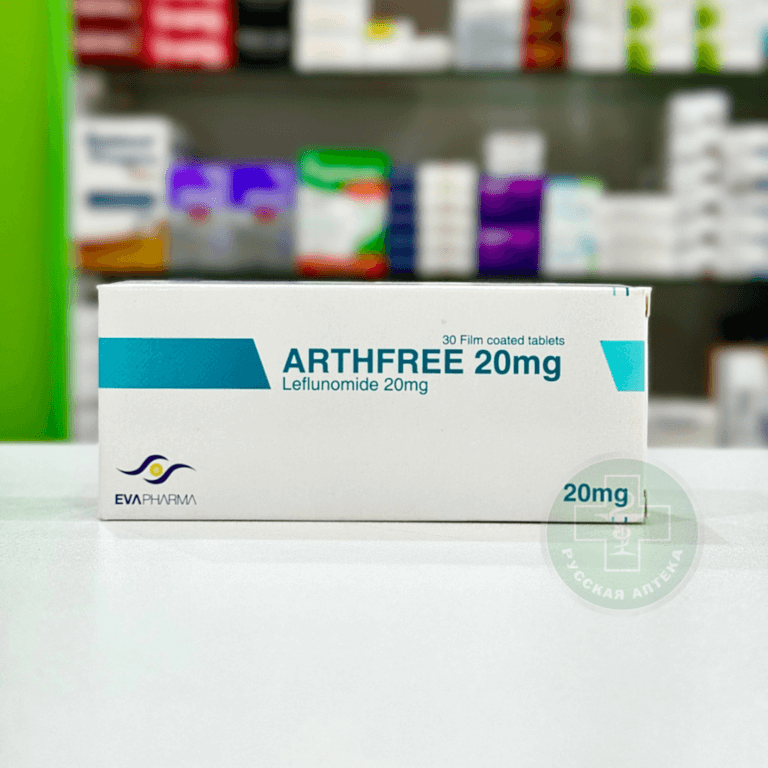
Arthfree 20 mg 30 tablets
Composition:
Each tablet contains:
Leflunomide 20 mg
Auxiliary components:
Lactose monohydrate, starch, colodial silicone dioxide, talc, magnesium stearate.
Properties:
An agent with antiproliferative, immunosuppressive and anti-inflammatory effects. The active metabolite of leflunomide A771726 inhibits the enzyme dehydroorotate dehydrogenase and has an antiproliferative effect. A771726 in vitro inhibits mitogeninduced proliferation and DNA synthesis of Tlymphocytes.
The therapeutic effect of leflunomide has been shown in several experimental models of autoimmune diseases, including rheumatoi arthritis.
Indications:
Basic therapy for rheumatoid arthritis in order to reduce the symptoms of the disease and delay the development of structural damage to the joints.
Active form of psoriatic arthritis.
Method of administration and dosage:
The optimal dosage regimen is determined by the doctor. It is necessary to strictly observe the compliance of the used dosage form of a particular drug with the indications for use and the dosage regimen.
The starting dose is 100 mg daily for 3 days. The maintenance dose is 10-20 mg 1 time / day.
The therapeutic effect is manifested after 4-6 weeks from the start of administration and can increase within 4-6 months.
Contraindications:
Liver dysfunctions, severe immunodeficiency states (including AIDS); – severe disorders of bone marrow hematopoiesis or anemia, leukopenia, thrombocytopenia as a result of other causes (except for rheumatoid arthritis), severe infections, moderate or severe renal failure (due to little experience of clinical observations), severe hypoproteinemia (including with nephrotic syndrome), pregnancy, lactation, children and adolescence up to 18 years, hypersensitivity to leflunomide.
Precautionary measures:
Application is possible only after a thorough medical examination of the patient.
Before starting treatment, it should be borne in mind the possibility of an increase in the number of side effects in patients who previously received other basic agents for the treatment of rheumatoid arthritis, which have hepato- and hematotoxic effects.
It should be borne in mind that with the development of severe dermatological adve reactions, severe infections, the use of leflunomide should be stopped and the “laundering” procedure should be started
immediately.
Patients with tuberculin reactivity should be monitored because of the risk of tuberculosis activation.
Given the long Tl / 2 of leflunomide, it is not recommended to vaccinate with live vaccines during the treatment period.
Side effects:
From the side of the cardiovascular system: often – increased blood pressure.
From the digestive system: often – diarrhea, nausea, vomiting, anorexia, lesions of the oral mucosa (aphthous stomatitis, ulceration of the lips), pain in the abdominal cavity, increased levels of liver enzymes (especially ALT, less often – GGT, alkaline phosphatase, bilirubin);
From the musculoskeletal system: often tendovaginitis; possible – ligament rupture.
Dermatological reactions: often – hair loss, eczema, dry skin; possible – Stevens-Johnson syndrome, Lyell’s syndrome, erythema
multiforme.
On the part of the hematopoietic system: often – leukopenia (leukocytes more than 2000 / WI) ; possible – anemia, thrombocytopenia (platelets less than 100,000 / PI); rarely – eosinophilia, leukopenia (leukocytes less than 2000 / PI), pancytopenia; in some cases – agranulocytosis. The risk of developing hematological disorders increases with recent, concomitant and subsequent use of myelotoxic drugs.
Allergic reactions: often – rash (including maculopapular), itching; atypical – urticaria; in some cases – anaphylactic reactions.
Storage method:
At a temperature not higher than 30 degrees.
Packaging:
The cardboard box contains 3 blisters of 10 tablets, paper instructions.
 Русский
 English
 عربي
عربي