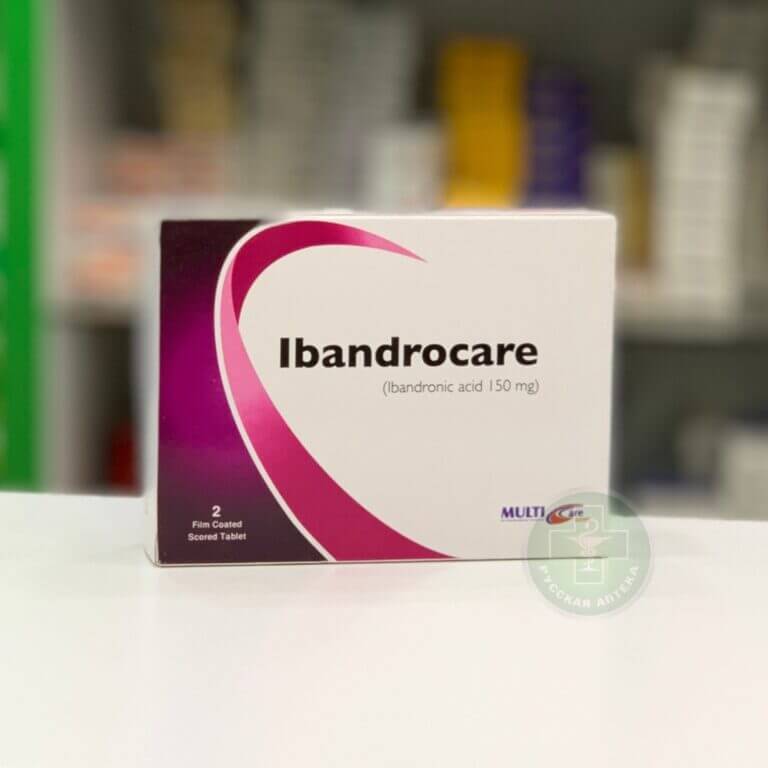
Ibandrocare 150 mg 2 tablets
Composition:
Ibandronic acid 150 mg
Inactive ingredients:
Lactose monohydrate, povidone, microcrystalline cellulose, crospovidone, colloidal anhydrous silica, and magnesium stearate, hydroxypropyl cellulose, macrogol and titanium dioxide (E171), shellac glaze, iron oxide black and propylene glycol
Properties:
Ibandronic Acid belongs to a group of medicines called bisphosphonates. Ibandronic Acid may reverse bone loss by stopping more loss of bone and increasing bone mass in most women who take it, even though they won’t be able to see or feel a difference. Ibandronic Acid may help lower the chances of breaking bones (fractures).
Indications:
Treatment of osteoporosis in postmenopausal women
Dosage and administration:
Always take this medicine exactly as your doctor has told you.
- Take Ibandronic Acid 150 mg once a month.
- Take the tablet the same day each month. Choose the date, which is easy to remember.
- Take your Ibandronic Acid at least 6 hours after you last had anything to eat or drink except water.
- Take your Ibandronic Acid tablet
- after you first get up for the day, and
- before you have anything to eat or drink (on an empty stomach)
- Swallow your tablet with a full glass of water (at least 180 ml).
- Do not take your tablet with water with a high concentration of calcium, fruit juice or any other drinks. If there is a concern regarding potentially high levels of calcium in the tap water (hard water)
it is advised to use bottled water with a low mineral content
- Swallow your tablet whole – do not chew it, crush it or let it dissolve in your mouth.
- For the next hour (60 minutes) after you have taken your tablet:
-do not lie down; if you do not stay upright (standing or sitting), some of the medicine could
leak back into your oesophagus
-do not eat anything
-do not drink anything (except water if you need it)
-do not take any other medicines
- After you have waited for an hour, you can have your first food and drink of the day. Once you have eaten it is OK to lie down if you wish, and to take any other medication you need.
- Do not take your medicine at bedtime or before you get up for the day.
Continuing to take Ibandronic Acid
It’s important to keep taking Ibandronic Acid every month, as long as your doctor prescribes it for you. After 5 years of using Ibandronic Acid, please consult with your doctor whether you should continue to take Ibandronic Acid.
- If you’ve taken more than one tablet by mistake, drink a full glass of milk and talk to your doctor straight away.
- Do not make yourself vomit and do not lie down – this could cause Ibandronic Acid to irritate your oesophagus.
- If you forget to take your tablet on the morning of your chosen day, do not take a tablet later in the day.
Instead, consult your calendar and find out when your next scheduled dose is.
- If you forget to take your tablet on your chosen day and your next scheduled dose is only 1 to 7 days away:
Never take two Ibandronic Acid tablets within the same week. You should wait until the next scheduled dose is due and take it as normal, then continue taking one tablet once a month on the scheduled days you’ve marked on your calendar.
- If you forget to take your tablet on your chosen day and your next scheduled dose is more than 7 days away:
You should take one tablet the next morning after the day you remember; then, continue taking one tablet once a month on the scheduled days you’ve marked on your calendar.
Side effects:
Uncommon (may affect up to 1 in 100 people):
- severe pain in the chest, severe pain after swallowing food or drink, severe nausea, or
vomiting, difficulty in swallowing. You may have a severe inflammation of your gullet/food
pipe, possibly with sores or constriction of the gullet/food pipe
Rare (may affect up to 1 in 1,000 people):
- itching, swelling of your face, lips, tongue and throat, with difficulty breathing
- persistent eye pain and inflammation
- new pain, weakness or discomfort in your thigh, hip or groin. You may have early signs of a
possible unusual fracture of the thigh bone
Very rare (may affect up to 1 in 10,000 people):
- pain or sore in your mouth or jaw, You may have early signs of severe jaw problems (necrosis
(dead bone tissue) in the jaw bone)
- talk to your doctor if you have ear pain, discharge from the ear, and/or an ear infection. These
could be signs of bone damage in the ear
- severe skin reactions including itchy red skin rash with raised patches and severe blistering or
peeling of the skin
- serious, potentially life-threatening allergic reaction
Other possible side effects
Common (may affect up to 1 in 10 people):
- headache
- heartburn, discomfort in swallowing, stomach or tummy pain (may be due to an inflammation of the stomach), indigestion, nausea, having diarrhoea (loose bowels)
- muscle cramps, stiffness of your joints and limbs
- flu-like symptoms, including fever, shaking and shivering, feeling of discomfort, bone pain and aching muscles and joints. Talk to a nurse or doctor if any effects become troublesome or last more than a couple of days
- rash
Uncommon (may affect up to 1 in 100 people):
- dizziness
- flatulence (farting, feeling bloated)
- symptoms of low blood calcium levels (hypocalcaemia) including muscle cramps or spasms
and/or tingling sensation in the fingers or around the mouth
- back pain
- feeling tired and exhausted
- asthma attacks
Rare (may affect up to 1 in 1,000 people):
- inflammation of the duodenum (first section of the bowel) causing stomach pain
- hives
Warnings and precautions:
Before receiving treatment, tell your doctor/nurse (health care professional) if:
- you have any problems with your mouth or teeth such as poor dental health, gum disease, or a planned tooth extraction
- you don’t receive routine dental care or have not had a dental check up for a long time
- you are a smoker (as this may increase the risk of dental problems)
- you have previously been treated with a bisphosphonate (used to treat or prevent bone disorders)
- you are taking medicines called corticosteroids (such as prednisolone or dexamethasone)
- you have cancer
Your doctor may ask you to undergo a dental examination before starting treatment with Ibandronic Acid.
While being treated, you should maintain good oral hygiene (including regular teeth brushing) and receive routine dental check-ups. If you wear dentures you should make sure these fit properly. If you are under dental treatment or will undergo dental surgery (e.g. tooth extractions), inform your doctor about your dental treatment and tell your dentist that you are being treated with ibandronic acid.
Contact your doctor and dentist immediately if you experience any problems with your mouth or teeth such as loose teeth, pain or swelling, or non-healing of sores or discharge, as these could be signs of osteonecrosis of the jaw.
Some people need to be especially careful while they are taking ibandronic acid. Talk to your doctor before taking Ibandronic Acid:
- If you have any disturbances of mineral metabolism (such as vitamin D deficiency).
- If your kidneys are not functioning normally.
- If you have any swallowing or digestive problems.
Irritation, inflammation or ulceration of the gullet/food pipe (oesophagus) often with symptoms of severe pain in the chest, severe pain after swallowing food and/or drink, severe nausea, or vomiting may occur, especially if you do not drink a full glass of water and/or if you lie down within an hour of taking ibandronic acid. If you develop these symptoms, stop taking Ibandronic Acid and tell your doctor straight away.
Do not give Ibandronic Acid to children or adolescents below 18 years.
- Pregnancy and breastfeeding:
Ibandronic Acid is for use only by postmenopausal women and must not be taken by women who could still have a baby.
Do not take Ibandronic Acid if you are pregnant or breast-feeding.
- Driving and using machines
You can drive and use machines as it is expected that Ibandronic Acid has no or negligible effect on your ability to drive and use machines.
Contraindications:
- allergy to ibandronic acid or any of the other ingredients of this medicine
- certain problems with your gullet/food pipe (oesophagus) such as narrowing or difficulty swallowing
- disability to stand or sit upright for at least one hour (60 minutes) at a time
- low blood calcium, also in the past
- age below 18 years old
Storage:
Store at a temperature not exceeding 30°C in a cool dry place.
Package:
Carton box holds 2 strips each of 1 film-coated tablet and paper instructions.
 Русский
 English
 عربي
عربي