Русский
 English
 عربي
عربي
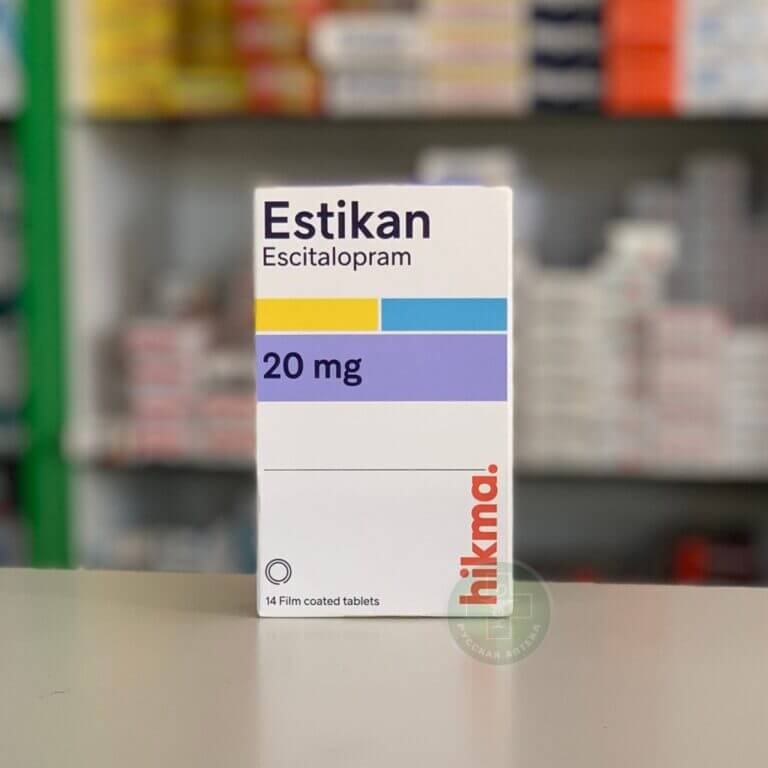
Estikan 20 mg 14 tablets
106£
View analogs- Depressive episodes of any severity;
- Panic disorders with/without agoraphobia;
- Social anxiety disorder (social phobia);
- Generalized anxiety disorder;
- Obsessive-compulsive disorder.
Buy
Product quantities
Form of Release: Tablets
Product Brand:
Hikma Pharmaceuticals
About the brand
Product Categories: Mental disorders


Estikan 20 mg 14 tablets
Composition:
Escitalopram oxalate 20 mg
Properties:
Escitalopram is an antidepressant, a selective serotonin reuptake inhibitor (SSRI) with high affinity for the active primary center. Escitalopram also binds to the allosteric center of the serotonin transporter protein with a 1000-fold lower affinity. Allosteric modulation of the transporter protein enhances the binding of escitalopram at the primary binding site, resulting in more complete inhibition of serotonin reuptake.
Escitalopram has no or very weak ability to bind to a number of receptors including: serotonin 5-HT1A, 5-HT2 receptors, dopamine D1- and D2-receptors, α1-, α2-, β-adrenergic receptors, histamine H1-, muscarinic cholinergic, benzodiazepine and opiate receptors.
Inhibition of 5-NT reuptake is the only possible mechanism of action that accounts for the pharmacologic and clinical effects of escitalopram.
Escitalopram is the S-enantiomer of racemic citalopram with intrinsic therapeutic activity. The R-enantiomer has been shown not to be inert but to counteract the serotonergic properties and corresponding pharmacological effects of the S-enantiomer.
Indications:
-Depressive episodes of any severity;
-Panic disorders with/without agoraphobia;
-Social anxiety disorder (social phobia);
-Generalized anxiety disorder;
-Obsessive-compulsive disorder.
Dosage and administration:
-Escitalopram is taken orally once a day (without chewing, drinking a small amount of liquid) regardless of food intake. The drug can be used at any time of the day, it is desirable to take the drug at the same time of the day.
-Depressive episodes:
Usually begin by taking 10 mg of escitalopram once daily. Depending on the individual patient’s response, the dose may be increased to a maximum of 20 mg daily. Antidepressant effect usually develops in 2-4 weeks after the start of treatment. After disappearance of symptoms of depression it is necessary to continue therapy for at least 6 months to consolidate the obtained effect.
-Panic disorders with/without agoraphobia:
In panic disorders, the recommended dose is 5 mg per day during the first week of treatment, then the dose is increased to 10 mg per day. The daily dose, depending on the individual reaction of the patient, can be further increased up to 20 mg per day. The maximum therapeutic effect is achieved approximately 3 months after the start of treatment. Therapy lasts for several months.
-Generalized anxiety disorder:
The recommended starting dose is 10 mg once daily. Depending on the individual reaction of the patient, the dose can be increased to a maximum of 20 mg per day.
Long-term administration of the drug (6 months or longer) at a dose of 20 mg per day is allowed.
-Social anxiety disorder (social phobia):
Usually 10 mg once daily is prescribed. Relief of symptoms usually develops 2-4 weeks after the start of treatment. Depending on the patient’s individual response, the dose may subsequently be reduced to 5 mg per day or increased to a maximum of 20 mg per day. Since social anxiety disorder is a disease with a chronic course, the minimum recommended duration of the therapeutic course is 12 weeks. To prevent relapses of the disease, the drug may be prescribed for 6 months or longer depending on the patient’s individual response.
-Obsessive-compulsive disorder:
Usually prescribed 10 mg once daily. Depending on the patient’s individual response, the dose may subsequently be increased to a maximum of 20 mg daily. Since obsessive-compulsive disorder is a chronic condition, the course of treatment should be long enough to ensure complete relief from symptoms and should last at least 6 months. A course of treatment of at least 1 year is recommended to prevent relapses.
-Elderly patients (over 65 years of age):
Half the usual recommended dose i.e. 5 mg per day is recommended. The maximum dose for elderly patients is 10 mg per day.
-Patients with renal impairment:
In mild to moderate chronic renal impairment, no dosing regimen adjustment is required. No dosage regimen adjustment is required in chronic renal insufficiency of mild to moderate severity. In patients with severe renal insufficiency (creatinine clearance below 30 ml/min) the drug should be used with caution under medical supervision.
-Patients with hepatic insufficiency:
In mild to moderate hepatic insufficiency (class A or B on the Child-Pugh scale), the recommended initial dose during the first two weeks of treatment is 5 mg per day. Depending on the individual reaction of the patient, the dose may be increased up to 10 mg per day. In severe hepatic insufficiency it is necessary to exercise caution in titration, treatment should be carried out under close medical supervision.
Side effects:
-Side of blood and lymphatic system: thrombocytopenia.
-Allergic reactions: infrequently – hypersensitivity; very rarely – anaphylactic reactions.
-Central nervous system: very often – drowsiness, headache, tremor, dizziness; often – migraine, paresthesia, sleep disorders; infrequently – extrapyramidal disorders, syncope, taste sensation disorders; rarely – serotonin syndrome (combination of agitation, tremor, myoclonus and hyperthermia), dyskinesia, movement disorders, seizure disorders.
-Psychiatric disorders: very often – agitation, nervousness; often – decreased libido, orgasm disorder (in women), anxiety, confusion, somnolence, drowsiness, impaired concentration of attention, strange dreams, amnesia; infrequently – aggression, depersonalization, hallucinations, euphoria, increased libido, bruxism, panic attacks, mania, suicidal thoughts, psychomotor agitation, akathisia.
-Digestive system: very often – nausea, vomiting; often – diarrhea, dry mouth, decreased appetite or on the contrary its increase, constipation.
-Liver and biliary tract: hepatitis.
-Skin: very often – increased sweating, often – skin rash, itching; infrequently – photosensitization, urticaria, alopecia, purpura, angioedema, bruising (ecchymosis).
-Cardiovascular system: very often – palpitations; often – tachycardia, arterial hypertension, orthostatic hypotension; rarely – bradycardia, decreased blood pressure, arrhythmia, prolongation of QT interval on ECG.
-Hematopoietic organs: rarely – hemorrhages (e.g., gynecological bleeding, gastrointestinal bleeding).
-Sensory organs: very often – impaired accommodation; often – impaired taste sensations, visual disturbances, infrequently – mydriasis, tinnitus (ringing in the ears).
-Respiratory system: often – rhinitis, sinusitis, yawning; infrequently – cough, nose bleeding; rarely – dyspnea, tracheitis.
-Reproductive system: often – sexual dysfunction, namely, ejaculation disorders, decreased libido, impotence, menstrual disorders; infrequently – metrorrhagia, menorrhagia, galactorrhea, priapism.
-Urinary system: often – painful urination, urinary retention.
-Metabolic disorders: often – decreased or increased appetite, weight gain; infrequently – weight loss; rarely – insufficient secretion of antidiuretic hormone (ADH), hyponatremia, hypokalemia; unknown – anorexia.
-Musculoskeletal system: infrequently – myalgia, arthralgia, increased risk of injuries and fractures.
-Laboratory parameters: often – changes in laboratory indicators of liver function; infrequently – increased activity of “liver” enzymes, electrocardiogram changes (prolongation of QT interval), hyponatremia.
-Other: often – weakness; infrequently – edema; rarely – hyperthermia.
Contraindications:
-Excessive sensitivity to escitalopram or to any of the excipients included in this preparation;
-Use in combination with monoamine oxidase inhibitors (MAOIs), MAO-A (MAO-A) or reversible non-selective MAO inhibitors;
-In concomitant use with drugs that prolong the QT interval on ECG (in particular, with pimozide, antiarrhythmic drugs of classes IA and III, tricyclic antidepressants, macrolides), as well as in congenital prolongation of the QT interval;
-Children under 18 years of age;
-Pregnancy;
-Breastfeeding period;
-Lactose intolerance;
-Lactase deficiency;
-Glucose-galactose malabsorption.
Warnings and precautions:
-The drug should not be administered to patients receiving therapy with the following drugs:
-irreversible non-selective MAO inhibitors;
-reversible selective MAO inhibitors of type A (moclobemide);
-irreversible non-selective MAO inhibitors (linezolid);
– irreversible selective MAO inhibitors of type B (selegiline);
-medications that prolong the QT interval;
-Combined use of escitalopram should be performed with caution when using:
-Drugs that lower the seizure readiness threshold;
-Serotonergic medications;
-Lithium, tryptophan;
-St. John’s Wort;
-Anticoagulants and agents affecting blood coagulation;
-Application in pregnancy and lactation:
Escitalopram should not be administered to pregnant and breastfeeding women unless the potential clinical benefit does not prevail over the theoretical risk, since the safety of the use of the drug during pregnancy and lactation in women has not been established.
-Escitalopram may cause dose-dependent prolongation of the QT interval on ECG, which may lead to heart rhythm disturbance.
-Hyponatremia develops due to impaired secretion of antidiuretic hormone, especially high risk in older women.
-When taking escitalopram, skin hemorrhages (ecchymosis and purpura) may develop. It is necessary to use the drug with caution in patients at risk of bleeding, as well as those taking oral anticoagulants and drugs affecting the coagulability of blood. Treatment with Escitalopram may alter glycemic control in patients with diabetes mellitus. The dose of insulin and/or oral hypoglycemic agents should be adjusted.
-Rarely, akathisia may develop, characterized by a constant or intermittent feeling of internal motor restlessness and manifested by the inability to sit quietly in one posture for long periods of time or to remain unmoved for long periods of time. It subsides within the first few weeks of treatment.
-Patients with bipolar disorder or a history of mania/hypomania may have mania. Then treatment with Escitalopram should be discontinued.
-Escitalopram should be used with caution in the presence of drug dependence (including history) and history of epileptic seizures. In case of development of convulsive seizures, as well as in patients with epilepsy in case of increase in the frequency of convulsive seizures, the drug Escitalopram, as well as other drugs of the SSRI group, should be discontinued. Use in patients with unstable epilepsy is not recommended.
-The drug should be discontinued if a manic state develops.
-Clinical experience of concomitant use of the drug Escitalopram and electroconvulsive therapy is insufficient, therefore caution is required.
-In the beginning of treatment insomnia and feelings of restlessness may occur, which can be resolved by adjusting the initial dose.
-No interaction of escitalopram with alcohol has been identified. However, as with other antidepressants, caution is advised.
Storage:
Store in a place protected from light at a temperature not exceeding 25°C
Package:
Carton box contains 2 blisters each of 7 tablets, paper instructions
Tags, Keywords:
Active Ingredients:
No comments yet. Be the first to write one.
Your comment will be published after moderation.
You’ll receive a notification to your email when someone replies.