 Русский
 English
 عربي
عربي
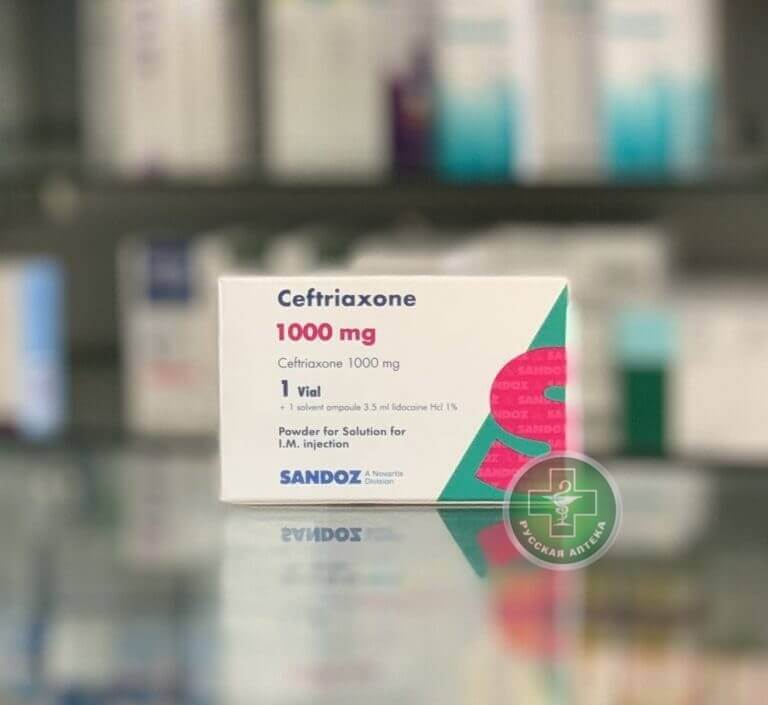
Ceftriaxone 1000 mg 1 ampoule
95£
View analogs- Infectious and inflammatory diseases caused by pathogens sensitive to ceftriaxone: sepsis, meningitis, typhoid fever, salmonellosis, disseminated Lyme borreliosis (early and late stages of the disease);
- infections of the abdominal organs (peritonitis, infections of the biliary tract and gastrointestinal tract);
- infections of bones, joints, soft tissues, skin, as well as wound infections;
- infections in patients with reduced immunity;
- kidney and urinary tract infections;
- infections of the lower respiratory tract (including pneumonia), as well as infections of the ENT organs;
- urogenital infections (including gonorrhea, chancre, syphilis);
- prevention of infections in the postoperative period.
Buy
Product quantities
Form of Release: Ampoules
Product Brand:
Sandoz
About the brand


Ceftriaxone 1000 mg 1 ampoule
Composition:
Each ampoule contains:
Ceftriaxone 1000 mg
Properties:
Ceftriaxone is a third generation cephalosporin antibiotic for parenteral use, has a bactericidal effect, inhibits the synthesis of the cell membrane, in vitro inhibits the growth of most gram-positive and gram-negative microorganisms. Ceftriaxone is resistant to beta-lactamase enzymes, such as penicillinase and cephalosporinase, produced by most gram-positive and gram-negative bacteria.
Indications:
– infectious and inflammatory diseases caused by pathogens sensitive to ceftriaxone: sepsis, meningitis, typhoid fever, salmonellosis, disseminated Lyme borreliosis (early and late stages of the disease);
– infections of the abdominal organs (peritonitis, infections of the biliary tract and gastrointestinal tract);
-infections of bones, joints, soft tissues, skin, as well as wound infections;
-infections in patients with reduced immunity;
– kidney and urinary tract infections;
-infections of the lower respiratory tract (including pneumonia), as well as infections of the ENT organs;
– urogenital infections (including gonorrhea, chancre, syphilis);
– prevention of infections in the postoperative period.
Method of administration and dosage:
The doctor selects the dose individually, depending on the indications.
The drug is used intramuscularly or intravenously.
For adults and children over 12 years of age, the average daily dose is 1-2 g of ceftriaxone 1 time / day or 0.5-1 g every 12 hours.
In severe cases or in cases of infections caused by moderately susceptible pathogens, the daily dose may be increased to 4 g.
IM introduction:
For intramuscular administration, 1 g of the drug must be diluted in 3.5 ml of 1% lidocaine solution and injected deep into a relatively large muscle (for example, the gluteus), it is recommended to inject no more than 1 g of the drug into one buttock. The lidocaine solution should never be administered IV.
Test aspiration helps to avoid inadvertent entry of the drug into the vessel.
For intravenous injection, 1 g of the drug must be diluted in 10 ml of water for injection and injected intravenously slowly over 2-4 minutes.
The duration of the intravenous infusion is at least 30 minutes. For intravenous infusion, 2 g of powder must be diluted in about 40 ml of a calcium-free solution, for example: in 0.9% sodium chloride solution, in 5% dextrose solution, in 10% dextrose solution, 5% fructose solution.
Contraindications:
-increased sensitivity to cephalosporins, penicillins and carbapenems.
With care: with nonspecific ulcerative colitis, with impaired liver and kidney function, with enteritis and colitis associated with the use of antibacterial drugs; premature and newborn babies with hyperbilirubinemia; pregnant women and during lactation.
Precautionary measures:
During treatment, the use of ethanol is contraindicated – disulfiram-like effects are possible (redness of the face, spasm in the stomach, nausea, vomiting, headache, decreased blood pressure, tachycardia, shortness of breath).
Also, the possibility of developing anaphylactic shock, which requires immediate therapy, cannot be ruled out – first, epinephrine is injected intravenously, then glucocorticoids.
In vitro studies have shown that, like other cephalosporin antibiotics, ceftriaxone is able to displace bilirubin associated with serum albumin. Therefore, in newborns with hyperbilirubinemia, and especially in premature infants, the use of ceftriaxone requires even greater caution.
Elderly and debilitated patients may require vitamin K.
Side effects:
Allergic reactions: hives, chills or fever, rash, itching;
From the digestive system: nausea, vomiting, diarrhea or constipation, flatulence, abdominal pain;
From the side of hematopoietic organs: anemia, leukopenia, leukocytosis, neutropenia, granulocytopenia, lymphopenia, thrombocytosis.
Storage method:
Store at a temperature not exceeding 30 degrees.
Package:
The cardboard box contains 1 bottle of the drug together with 1 ampoule of lidocaine hydrochloride 1% 3.5 ml, paper instructions.
Manufacturer:
Novartis, Egypt
Tags, Keywords:
Active Ingredients:
Your comment will be published after moderation.
You’ll receive a notification to your email when someone replies.









Аноним 2026-01-30 20:16:07
А как его колоть? Для инъекции нужен лидокаин (и вода) - где взять лидокаин в ампуле?
Менеджер Русской Аптеки 2026-01-31 08:11:26
Здравствуйте! Спасибо за обращение в нашу аптеку! Вы можете обратиться в онлайн-службу поддержки +201010910519 — специалист проконсультирует вас и поможет подобрать подходящий препарат.