Русский
 English
 عربي
عربي
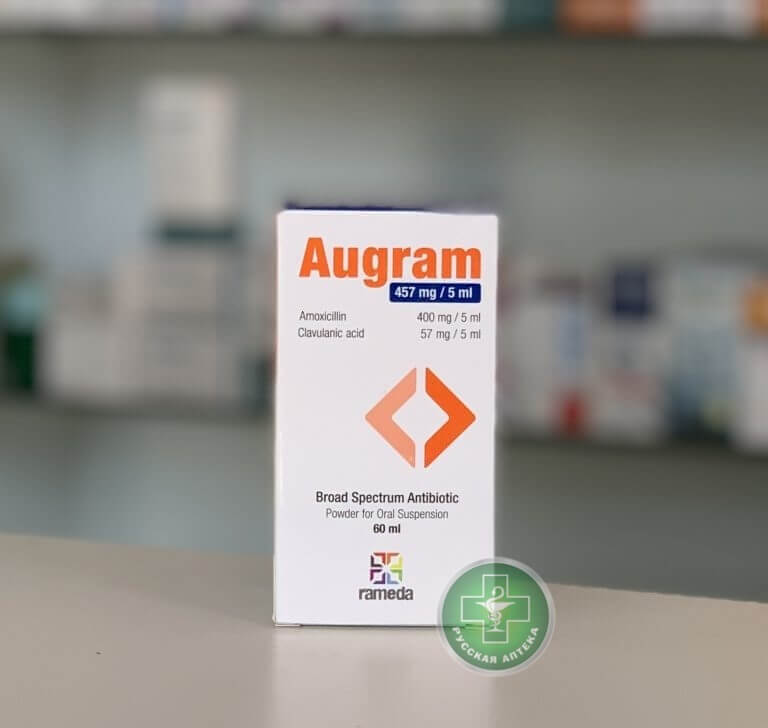
Augram Suspension 457 mg/5 ml 60 ml
81£
View analogsBroad spectrum antibiotic
Bacterial infections caused by microorganisms sensitive to the drug.
Buy
Product quantities
Form of Release: Suspension
Product Brand:
Rameda Pharmaceutical Company
About the brand
Product Categories: Antibiotics • Broad spectrum antibiotics


Augram Suspension 457 mg/5 ml 60 ml
Composition:
Each 5 ml contains:
Amoxicillin trihydrate 458.1mg equivalent to 400 mg Amoxicillin base + Potassium clavulanate 67.8 equivalent to 57mg clavulanic acid
Inactive Ingredients:
Microcrystalline cellulose (Avicel PH 101), sucrose, colloidal anhydrous silica (Aerosil200), syloid
Properties:
Amoxicillin is a semi-synthetic broad-spectrum antibiotic with activity against many gram-positive and gram-negative microorganisms. At the same time, amoxicillin is susceptible to destruction by β-lactamases, and therefore the spectrum of activity of amoxicillin does not extend to microorganisms that produce this enzyme.
Clavulanic acid, a β-lactamase inhibitor structurally related to penicillins, has the ability to inactivate a wide range of β-lactamases found in microorganisms resistant to penicillins and cephalosporins. Clavulanic acid is reasonably effective against plasmid β-lactamases, which most often confer bacterial resistance, and less effective against chromosomal type 1 β-lactamases, which are not inhibited by clavulanic acid.
The presence of clavulanic acid in Augram protects amoxicillin from destruction by enzymes – β-lactamases, which allows expanding the antibacterial spectrum of amoxicillin.
Indications:
Bacterial infections caused by microorganisms sensitive to the drug:
infections of the upper respiratory tract and ENT organs (for example, recurrent tonsillitis, sinusitis, otitis media), usually caused by Streptococcus pneumoniae, Haemophilus influenzae, Moraxella catarrhalis, Streptococcus pyogenes;
infections of the lower respiratory tract: exacerbations of chronic bronchitis, lobar pneumonia and bronchopneumonia, usually caused by Streptococcus pneumoniae, Haemophilus influenzae and Moraxella catarrhalis;
urinary tract infections: cystitis, urethritis, pyelonephritis, infections of the female genital organs, usually caused by species of the family Enterobacteriaceae (mainly Escherichia coli), Staphylococcus saprophyticus and species of the genus Enterococcus;
gonorrhea caused by Neisseria gonorrhoeae;
infections of the skin and soft tissues, usually caused by Staphylococcus aureus, Streptococcus pyogenes and species of the genus Bacteroides;
bone and joint infections (eg, osteomyelitis, usually caused by Staphylococcus aureus); if necessary, long-term therapy.
Dosage and administration:
The drug is taken orally.
The dosage regimen is set individually depending on the age, body weight, kidney function of the patient, as well as the severity of the infection.
For optimal absorption and to reduce possible side effects on the digestive system, Augram is recommended to be taken at the beginning of a meal.
The minimum course of antibiotic therapy is 5 days.
Treatment should not be continued for more than 14 days without a review of the clinical situation.Children over 3 months old:
Multiplicity of reception – 2 times / day
Suspension 7:1 (400 mg/57 mg in 5 ml)
Low doses 25 mg/kg/day
High doses 45 mg/kg/day
Low doses of Augram are used to treat infections of the skin and soft tissues, as well as recurrent tonsillitis.
High doses of Augram are used to treat conditions such as otitis media, sinusitis, lower respiratory and urinary tract infections, bone and joint infections.
Contraindications:
– hypersensitivity to amoxicillin, clavulanic acid, other components of the drug, beta-lactam antibiotics (for example, penicillins, cephalosporins) in history;
– previous episodes of jaundice or abnormal liver function when using a combination of amoxicillin with clavulanic acid in history;
– children’s age up to 3 months (for powder for suspension for oral administration 200 mg / 28.5 mg in 5 ml and 400 mg / 57 mg in 5 ml);
– impaired renal function (CC less than 30 ml / min) – for powder for suspension for oral administration 200 mg / 28.5 mg in 5 ml and 400 mg / 57 mg in 5 ml;
-phenylketonuria.
With caution: abnormal liver function.
Warnings and precautions:
Before starting treatment with Augram, it is necessary to collect a detailed history regarding previous hypersensitivity reactions to penicillins, cephalosporins or other substances that cause an allergic reaction in the patient.
Serious and sometimes fatal hypersensitivity reactions (anaphylactic reactions) to penicillins have been described.The risk of such reactions is highest in patients with a history of hypersensitivity reactions to penicillins. In the event of an allergic reaction, treatment with Augram should be discontinued and appropriate alternative therapy initiated.
Side effects:
Infectious and parasitic diseases: often – candidiasis of the skin and mucous membranes;
From the hematopoietic system: rarely – reversible leukopenia (including neutropenia) and reversible thrombocytopenia; very rarely – reversible agranulocytosis and reversible hemolytic anemia, prolongation of prothrombin time and bleeding time, anemia, eosinophilia, thrombocytosis.
On the part of the immune system: very rarely – angioedema, anaphylactic reactions, a syndrome similar to serum sickness, allergic vasculitis.
From the nervous system: infrequently – dizziness, headache; very rarely – reversible hyperactivity, convulsions (convulsions may occur in patients with impaired renal function, as well as in those receiving high doses of the drug), insomnia, agitation, anxiety, behavior change.
From the digestive system: adults: very often – diarrhea, often – nausea, vomiting; children – often – diarrhea, nausea, vomiting; the entire population: nausea is most often observed when taking high doses of the drug.
From the side of the liver and biliary tract: infrequently – a moderate increase in the activity of ACT and / or ALT (observed in patients receiving therapy with beta-lactam antibiotics, but its clinical significance is unknown).
Storage:
Store at a temperature not exceeding 25°C. Once opened, store in the refrigerator for up to 7 days.
Package:
The carton box contains 60 ml plastic bottle and suspension powder, paper instructions
Tags, Keywords:
Active Ingredients:
No comments yet. Be the first to write one.
Your comment will be published after moderation.
You’ll receive a notification to your email when someone replies.