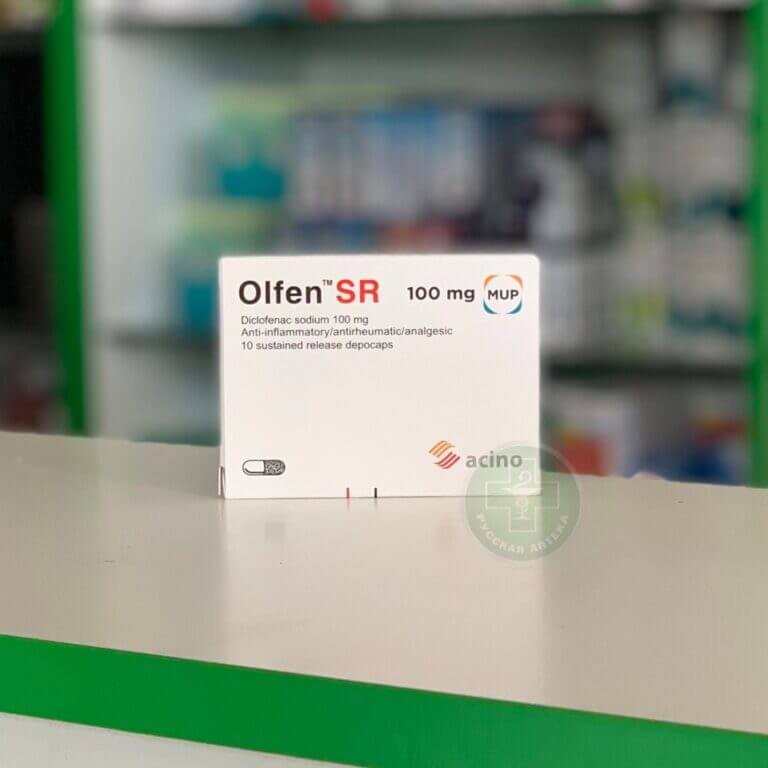
Olfen SR 100 mg 10 capsules
Composition:
Each capsule contains:
Diclofenac sodium 100 mg
Inactive ingredients:
Lactose monohydrate, Microcrystalline cellulose, carmellose sodium, Glycerin trimyristate, Titanium dioxide E171, Ammonio, methacrylate copolymer dispersion type B, Triethyl citrate, Silica colloidal, hydrated, Gelatin, Titanium dioxide E171, Iron oxide black E172, Iron oxide red E172, Erythrosine E127
Properties:
Anti- Inflammatory and antirheumatic product, non-steroid.
Olfen contains the sodium salt of diclofenac, a nonsteroidal active substance having pronounced antirheumatic, anti-inflammatory, analgesic and antipyretic properties.
Inhibition of prostaglandin biosynthesis, which has been demonstrated experimentally, is thought to be important for the mechanism of action.
Prostaglandins play an essential role in the development of inflammation, pain and
fever. In vitro, at concentrations equivalent to levels reached in humans, Olfen does not induce suppression of proteoglycan biosynthesis in cartilage.
Indications:
-Inflammatory and degenerative forms of rheumatism: chronic polyarthritis, juvenile chronic polyarthritis, ankylosing spondylitis, osteoarthritis, including spondylarthrosis, painful cervical syndrome.
-Extra-articular rheumatic disorders.
-Painful conditions of inflammation and swelling after trauma and surgery, e.g. in dentistry/orthodontics, and orthopedics.
-Painful and/or inflammatory conditions in gynecology, e.g. primary dysmenorrhea, adnexitis.
Dosage and administration:
-Adults:
For milder cases and long-term treatment, 1 capsule of Olfen-100 SR Depocaps per day is generally sufficient. If the symptoms are at their most severe level during the night or in the morning, Olfen-100 SR Depocaps should preferably be taken in the evening.
-The capsules are to be taken before a meal, without chewing together with a glass of water.
-Children and adolescents:
Olfen-100 SR Depocaps are not suitable for children and adolescents.
Side effects:
-Blood and lymphatic system disorders:
Very rare: thrombocytopenia, leukopenia, anemia (including haemolytic and aplastic anemia), agranulocytosis.
-Immune system disorders:
Rare: hypersensitivity, anaphylactic and anaphylactoid reactions (including hypotension and shock).
Very rare: angioedema (including facial oedema).
-Psychiatric disorders:
Very rare: disorientation, depression, insomnia, nightmare, irritability, psychotic disorder.
-Nervous system disorders:
Common: headache, dizziness.
Rare: somnolence.
Very rare: paraesthesia, impaired memory, convulsions, anxiety, tremor, aseptic meningitis, taste disturbances, cerebrovascular accidents.
-Eye disorders:
Very rare: visual disturbances, blurred vision, diplopia.
-Ear and labyrinth disorders:
Common: vertigo.
Very rare: tinnitus, impaired hearing.
-Cardiac disorders:
Very rare: palpitations, chest pain, cardiac insufficiency, myocardial infarction, hypertension.
-Vascular disorders:
Very rare: vasculitis.
-Respiratory, thoracic and mediastinal disorders:
Rare: asthma (including dyspnoea).
Very rare: pneumonitis.
-Gastrointestinal disorders:
Common: nausea, vomiting, diarrhea, dyspepsia, abdominal pain, cramps, flatulence, anorexia.
Rare: gastritis, gastrointestinal bleeding, haematemesis, bloody diarrhea, melaena, gastric or intestinal ulcer (with or without bleeding or perforation).
Contraindications:
-Hypersensitivity to the active substance or to any of the excipients of the product;
-History of allergic diseases such as bronchospasm, acute rhinitis, nasal polyps, urticaria following intake of acetylsalicylic acid or other non-steroidal anti- inflammatory drugs;
-Third trimester of pregnancy;
-Active gastric and/or duodenal ulcer, or gastrointestinal hemorrhage, or perforation;
-Bowel inflammation such as Crohn’s disease or ulcerative colitis;
-Severe liver insufficiency (hepatic cirrhosis and ascites);
-Severe renal insufficiency (creatinine clearance < 30 ml/min);
Severe cardiac insufficiency (NYHA l|-IV).
-Treatment of postoperative pain after coronary by-pass surgery (or use of a heart-lung machine).
Warnings and precautions:
- Gastrointestinal ulceration, bleeding or perforation may occur at any time during treatment with non-steroidal anti-inflammatory drugs (NSAID), whether COX-2 selective or otherwise, with or without warning signs or previous history. To minimize this risk, the smallest effective dose should be administered over the shortest possible duration of treatment.
- An increased risk of thrombotic cardiovascular and cerebrovascular complications has been demonstrated for certain selective COX-2 inhibitors in placebo-controlled studies. It is not yet known whether this risk correlates directly with the COX-1/COX- 2 selectivity of the individual NSAID. As there are currently no comparable clinical studies at the maximum dosage and in long-term therapy for diclofenac, a similarly increased risk cannot be excluded. Until relevant data are available, diclofenac should be used in clinically confirmed coronary heart disease, cerebrovascular disease, peripheral arterial occlusive disease or in patients with major risk factors (e.g. hypertension, hyperlipidaemia, diabetes mellitus, smoking) only after careful analysis of the risks and benefits. Again, because of this risk, the smallest effective dose should be administered over the shortest possible duration of treatment.
The renal effects of NSAIDs include fluid retention with oedema and/or hypertension.
Therefore, diclofenac should be used with caution in patients with impaired cardiac function and other conditions that predispose to fluid retention. Caution should also be exercised in patients concomitantly taking diuretics or ACE inhibitors and in those at increased risk of hypovolaemia.
- The consequences are generally more serious in the elderly. If gastrointestinal bleeding or ulceration occurs in patients during treatment with Olfen, the medicinal product should be withdrawn.
- Serious skin reactions, some of them fatal., including exfoliative dermatitis, Stevens- Johnson syndrome and toxic epidermal necrolysis, have been reported very rarely in association with the use of NSAIDs. Patients appear to be at greatest risk early in the course of therapy, the onset of reactions usually occurring within the first month of treatment. Olfen should be discontinued at the first signs of skin rash, mucosal lesions or any other sign of hypersensitivity.
- As with other NSAIDs, allergic reactions, including anaphylactic/ anaphylactoid reactions, can occur in rare cases, even in the absence of any previous treatment with diclofenac.
- Concomitant use of Olfen with systemic NSAIDs such as cyclo-oxygenase-2- selective inhibitors should be avoided due to the absence of any evidence demonstrating synergistic benefits and the potential for additive adverse effects.
- As a basic medical principle, caution is indicated in elderly. In particular, it is recommended that the lowest effective dose should be used in frail elderly subjects or those with a low body weight.
Olfen-100 SR Depocaps contain lactose. Patients with hereditary problems of galactose intolerance, severe lactase deficiency or glucose- galactose malabsorption should not take Olfen 100 SR Depocaps.
- In patients with asthma, seasonal allergic rhinitis, chronic obstructive pulmonary disease or chronic respiratory tract infections (especially if associated with allergic rhinitis-like symptoms), reactions to NSAIDs such as asthma exacerbation (so-called analgesic intolerance/analgesic asthma), Quincke’s oedema or urticaria are more frequent than in other patients. Therefore, particular caution is recommended in these patients (readiness for emergency). This is also applicable for patients who are allergic to other substances, e.g. with skin rash, pruritus or urticaria.
- As with other NSAIDs, liver function should be monitored regularly during long-term therapy with Olfen SR.
- Particular care must be taken in the case of patients with impaired cardiac or renal function; previous history of hypertension; elderly patients; patients taking diuretics or medications with a significant effect on renal function, as well as in patients with extracellular fluid deficit of any cause, e.g. during the peri- or post-operative phase of major surgery. If Olfen is used in such cases, it is recommended to monitor kidney function as a precautionary measure. Upon discontinuation of therapy, pre-treatment conditions are usually re-established.
- When used concomitantly, diclofenac may increase the plasma concentrations of lithium. Monitoring of the serum lithium level is recommended.
- Infirm your doctor if you take any of these medicines:
-Digoxin
-Diuretics and antihypertensives
-Other NSAIDs and corticosteroids
-Anticoagulants and antiplatelet agents
-Selective serotonin reuptake inhibitors (SSRIs)
-Antidiabetic agents
-Methotrexate
-Cyclosporin
-Quinolone antibiotics
Inhibition of prostaglandin synthesis can adversely affect pregnancy and/or embryo fetal development. The risk is assumed to increase with the dose and duration of therapy.
Diclofenac should not be given during the first and second trimesters of pregnancy unless absolutely necessary. If diclofenac is used by a woman who is attempting to conceive or during the first or second trimester, the dose should be kept as low as possible and the duration of treatment as short as possible.
Diclofenac is contraindicated during the third trimester of pregnancy.
NSAIDs pass into breast milk. As a precaution, diclofenac should therefore not be taken by breast-feeding women. If treatment is essential, the infant should be switched to bottle feeding.
The use of diclofenac may impair female fertility and is therefore not recommended in women wishing to conceive. In women who have difficulties in conceiving or who are undergoing investigation for infertility, withdrawal of diclofenac should be considered.
- Effects on ability to drive and use machines:
Patients experiencing visual disturbances, dizziness, vertigo, somnolence or other central nervous disturbances while taking Olfen SR should refrain from driving or using machines.
Storage:
Store at a temperature not exceeding 25°C
Package:
Carton box holds a strip of 10 sustained release depocaps and an insert leaflet.
 Русский
 English
 عربي
عربي