Русский
 English
 عربي
عربي
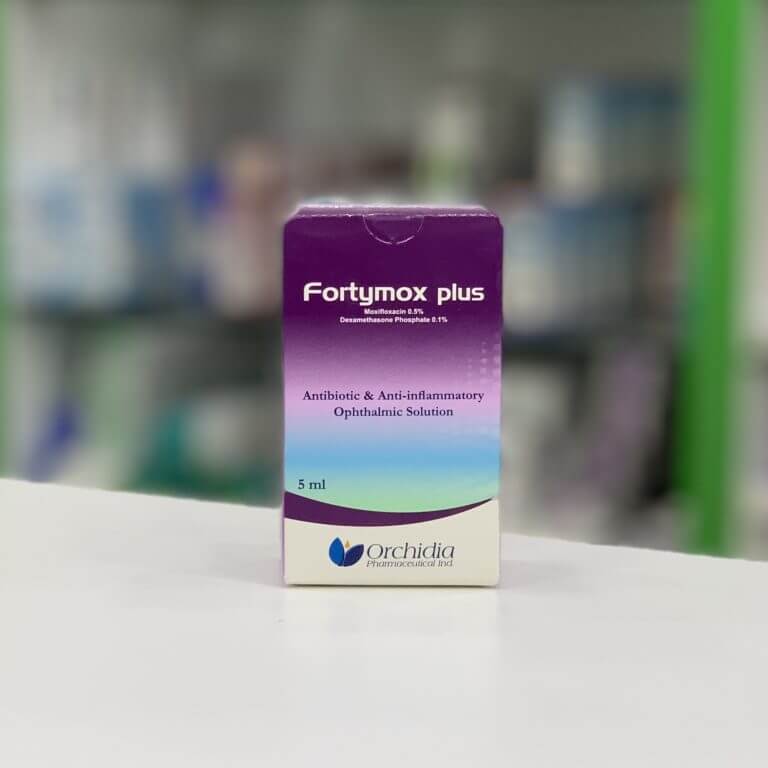
Fortymox Plus Eye drops 5 ml
39£
View analogsTreatment of ocular infections caused by susceptible microorganisms and prevention of inflammation and bacterial infection that may occur after ocular surgery.
Buy
Product quantities
Form of Release: Drops
Product Brand:
Orchidia Pharmaceutical Industries
About the brand
Product Categories: Eyes Health • Medicines and vitamins for eyes


Fortymox Plus Eye drops 5 ml
Composition:
Each 1 ml contains:
Moxifloxacin hydrochloride 5.45 mg (corresponding to 5 mg Moxifloxacin) and Dexamethasone Sodium phosphate 1.1 mg (corresponding to 1 mg Dexamethasone phosphate)
Inactive ingredients:
Boric Acid, Sodium chloride, Disodium edetate, Sorbitol, Polysorbate 80, Hydrochloric acid/Sodium hydroxide for PH adjustment (7.3 – 8.3), Water for injection.
Properties :
-Belongs to the class of combinations of corticosteroids and anti-infectives (quinolones & Steroids).
-Fortymox Plus is a sterile, isotonic ophthalmic solution which combines moxifloxacin hydrochloride and dexamethasone sodium phosphate.
-The steroid suppresses the inflammation while the antibiotic controls the proliferation of potential susceptible pathogenic bacteria and also works prophylactically.
-Many species of bacteria implicated in the postsurgical endophthalmitis are the same commonly present in the periocular flora.
-The mechanism of action of moxifloxacin (and other fluoroquinolone antimicrobials) involves the inhibition of bacterial topoisomerase IV and deoxyribonucleic acid (DNA) gyrase, enzymes required for DNA replication, transcription, repair, and recombination. In gram-negative bacteria, fluoroquinolones preferentially target DNA gyrase rather than topoisomerase IV. Whereas in gram-positive bacteria, the target specificity is reversed.
– Moxifloxacin has been shown to be active against most strains of the following microorganisms, both in vitro and in clinical infections:
Aerobic Gram-Positive Microorganisms:
Corynebacterium sp, Micrococcus luteus, Staphylococcus aureus, Staphylococcus epidermidis, Staphylococcus haemolyticus, Staphylococcus hominis, Staphylococcus warneri, Streptococcus pneumoniae e Grupo dos Streptococcus viridans.
Aerobic Gram-Negative Microorganisms: Acinetobacter Iwoffii, Haemophilus influenzae, Haemophilus parainfluenzae.
Indications :
Treatment of ocular infections caused by susceptible microorganisms and prevention of inflammation and bacterial infection that may occur after ocular surgery.
Dosage and administration:
-Prevention of post-op ocular inflammation and infection Instill 1 drop 4 times daily in the eye, starting 1 day pre-operative and during 15 days post-operative and follow the below.
-Cataract surgery Instill immediately post-operative.
-Refractive surgery by LASIK Instill within 15 min post-operative.
-Ocular infections caused by susceptible organisms Instill 1 drop 4 times daily for 7 days.
-Follow doctor’s instructions on the schedule, dose and duration of treatment should be followed. Do not discontinue treatment without consulting the doctor.
-Pediatric population :
Efficacy in pediatric patients has not been established.
-Elderly Population :
No changes of dose are required for elderly patients.
-If you use other medicines in the eye, leave at least 5 minutes between putting in Fortymox Plus and the other medication.
Side effects:
- The adverse reactions that may occur with use of corticosteroids are: Glaucoma with optic nerve damage, visual acuity defects and visual field defects; cataract formation; secondary ocular infection following suppression of host response; and perforation of the globe.
- The most frequently ocular adverse reported with the use of moxifloxacin ophthalmic solution 0.5% were conjunctivitis, decreased visual acuity, dry eye, keratitis; ocular discomfort, ocular hyperemia, ocular pain and ocular pruritus, sub conjunctival hemorrhage, and tearing.
- In surgical procedures, some of these events are consequences of the surgery. Non-ocular adverse events reported at a rate of 1 – 4% were fever, increased cough, infection, otitis media, pharyngitis, rash and rhinitis.
Contraindications :
- Hypersensitivity to other quinolones and any components of Fortymox Plus.
- Patients with glaucoma and/or ocular disease causing thinning of the cornea or sclera; inflammation in the eye caused by virus, fungi or mycobacteria.
- Epithelial herpes simplex keratitis (dendritic keratitis), vaccinia, varicella and many other viral diseases of the cornea, and conjunctiva.
- Mycobacterial infection of the eye.
- Fungal diseases of ocular structures.
Warnings and precautions:
- If an allergic reaction to moxifloxacin occurs, discontinue use of Fortymox Plus and contact the doctor.
- Prolonged steroid use may result in ocular hypertension and/or glaucoma with damage to the optic nerve, defect in visual acuity and fields of vision, posterior subcapsular cataract formation, or increased hazard of developing secondary ocular infections.
- The intraocular pressure must be evaluated routinely.
- In those diseases causing thinning of the cornea or sclera (white part of the eye), perforations have been known to occur with use of topical corticosteroids.
- In acute purulent conditions of the eye, steroids may mask infection or enhance existing infection.
- Not for injection. Fortymox Plus solution should not be injected sub-conjunctively, nor should it be introduced directly into the anterior chamber of the eye.
- As with other antibiotic preparations, prolonged use may result in overgrowth of non-susceptible organisms, including fungi. If super infection occurs, appropriate therapy should be initiated. Whenever clinical judgment dictates, the patient should be examined by biomicroscopy and, where appropriate, fluorescein staining. The possibility of fungal infections of the cornea should be considered after long-term steroid dosing.
- Pediatric population:
Safety and effectiveness in the pediatric population have not been established.
- Based on findings from systemic administration studies, corticosteroids may increase the activity of barbiturates, tricyclic antidepressants and decrease the activity of anticholinesterase agents, salicylates and anticoagulants.
- Fortymox plus can be used during pregnancy if the benefits from its use outweighs the risks for the fetus.
- Systemically administered corticosteroids appear in human milk and could suppress growth, interfere with endogenous corticosteroid production, or cause other undesirable effects.
- Corticosteroids achieve their anti-inflammatory effects through decreased release of arachidonic acid as well as suppression of vascular endothelial cell adhesion molecules, cyclooxygenase, and cytokine expression. This action results in a reduced release of pro-inflammatory mediators and reduced adhesion of circulating leukocytes to vascular endothelium, preventing their passage into inflamed ocular tissue. Additionally, decreased expression of cyclooxygenase results in a decreased production of inflammatory prostaglandins, which are known to cause breakdown of the blood aqueous barrier and leakage of plasma proteins into the ocular tissue.
Storage:
Store at a temperature not exceeding 30°C
Package:
Carton box holds a plastic dropper bottle 5 ml and insert leaflet.
Tags, Keywords:
Active Ingredients:
No comments yet. Be the first to write one.
Your comment will be published after moderation.
You’ll receive a notification to your email when someone replies.