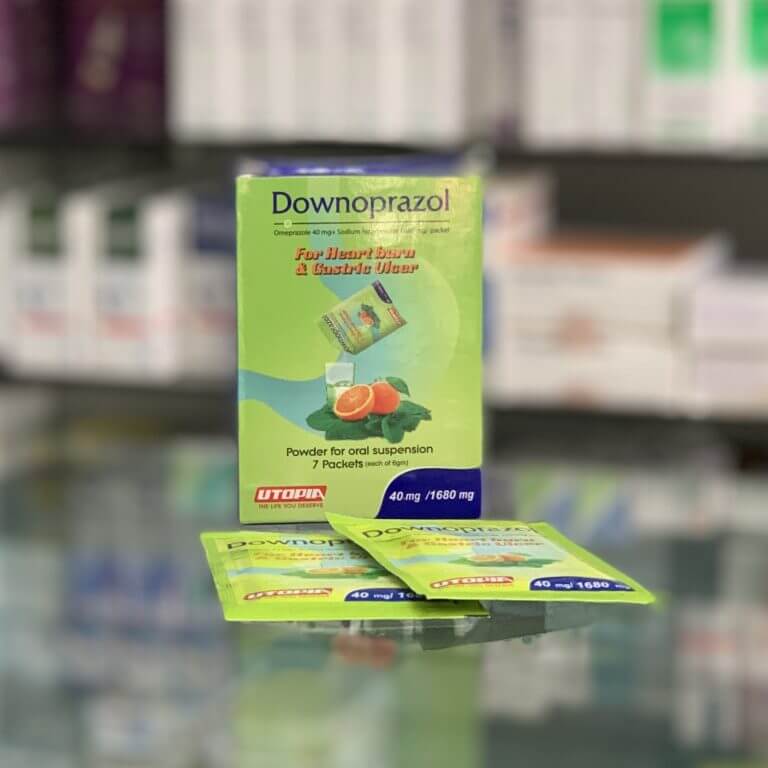
Downoprazol 40/1680 mg 7 sachets
Compound:
Each sachet contains:
Omeprazole 40 mg
Sodium bicarbonate 1680 mg
Auxiliary components:
Aspartame sodium carboxymethyl cellulose, orange flavor, menthol flavor, sucrose.
Properties:
Omeprazole inhibits the enzyme H + – K + -ATPase (“proton pump”) in the parietal cells of the stomach and thereby blocks the final stage of hydrochloric acid synthesis. This leads to a decrease in the level of basal and stimulated secretion, regardless of the nature of the stimulus. After a single dose of the drug inside, the effect of omeprazole occurs within the first hour and lasts for 24 hours, the maximum effect is achieved after 2 hours. In patients with duodenal ulcer, taking 20 mg of omeprazole maintains intragastric pH = 3 for 17 hours. drug secretory activity is fully restored after 3-5 days.
Indications:
peptic ulcer of the stomach and duodenum;
reflux esophagitis;
erosive and ulcerative lesions of the stomach and duodenum associated with the use of NSAIDs;
stress ulcers;
erosive and ulcerative lesions of the stomach and duodenum associated with Helicobacter pylori (as part of complex therapy);
Zollinger-Ellison syndrome.
Dosage and administration:
Take in the morning 1 hour before meals. Pour the contents of the sachet into a glass with 20 ml of water, stir and drink. Do not use liquid other than water!
Doses for people over 18:
Peptic ulcer of the stomach in the acute phase and erosive and ulcerative esophagitis: 20-40 mg per day for 4-8 weeks.
Eradication of Helicobacter pylori: 20 mg 1 time per day for 7 days in combination with antibacterial agents.
Zollinger-Ellison syndrome: the dose is selected individually depending on the initial level of gastric secretion, usually starting from 60 mg / day. If necessary, the dose is increased to 80-120 mg / day, in which case it is divided into 2 doses.
Contraindications:
hypersensitivity to the drug;
childhood;
pregnancy;
lactation period.
Precautionary measures:
Before starting therapy, it is necessary to exclude the presence of a malignant process (especially with a stomach ulcer), because. treatment, by masking symptoms, may delay the correct diagnosis.
Reception along with food does not affect the effectiveness.
In patients with severe hepatic insufficiency, the daily dose should not exceed 20 mg.
Side effects:
In rare cases, the following usually reversible side effects may occur.
On the part of the digestive system: diarrhea or constipation, nausea, vomiting, flatulence, abdominal pain, dry mouth, taste disturbances, stomatitis, transient increase in plasma levels of liver enzymes; in patients with previous severe liver disease – hepatitis (including with jaundice), impaired liver function.
From the nervous system: headache, dizziness, agitation, drowsiness, insomnia, paresthesia, depression, hallucinations; in patients with severe concomitant somatic diseases, in patients with previous severe liver disease – encephalopathy.
From the musculoskeletal system: muscle weakness, myalgia, arthralgia.
From the hemopoietic system: leukopenia, thrombocytopenia; in some cases – agranulocytosis, pancytopenia.
On the part of the skin: itching; rarely (in some cases) – photosensitivity, erythema multiforme, alopecia.
Allergic reactions: urticaria, angioedema, bronchospasm, interstitial nephritis and anaphylactic shock.
Other: blurred vision, peripheral edema, increased sweating, fever, gynecomastia; rarely – the formation of gastric glandular cysts during long-term treatment (a consequence of inhibition of the secretion of hydrochloric acid, is benign reversible).
Storage method:
Store in a dry, dark place at a temperature not exceeding 30C.
Package:
The cardboard box contains 7 sachets of 6 g, paper instructions.
 Русский
 English
 عربي
عربي