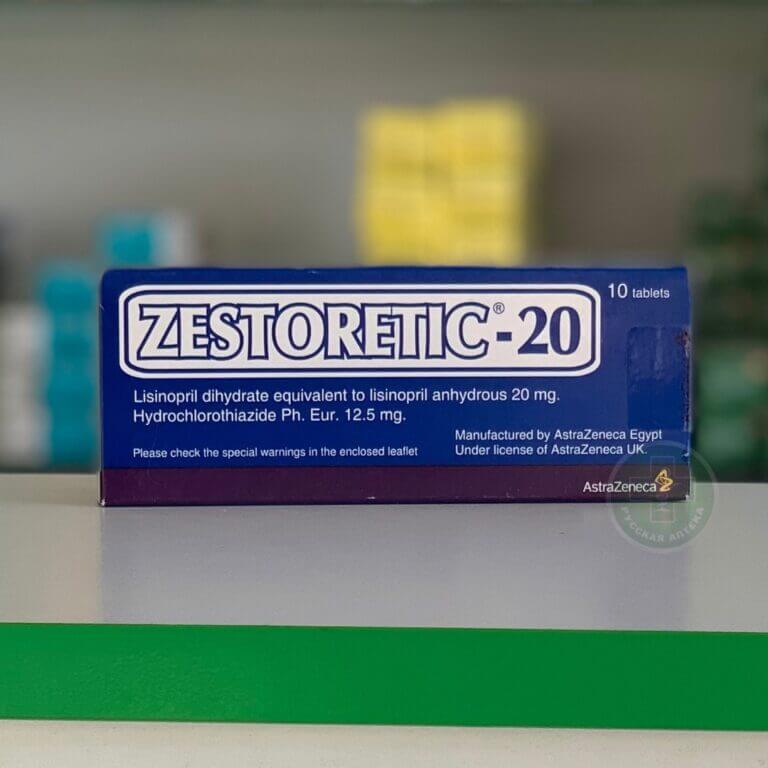
Zestoretic 20 mg/12.5 mg 10 tablets
Composition:
Lisinopril 20 mg
Hydrochlorothiazide 12.5 mg
Inactive ingredients are calcium hydrogen phosphate dihydrate, magnesium stearate, maize starch, mannitol and pregelatinized starch.
Properties:
Zestoretic is used to treat high blood pressure (hypertension). It contains two medicines called lisinopril and hydrochlorothiazide.
-Lisinopril belongs to a group of medicines called ACE inhibitors. It works by making your blood vessels widen.
-Hydrochlorothiazide belongs to a group of medicines called diuretics (water tablets). It helps your body to get rid of water and salts like sodium in your urine.
These medicines work together to lower your blood pressure.
Dosage and administration:
-Always take Zestoretic exactly as your doctor has told you.
-Once you have started taking Zestoretic your doctor may take blood tests. Your doctor may then adjust your dose so you take the right amount of medicine for you.
-Swallow the tablet with a drink of water.
-Try to take your tablets at the same time each day.
-It does not matter if you take Zestoretic before or after food.
-Take special care when you have your first dose of Zestoretic or if your dose is increased. It may cause a greater fall in blood pressure than later doses.
This may make you feel dizzy or light-headed. If this happens, it may help to lie down. If you are concerned, please talk to your doctor as soon as possible.
-Adults:
The recommended dose is one tablet once a day. Your doctor will prescribe the tablet that is the right strength for you.
If necessary, your doctor may increase your dose to two tablets once a day.
-Use in children:
Zestoretic is not recommended for use in children.
-If you take more Zestoretic, than you should, talk to a doctor or go to a hospital immediately. Take the medicine pack with you so that the tablets can be identified.
-If you forget to take a dose, take it as soon as you remember. However, if it is nearly time for the next dose, skip the missed dose. Do not take a double dose to make up for a forgotten dose.
-Do not stop taking your tablets, even if you are feeling well, unless your doctor tells you to.
Side effects:
Common:
-Headache, Feeling dizzy or light-headed,
Fainting;
-Diarrhea, Being sick (vomiting);
-Cough;
-Kidney problems (shown in a blood test);
Uncommon:
-Mood changes, including feeling depressed;
-Tingling feeling such as ‘pins and needles’;
-Spinning feeling (vertigo);
-Changes in the way things taste;
-Difficulty sleeping;
-A very big drop in blood pressure may happen in people with the following conditions: coronary heart disease; narrowing of the aorta (a heart artery), kidney artery or heart valves; an increase in the thickness of the heart muscle. If this happens to you, you may feel dizzy or light-headed, especially if you stand up quickly;
-Heart attack or stroke, Unusual heart beat;
-Change of color in your fingers or toes;
-Runny nose;
-Feeling sick (nausea);
-Stomach pain and indigestion;
-Changes in blood tests that check how the liver is working;
-Rash, Itching;
-Being unable to get an erection (impotence);
-Feeling weak, Feeling tired;
-Increased levels of certain substances in your blood (urea, creatinine or potassium).
Rare (may affect up to 1 in 1,000 people)
-Changes to some of the cells or other parts of your blood. The signs may include feeling tired and pale skin.;
-Feeling confused;
-Changes in the way things smell;
-Dry mouth;
-Skin rash with dark red, raised, itchy bumps (hives);
-Hair loss (alopecia);
-Psoriasis;
-Infection of the blood;
-Kidney failure;
-Enlarged breasts in men;
-Syndrome of inappropriate antidiuretic hormone secretion (SIADH);
-Low levels of sodium in the blood, which may cause weakness, tiredness, headache, feeling sick, being sick (vomiting) and cramps.
Contraindications:
Do not take Zestoretic:
–if you are allergic to lisinopril or hydrochlorothiazide or any of the other ingredients of Zestoretic;
-if you are allergic to ACE inhibitors or sulfonamide medicines;
-if you have ever had sudden swelling of the hands, feet, ankles, face, lips, tongue or throat, especially if this followed treatment with an ACE inhibitor. It may also have been difficult to swallow or breathe;
-if you have taken or are currently taking sacubitril/valsartan, a medicine used to treat a type of long-term (chronic) heart failure in adults, as the risk of angioedema (rapid swelling under the skin in an area such as the throat) is increased;
-if you have hereditary angioedema (a condition that makes you more prone to the swelling described above).
-if you have severe kidney problems.
-if you have stopped passing water (urine)
-if you have severe liver problems.
-if you are more than 3 months pregnant.
-if you have diabetes or impaired kidney function and you are treated with a blood pressure lowering medicine containing aliskiren.
Warnings and precautions:
- Talk to your doctor or pharmacist before taking Zestoretic:
-if you have had skin cancer or if you develop an unexpected skin lesion during the treatment. Treatment with hydrochlorothiazide, particularly long term use with high doses, may increase the risk of some types of skin and lip cancer (non-melanoma skin cancer). Protect your skin from sun exposure and UV rays while taking Zestoretic.
- if you have a narrowing (stenosis) of the aorta (an artery in your heart), the heart valves (mitral valves) or the kidney artery.
-if you have an increase in the thickness of the heart muscle (known as hypertrophic cardiomyopathy).
-if you have problems with your blood vessels (collagen vascular disease).
-if you have low blood pressure. You may notice this as feeling dizzy or light-headed, especially when standing up.
-if you have kidney problems or you are having kidney dialysis or you have had a kidney transplant.
-if you have liver problems.
-if you have diabetes.
-if you are taking any of the following medicines used to treat high blood pressure:
an angiotensin II receptor blocker (ARBs) (also known as sartans – for example valsartan, telmisartan, irbesartan), (in particular if you have diabetes-related kidney problems), aliskiren.
- Your doctor may check your kidney function, blood pressure and the amount of electrolytes (e.g. potassium) in your blood at regular intervals:
-if you have recently had diarrhea or vomiting (being sick).
-if your doctor has told you to control the amount of salt in your diet.
-if you have high levels of cholesterol and you are having a treatment called ‘LDL apheresis’.
-if you have ever had a condition called systemic lupus erythematosus (SLE).
-if you are of black origin as Zestoretic may be less effective. You may also more readily get the side effect ‘angioedema’ (a severe allergic reaction with swelling of the hands, feet, ankles, face, lips, tongue or throat).
- If you are taking any of the following medicines, the risk of angioedema (rapid swelling under the skin in area such as the throat) is increased:
-temsirolimus, sirolimus, everolimus and other medicines belonging to the class of mTOR inhibitors (used to avoid rejection of transplanted organs and for cancer).
-Racecadotril, a medicine used to treat diarrhea;
-Vildagliptin, a medicine used to treat diabetes.
- Pregnancy and breastfeeding:
-You must tell your doctor if you think you are (or might become) pregnant. Zestoretic is not recommended in early pregnancy, and must not be taken if you are more than 3 months pregnant, as it may cause serious harm to your baby if used at that stage.
-Tell your doctor if you are breast-feeding or about to start breast-feeding. Zestoretic is not recommended for mothers who are breast-feeding, and your doctor may choose another treatment for you if you wish to breast-feed, especially if your baby is newborn, or was born prematurely.
- Tell your doctor if you are having or are going to have treatment to lower the effects of an allergy such as insect stings (desensitization treatment). If you take Zestoretic while you are having this treatment, it may cause a severe allergic reaction.
- If you are going to have an operation (including dental surgery) tell the doctor or dentist that you are taking Zestoretic. •Zestoretic can affect the way some medicines work and some medicines can have an effect on Zestoretic. In particular, tell your doctor or pharmacist if you are taking any of the following medicines:
-Other medicines for treatment of high blood pressure (antihypertensives);
-An angiotensin II receptor blocker (ARB) or aliskiren;
-Medicines associated with low blood potassium (hypokalaemia) such as other diuretics (“water tablets” including those which conserve potassium, laxatives, corticosteroids (e.g. prednisone), ACTH (A hormone), amphotericin (an antifungal medicine) and salicylic acid derivatives.
-Non-steroidal anti-inflammatory drugs (NSAIDs) such as aspirin, ibuprofen or indomethacin, used to treat muscle pain or arthritis;
-Medicines for depression (tricyclic and tetracyclic antidepressants);
-Medicines for mental problems such as lithium;
-Aspirin (acetylsalicylic acid), if you are taking more than 3 grams each day;
-Potassium supplements (including salt substitutes), potassium-sparing diuretics and other medicines that can increase the amount of potassium in your blood (e.g. trimethoprim and co-trimoxazole for infections caused by bacteria; ciclosporin, an immunosuppressant medicine used to prevent organ transplant rejection; and heparin, a medicine used to thin blood to prevent clots);
-Calcium salts or Vitamin D supplements;
-Medicines for diabetes (insulin and oral antidiabetics such as sulfonylureas);
-Medicines to treat nose or sinus congestion or other cold remedies;
-Medicines to suppress the body’s immune response (immunosuppressants, such as cyclosporine);
-Allopurinol (for gout);
-Medicines for uneven heart beat problems (such as procainamide);
-Heart medicines (e.g. digoxin) or other medicines to control the rhythm of your heart;
-Gold injections (such as sodium aurothiomalate), usually used to treat rheumatoid arthritis;
-Amphotericin B injection (to treat fungal infections);
-Carbenoxolone (to treat ulcers or inflammation in the gullet or in and around the mouth);
-Corticosteroids (steroid medicines);
-Corticotropin (a hormone);
-Medicines to treat constipation (stimulant laxatives);
-Cholestyramine and colestipol (to lower cholesterol, prevent diarrhea or reduce itching);
-Muscle relaxants such as tubocurarine;
-Trimethoprim (an antibiotic);
-Sotalol (a beta-blocker);
-Lovastatin (to lower cholesterol);
-Dextran sulfate (used in the treatment called ‘LDL apheresis’ to lower cholesterol).
- This medicine may cause occasional dizziness or tiredness which may have an effect on your ability to drive or use machines, especially at the start of treatment or when the dose is adjusted, or in combination with alcohol. If this happens to you, do not drive or use any tools or machines.
- Keep out of reach of children.
Storage:
Store at a temperature not exceeding 30°C
Package:
Carton box holds a blister of 10 tablets and paper instructions.
 Русский
 English
 عربي
عربي