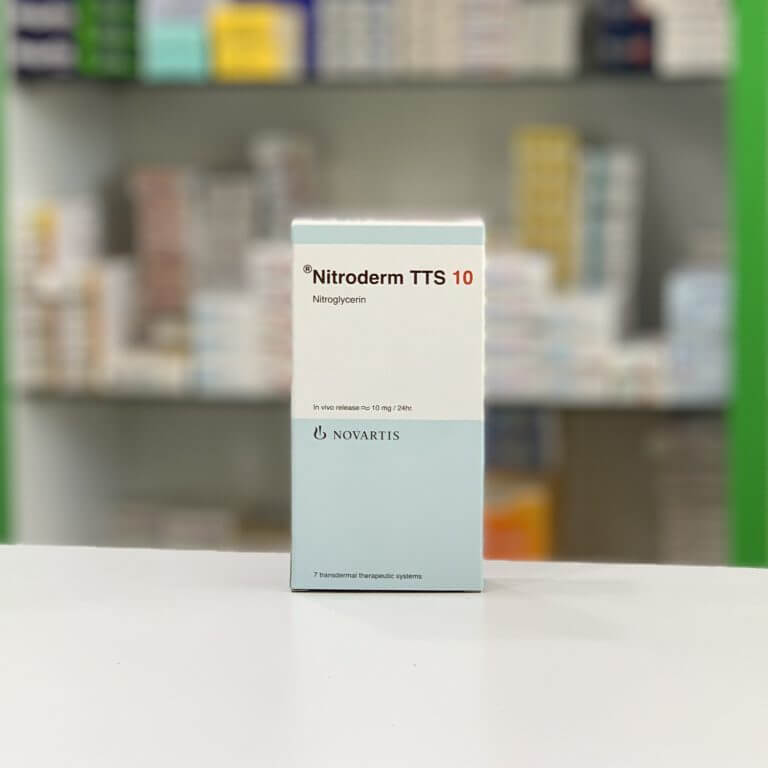
Nitroderm TTS 10 mg/24 h 7 patches
Composition:
Nitroderm®TTS 10 patches contain 50 mg nitroglycerin and have a contact surface of 20 square cm that releases approximately 10 mg nitroglycerin in 24 hours.
Inactive ingredients:
Lactose, silica oil, silica aerogel, ethylene va copolymer, silicone medical adhesive
Properties:
Nitroderm®TTS is an adhesive patch that delivers a medicine called nitroglycerin through the skin and into the bloodstream.
Nitroderm®TTS is used to prevent or reduce the frequency of angina attacks (chest pain or discomfort).
Nitroderm®TTS is also used as a supplementary medicine for the treatment of patients suffering from heart failure who do not respond adequately to conventional therapy.
Nitroderm®TTS belongs to a group of medicines called nitrates. Nitrates work by widening blood vessels, letting more blood and oxygen reach the heart.
Dosage and administration:
-Your doctor may start your treatment with one Nitroderm®TTS 5 patch each day for several days and then change to the larger Nitroderm®TTS 10 patch. The usual dose for most people is one Nitroderm®TTS 10 patch each day, although some people may need more or less.
-You will normally apply a patch once each day, usually in the morning. Your doctor will likely ask you to take the patch off for 8 to 12 hours out of every 24 hours (e.g. take it off at bedtime and put a new one on
when you wake up in the morning).
This “patch off” period may make the medicine more effective.
-How to apply the patch:
A leaflet in the cardboard carton contains pictures showing how to apply the patch properly. Follow these steps to apply a patch to your skin.
- Choose an area of skin. The best place is your chest but you may use any area except below your knees or elbows. Choose an area of skin that has no sores, cuts or rashes. If the skin is very hairy, you can clip the hair (do not shave it) so that the patch sticks well and won’t be hard to remove. Use a different area of skin each day. Wait several days before using the same area again.
- Make sure the skin is clean, cool, dry and free from creams, lotions or oils. You may need to wash the area with soap and water and dry it completely. After a shower or bath, wait a few minutes before applying the patch to make sure your skin is completely cool and dry. You may use body lotion or bath oil after the patch has been applied.
- Open the sachet that contains the patch: Tear open the sachet at the notch and remove the patch. Do not use scissors because you may accidentally cut the patch and the medicine may leak out.
- Remove the protective film from the sticky side of the patch.
- Apply the patch to the skin as soon as you have removed the film:
- Press the patch firmly in place you have chosen with the palm of your hand for 10 to 20 seconds. The patch needs the pressure and heat of your hand to stick well. Check that the patch has stuck by running your finger around the edge. Do not try to lift the edge of the patch to see if it has stuck.
-How to remove the patch
- Use the little tab to pull the patch away from your skin.
- Fold the old patch in half with the sticky side inwards.
- Throw the old patch away safely out of the reach of children. The patch still contains some leftover medicine that could harm a child.
- Remove any stickiness from the skin with soap.
- If the new patch falls off, throw the patch away. Apply a new patch to a different area of clean, dry skin.
-Bathing, swimming, showering or exercising will usually not affect the patch if it has been correctly applied.
-If the patch irritates your skin, check that water has not gotten under the patch. If it has, remove the patch and apply a new one to a different area. Try a less sensitive area, for example your upper arm.
-Use Nitroderm®TTS for as long as your doctor tells you to. Otherwise, you may not get relief from your attacks of angina. Try not to miss any doses and use the medicine even if you feel well.
-Do not stop using Nitroderm®TTS suddenly. Stopping this medicine suddenly may bring on attacks of angina, especially if you have been using it for several weeks or more. If you want to stop using it, your doctor will tell you how to do it gradually.
-If you forget to use it:
If it is almost time to apply your next patch, skip the one you missed and apply the next patch when you are meant to.
Do not use a double dose to make up for the one that you missed.
This may increase the chance of you getting an unwanted side effect.
-If you use too much:
Remove the patch. Immediately telephone your doctor.
Some of the symptoms of an overdose may include fast heartbeat, dizziness, light-headedness or fainting, especially when you get up quickly from a sitting or lying position. This is because your blood pressure is too low.
Side effects:
Tell your doctor if you notice any of the following and it disturbs you: headache, dizziness or lightheadedness, sometimes accompanied by a fast heart beat, especially when getting up suddenly, itching or burning under the patch, reddening of the skin after the patch has been taken off, flushing of the face, nausea (feeling sick) or vomiting, signs of allergy such as rash, swelling of the face, lips, tongue or other parts of the body; shortness of breath, wheezing or troubled breathing, chest pains that are not relieved by taking your usual medicine for treating angina attacks.
Contraindications:
-allergy to nitroglycerin (the active ingredient) or any of the other ingredients, or food containing nitrates or nitrites
-severe anaemia
-glaucoma or raised pressure in the eye from any cause increased pressure in the head from any cause (stroke, tumor, head injury)
-Disease in the valves of your heart or inflammation of your heart.
-intake of Viagra or Levitra together with Nitroderm®TTS (your blood pressure may fall to a dangerously low level).
Warnings and precautions:
- Tell your doctor if you have any of the following medical conditions: recent heart attack, stroke or head injury, heart problems or a blood vessel disorder other than angina, low blood pressure, problems with your lungs, problems with your liver
- Tell your doctor if you are pregnant or breast-feeding. This medicine may affect your baby if you use it while you are pregnant or breast-feeding.
- If you become pregnant while taking Nitroderm®TTS, tell your doctor immediately. You doctor can discuss with you the risks of using it while you are pregnant.
- Tell your doctor if you are allergic to any other medicines, foods, dyes or preservatives.
- Tell your doctor if you are taking any other medicines, including any that you buy without a prescription from a pharmacy, supermarket or health food shop, other medicines for angina medicines for high blood pressure or heart problems, diuretic medicines, some medicines used to treat depression called tricyclic antidepressants, medicines for mental disorders; dihydroergotamine, acetylsalicylic acid (aspirin), medicines used to treat inflammation called non-steroidal anti-inflammatory drugs (NSAIDs).
- Tell your doctor if you continue to have angina attacks or if they become more frequent or severe while you are using Nitroderm®TTS. Keep a record of the number of attacks, when they happen and the possible cause (for example, during exercise or during the period when the patch is off). This helps your doctor give you the best possible treatment.
- If you are about to be started on any new medicine, remind your doctor that you are using Nitroderm®TTS.
- Before any surgery, hospital admission, emergency unit visit, or imaging procedure, inform all doctors and nurses that you are wearing a Nitroderm®TTS patch which contains an aluminum layer.
- Do not use Nitroderm®TTS to relieve an attack of angina. This medicine will not relieve an attack of angina once it has started.
- Do not give this medicine to anyone else, even if their condition seems similar to yours.
- Be careful driving, operating machinery or doing jobs that require you to be alert until you know how Nitroderm®TTS affects you. This medicine may cause dizziness, fainting or blurred vision in some people, especially when you first start to use it or if the dose is increased.
- Be careful when drinking alcohol while you are using Nitroderm®TTS.
Your blood pressure may drop, making you feel dizzy or faint.
- If this medicine makes you feel light-headed, dizzy or faint, be careful when getting up from a sitting or lying position.
- Use extra care when exercising, driving or standing for long periods, especially in hot weather.
- Be careful not to overdo physical activities when you start using Nitroderm®TTS.
- Do not store Nitroderm®TTS or any other medicine in the bathroom or near a sink.
- Do not leave it in the car or on window sills.
Storage:
Store at a temperature not exceeding 30°C, in a cool dry place, but not in the freezer.
Package:
Carton box holds 7 patches and insert leaflet
 Русский
 English
 عربي
عربي