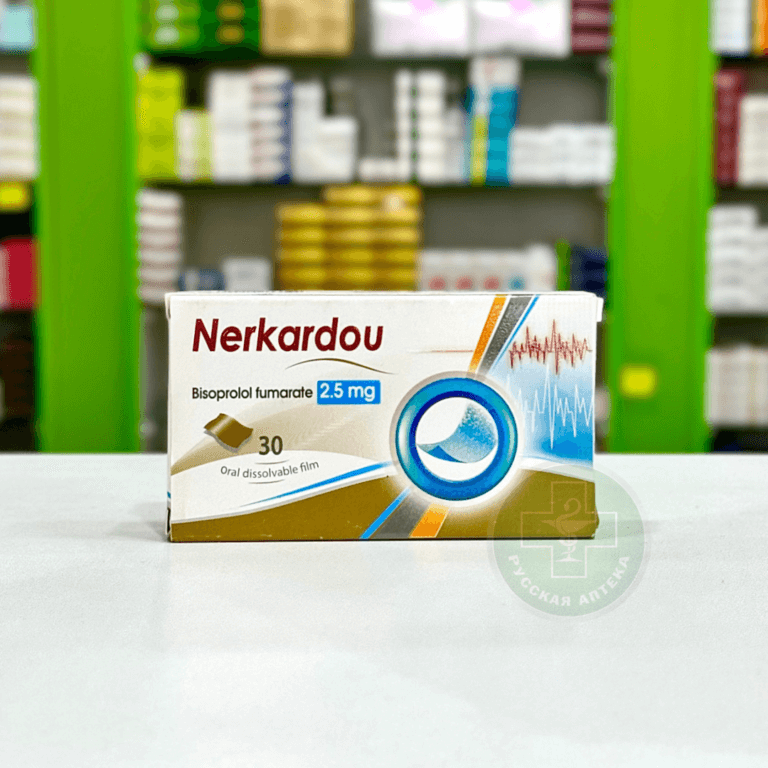
Nerkardou 2,5 mg 30 dissolvable films
Description:
Nerkardou has launched the first rapidly dissolving pressure and heart medication to be placed on the tongue.
A treatment that belongs to beta-blocker inhibitors, and it also has an effect on the adrenergic receptors, reduces the pumping power of the heart, makes the heartbeat more regular, and causes the relaxation and widening of blood vessels, thus lowering blood pressure.
Composition:
Narcardou contains bisoprolol fumarate in concentrations of 2.5 mg
Other ingredients:
Polyvinyl Alcohol PEG-1000, Rice Starch, Glycerol Sucralose, PEG-400, Sunset Yellow
Menthol, Orange Oil, Simethicone 30% Emulsifier.
Properties:
Nercardou belongs to the group of drugs that are referred to as beta-blockers. They protect against hypercardiac activity.
Indications:
High blood pressure
Angina (pain in the heart)
Heart failure causes shortness of breath when exerting exertion or fluid retention. In this case, nercado may be given as an additional treatment to other medications used for heart failure.
Contraindications:
– You are allergic to bisoprolol fumarate or any of the other ingredients of this medicine.
– If you suffer from cardiogenic shock, a serious heart condition that leads to a rapid
and weak pulse, low blood pressure, feeling cold, damp skin, weakness and fainting.
– If your heart rate is slow (less than 60 beats per minute). Ask your doctor if you’re not sure.
– If you have very low blood pressure.
– If you have severe circulatory problems (which may cause tingling of your fingers and
toes or turn blue or pale).
– If you have serious heart rhythm problems.
– If you have heart failure that has just occurred or is not stable and requires hospitalization.
– If you have an adrenal tumor known as an untreated pheochromocytoma.
Caution & Warnings:
– Talk to your doctor before taking bisoprolol
– This medicine has been prescribed to you just don’t pass it on to others that may
harm them, even if their symptoms are the same as yours. If you experience any side
effects, talk – to your doctor or pharmacist including any potential side effects not
listed in this leaflet see section.
– If you have wheezing or difficulty breathing (asthma), bronchodilator therapy should
be given simultaneously. A higher dose of beta steroids may be needed.
– If you have diabetes. Tablets can mask symptoms of low blood sugar (such as rapid heartbeat, heart palpitations, or sweating).
– If you are being treated for hypersensitivity reactions (allergies). Bisoprolol may
increase hypersensitivity to substances you are allergic to and increase the severity of hypersensitivity reactions.
– Adrenaline therapy may not produce the desired result. A higher dose of adrenaline
(epinephrine) may be required.
– If you have Prinzmetal angina which is a type of chest pain caused by narrowing of the coronary arteries that supply the heart muscle.
– If you have any problems with blood circulation to the extremities of the body such as hands and feet.
– In the case of surgery involving the use of an anesthetic If you consult a doctor or go to the hospital or dentist for surgery that involves anesthesia, tell them what medications you are taking.
– If you have (or) have psoriasis (a recurrent skin disorder that includes flaking and a dry rash).
– If you have a thyroid problem. Tablets can mask the symptoms of hyperthyroidism.
– Treatment with Nercardo should not be stopped abruptly except for compelling reasons.
– For patients with high blood pressure, angina and associated heart failure, the drug
should not be abruptly discontinued, so the dose should be reduced slowly by halving the weekly dose.
Drug interactions with Nercardou:
Always tell your doctor if you are using or receiving any of the following medicines in addition to Nercardou:
– Blood pressure control medications or heart problems such as (amiodarone, amlodipine, clonidine, digitalis glycosides, diltiazem, disopyramide, felodipine, fliquinide, lidocaine, methyldopa, moxonidine, phenytoin, propafenone, quinidine, realmenidine, verapamil)
– Sedatives and treatments for psychosis (mental illness) e.g. barbiturates (also used
for epilepsy), phenothiazines (also used for vomiting and nausea).
– Medications to treat depression such as tricyclic antidepressants, MAO-A inhibitors
– Some painkillers such as acetylsalicylic acid, diclofenac, indomethacin, ibuprofen, naproxen).
– Medications for asthma, nasal obstruction or certain eye disorders such as glaucoma
(increased pressure in the eye) or dilation (dilation) of the pupil of the eye
– Certain medications for the treatment of shock (e.g. epinephrine, dobutamine, noradrenaline).
– Mefloquine is a drug for malaria.
– Antibiotic rifampicin
– Ergotamine derivatives for migraines.
All of these medications as well as Nercardou may affect blood pressure and/or heart function.
Pregnancy and breastfeeding:
– If you are pregnant, breastfeeding, think you are pregnant or plan to have a baby, consult your doctor before taking this medicine. Narcardo may be harmful to pregnancy and/or unborn baby. There is an increased likelihood of premature birth, miscarriage, low blood sugar and a low heart rate in the baby.
– The child’s development may also be affected. Therefore, Nercardou should not be taken during pregnancy.
– It is not known whether Nercardo is excreted in breast milk and is therefore not recommended during breastfeeding.
Driving and using machines:
This medicine may make you feel tired, sleepy or dizzy. If you experience these side effects, do not operate vehicles and/or machines.
How to Use:
Always take this medicine exactly as your doctor or pharmacist told you. Consult your doctor or pharmacist if you are not sure. Your doctor will tell you how many films to take. This medicine should be taken in the morning, before or after breakfast with it.
Narcardo is a fast soluble oral film intended for oral use and taken without water. Nercardo may be taken with water if you wish.
It should be applied to the tongue where it quickly dissolves.
Instructions on how to take:
Important: Do not take instant films with wet hands.
1.Hold the cover, mark the arrow mark on the top sides and hold the cover so that this side faces up.
2.Gently peel both sides of the casing to separate them at the arrow marker. You can now hold each side between your thumb and forefinger using one hand for each part.
3.Remove the rapidly dissolving film with dry fingers from the coating and place it in your mouth directly on your tongue. It will dissolve quickly. Water can be used if you wish.
Dosage:
Use in cases of hypertension / angina pectoris
Adult:
The dosage is determined individually.
The recommended starting dose is 2,5 mg- 5 mg once daily.
The usual dose for adults is 10 mg once daily. Your doctor may decide to increase or decrease the dose.
The maximum dose is 20 mg once daily.
Use in case of severe kidney disorders or liver function:
If you have a severe kidney disorder or severe liver function disorder, the maximum dose is 10 mg per day.
Seniors:
Dosage adjustment is usually not required and your doctor will start treatment at the lowest possible dose.
The dose will be increased gradually until the appropriate dose is reached for you:
1.25 mg once daily for a week.
If this is well tolerated, the dose may be increased to 2.5 mg once daily for the following week.
If this is well tolerated, the dose can be increased to 3.75 mg once daily over the following week.
If this is a hand tolerant, the dose may be increased to 5 mg once daily for the next four weeks.
If this is a hand of tolerance, the dose may be increased to 7.5 mg once daily for the next four weeks.
If this hands endure, the dose may be increased to 10 mg once daily as a permanent dose.
The maximum dose is 10 mg once daily.
Use in children and adolescents:
There is no experience with Nercardou in children and adolescents, so its use in children is not recommended.
Symptoms of overdose may include:
Dizziness, mild dizziness, fatigue, shortness of breath and/or wheezing, there may also be a
drop in heart rate, low blood pressure, insufficient heart functioning and low blood sugar
level which may include feeling hungry, sweating and palpitations.
The most serious side effects are related to heart function:
Slowing heart rate (may affect more than 1 in 10 people)
Exacerbation of pre-existing heart failure (may affect up to 1 in 10 people)
Slow or irregular heartbeat (may affect up to 1 in 100 people)
If you feel dizzy or weak, or have breathing difficulties, please contact your doctor as soon as possible.
You should see a doctor immediately if you experience more severe allergic reactions, which
may include swelling of the face, neck, tongue, mouth or throat, or difficulty breathing.
More side effects are listed below according to how often they occur:
Common:
– Dizziness, weakness and fatigue, headache
– Feeling of coldness or numbness in the extremities of the fingers or toes, ears and nose), pain similar to cramps in the legs and more frequent when walking.
– Very low blood pressure (low blood pressure), especially in patients with heart failure.
– Feeling nauseous, vomiting.
– Diarrhea
– Constipation
Uncommon can appear in up to 1 in 100 people:
– Overheating This side effect is most commonly found in the treatment of heart failure.
– Low blood pressure when standing, which may cause dizziness, lightness of the head or fainting
– Sleep disorders
– Depression
– Patients with asthma or a history of breathing problems may have difficulty breathing
– Arrhythmia
– Muscular weakness and muscle spasms.
Rare can occur in up to 1 in 1,000 people:
– Inflammation of the lining of the nose causes a runny nose with irritation
– Allergic reactions to the skin such as (itching, redness, rash).
– Dry eyes from lack of tear flow (which can be very annoying if you use contact lenses)
– Hepatitis causes abdominal pain, loss of appetite and sometimes jaundice with
yellowing of the whites of the eyes, skin and dark urine.
– Decreased sexual performance (disorder of sexual ability)
– High levels of lipids in the blood (triglycerides) and liver enzymes.
– Very rare can occur in up to 1 in 10,000 people
– Exacerbation of psoriasis or causing similar dry, scaly rashes and hair loss
– Itching or redness of the eye conjunctivitis.
If you experience any side effects, talk to your doctor, pharmacist or nurse including any
potential side effects not listed in this leaflet.
Storage:
Keep out of reach of children.
Store at a temperature not exceeding 30°C and in a dry place
Do not use this medicine after the expiration date stated on the packaging and box after the
expiration date to the last day of that month.
Package:
A carton box contains 30 oral dissolvable film
 Русский
 English
 عربي
عربي