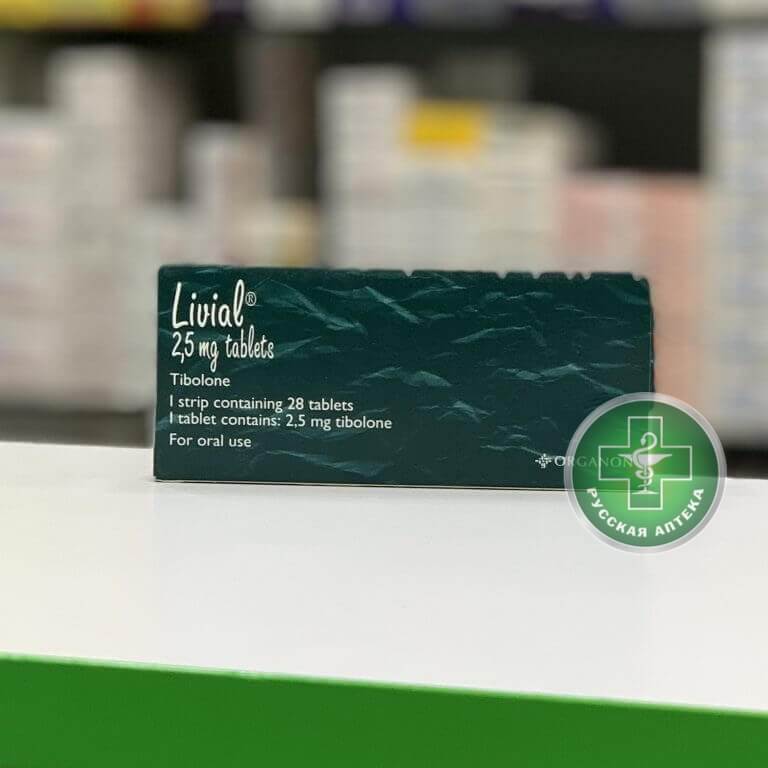
Livial 2.5 mg 28 tablets
Composition:
Each tablet contains:
Tibolone 2.5 mg
Inactive ingredients:
potato starch
lactose
ascorbyl palmitate
magnesium stearate
Properties:
Livial tablets contain the active ingredient tibolone, which is a synthetic steroid medicine used for hormone replacement therapy (HRT).
It mimics the activity of the female sex hormones in the body.
Tibolone has favorable effects on different organs in the body, such as the brain, vagina and bone. Livial is used in postmenopausal women at least 12 months after their last natural period.
Indications:
- Relief of symptoms occurring aftermenopause.
During the menopause, the amount of estrogen produced by a woman’s body drops. This can cause symptoms such as hot face, neck and chest (“hot flushes”). Livial alleviates these symptoms after menopause. You will only be prescribed Livial if your symptoms seriously hinder your daily life.
- Prevention of osteoporosis.
After the menopause some women may develop fragile bones (osteoporosis). You should discuss all available options with your doctor.
If you are at an increased risk of fractures due to osteoporosis and other medicines are not suitable for you, you can take Livial to prevent osteoporosis after menopause.
- Livial is not a contraceptive.
Dosage and administration:
- Livial should not be taken until 12 months after your last natural menstrual bleed. If Livial is taken sooner than this, the chance of irregular vaginal bleeding may be increased.
- Women who have undergone premature menopause (surgical removal of ovaries) can start taking Livial immediately.
- If you are already using a different type of HRT, your doctor will advise you when to switch to Livial.
- Take Livial exactly as directed by your doctor.
- Take one tablet daily, at about the same time each day. Swallow the tablet with some water or other non-alcoholic drink.
- The strips with Livial are marked with the days of the week. Start by taking the tablet marked with that day. For example, if it is Monday, take a tablet marked Monday on the upper row of the strip. Follow the days of the week until the strip is empty. Start the next strip the next day.
Do not take a break between strips or packs.
- Livial should be prescribed at the lowest effective dose and for the shortest duration necessary. Your doctor can advise you how long you may need to take Livial.
- If you forget to take a tablet, take it as soon as you remember, unless you are more than 12 hours late. If you are more than 12 hours late, skip the dose you missed and take your next dose when you are meant to.
Do not take a double dose to make up for the forgotten dose.
- If you have taken more tablets than you have been prescribed, immediately telephone your doctor.
Signs of an overdose may include feeling sick or vomiting. Vaginal bleeding may also occur after a few days.
- Tell your doctor and your surgeon that you are taking Livial if you are going to have surgery.
You may need to stop taking Livial about 4-6 weeks before the operation to reduce the risk of a blood clot. Ask your doctor when you can start taking Livial again.
Side effects:
Allergic reaction may include:
-shortness of breath;
-wheezing or troubled breathing;
-swelling of the face, lips, tongue or other parts of the body;
-rash, itching or hives on the skin.
If any of the above conditions appear for the first time while taking Livial, stop taking it at once and consult your doctor immediately.
Common:
-vaginal bleeding or spotting;
-abdominal pain;
-weight gain;
-breast pain;
-unnatural hair growth;
-vaginal symptoms, such as discharge, itching, and irritation.
Uncommon:
-acne
Others:
-dizziness, headache, migraine;
-depression;
-rash or itching;
-visual disturbances;
-gastrointestinal upset;
-fluid retention;
-joint pain, muscle pain;
-changes in liver function;
-gall bladder disease;
-various skin disorders;
-discolouration of the skin, especially of the face or neck known as “pregnancy
patches” (chloasma);
-painful reddish skin nodules (erythema nodosum);
-rash with target-shaped reddening or sores (erythema multiforme).
Contraindications:
Do not take Livial if:
-you are pregnant or think you may be pregnant;
-you are breastfeeding;
-you have or have ever had breast cancer, or if you are suspected of having it;
-you have cancer which is sensitive to oestrogens, such as cancer of the womb lining (endometrium), or if you are suspected of having it;
-you have any unexplained vaginal
bleeding;
-you have excessive thickening of the womb lining (endometrial hyperplasia) that is not being treated;
-you have or have ever had a blood clot in a vein (thrombosis), such as in the legs (deep venous thrombosis) or the lungs (pulmonary embolism);
-you have a blood clotting disorder (such as protein C, protein S, or antithrombin deficiency);
-you have or recently have had a disease caused by blood clots in the arteries, such as a heart attack, stroke or angina;
-you have or have ever had liver disease and your liver function tests have not returned to normal;
-you have a rare blood problem called porphyria which is passed down in families (inherited);
-you are allergic (hypersensitive) to tibolone or any of the ingredients of this medicine.
Warnings and precautions:
- It is unknown if Livial causes blood clots called deep vein thrombosis. Inform your doctor if any of these situations apply to you:
-you are pregnant or recently had a baby;
-you use estrogens;
-you are unable to walk for a long time, because of major surgery, injury or illness;
-you are seriously overweight;
-you have any blood clotting problem that needs long-term treatment with a medicine used to prevent blood clots;
-if any of your close relatives has ever had a blood clot in the leg, lung or another organ;
-you have systemic lupus erythematosus (SLE, a disease of your immune system);
-you have cancer.
- See a doctor as soon as possible and do not take any more Livial until your doctor says you can if you get any unexplained migraine-type headaches with or without disturbed vision. These headaches may be an early warning sign of a stroke.
- See a doctor as soon as possible and do not take any more Livial if you get a pain in your chest that spreads to your arm or neck. This pain could be a sign of heart disease.
- Tell your doctor if you have ever had any of the following conditions before you start the treatment, as these may return or become worse during treatment with Livial. If so, you should see your doctor more often for check-ups:
-fibroids inside your womb;
-growth of the womb lining outside your womb (endometriosis) or a history of excessive growth of the womb lining (endometrial hyperplasia);
-increased risk of developing blood clots;
-increased risk of getting an estrogen-sensitive cancer (mother, sister or grandmother who has had breast cancer);
-high blood pressure;
-a liver disorder, such as a benign liver tumor;
-diabetes;
-gallstones;
-migraine or severe headaches;
-a disease of the immune system that affects many organs of the body (systemic lupus erythematosus, SLE);
-epilepsy;
-asthma;
-a disease affecting the eardrum and hearing (otosclerosis);
-a very high level of fat in your blood (triglycerides);
-fluid retention due to cardiac or kidney problems;
-a large rise in your blood pressure (symptoms may be headache, tiredness, dizziness);
-migraine-like headaches which happen for the first time;
-if you become pregnant;
-if you notice signs of a blood clot, such as: painful swelling and redness of the legs, sudden chest pain, difficulty in breathing.
- There have been reports and studies of an increased cell growth or cancer of the lining of the womb in women using Livial. The risk of cancer of the lining of the womb increases with the duration of use.
- You may have irregular bleeding or drops of blood (spotting) during the first 3-6 months of taking Livial.
- See your doctor as soon as possible if the irregular bleeding:
-carries on for more than the first 6 months;
-starts after you have been taking Livial for more than 6 months;
-carries on after you have stopped taking Livial.
- Taking estrogen, estrogen-progesterone combined HRT or Livial for several years slightly increases the risk of breast cancer.
The risk increases with the duration of HRT use and returns to normal within about 5 years after stopping HRT.
- Regularly check your breasts. See your doctor if you notice any changes such as:
-dimpling or sinking of the skin;
-changes in the nipple;
-any lumps you can see or feel.
- Tell your doctor if you react badly to lactose or milk before you start taking Livial. Livial tablets contain lactose.
- Tell your doctor if you are taking any other medicines, including medicines that you get without a prescription, herbal medicines or other natural products.
Some medicines may interfere with the effect of Livial:
This applies to the following medicines:
-medicines against blood clotting (such as warfarin);
-medicines for epilepsy (such as phenobarbitone, phenytoin and carbamazepine);
-medicines for tuberculosis (such as rifampicin);
-herbal remedies containing St. John’s Wort (hypericum perforatum).
- Ask your doctor or pharmacist for advice before taking any medicine.
- Livial has no effect on alertness and concentration as far as is known.
- Keep out of reach of children.
Storage:
Store in the original package at a temperature not exceeding 25°C.
Package:
Carton box holds 1 strip containing 28 tablets and paper instructions.
 Русский
 English
 عربي
عربي