Русский
 English
 عربي
عربي
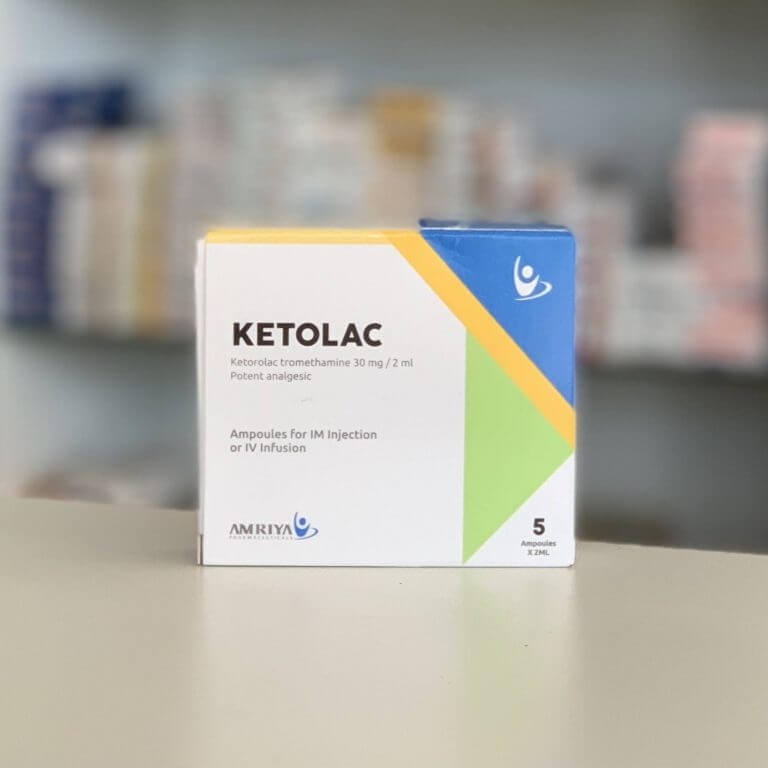
Ketolac 30 mg/2 ml 5 ampoules
60£
View analogs- Moderate to severe pain: trauma, dental pain, postoperative pain, oncological diseases
- Myalgia, arthralgia, neuralgia, radiculitis
- Dislocations, sprains
- Rheumatic diseases Intended for symptomatic therapy to reduce pain and inflammation; does not affect disease progression.
Buy
Product quantities
Form of Release: Ampoules
Product Brand:
Amriya for Pharmaceutical Industries S.A.E
About the brand
Product Categories: Painkillers, anti-inflammatory • Nonsteroidal anti-inflammatory drugs


Ketolac 30 mg/2 ml 5 ampoules
Composition:
Ketorolac tromethamine — 30 mg (per 2 ml ampoule).
Excipients:
Sodium chloride, Disodium edetate, Water for injections.
Product Description:
Ketolac is a non‑steroidal anti‑inflammatory drug (NSAID) with strong analgesic properties.
It also has anti‑inflammatory and moderate antipyretic effects.
Ketolac does not act on opioid receptors, does not depress respiration, does not cause drug dependence, and has no sedative or anxiolytic effects.
Its analgesic efficacy is comparable to morphine and significantly exceeds other NSAIDs.
After intramuscular administration, onset of analgesia occurs within 30 minutes, with maximum effect reached in 1–2 hours.
Indications for use:
- Moderate to severe pain: trauma, dental pain, postoperative pain, oncological diseases
- Myalgia, arthralgia, neuralgia, radiculitis
- Dislocations, sprains
- Rheumatic diseases Intended for symptomatic therapy to reduce pain and inflammation; does not affect disease progression.
Method of administration and dosage:
- Administer deeply intramuscularly or slowly intravenously (at least 15 seconds).
- Single dose:
Adults under 65 years — 10–30 mg depending on pain severity;
elderly patients over 65 years or with renal impairment — 10–15 mg. - Multiple doses:
Adults under 65 years and children over 16 years — 10–60 mg initially, then 10–30 mg every 6 hours (typically 30 mg);
elderly patients over 65 years or with renal impairment — 10–15 mg every 4–6 hours. - If necessary, opioid analgesics may be co‑administered in reduced doses.
Contraindications:
- Bronchial asthma, nasal/sinus polyposis, intolerance to aspirin or other NSAIDs.
- Urticaria, rhinitis induced by NSAIDs.
- Intolerance to pyrazolone derivatives.
- Dehydration, hypovolemia.
- Active bleeding or high risk of bleeding.
- Post‑coronary artery bypass graft surgery.
- Confirmed hyperkalemia.
- Inflammatory bowel disease.
- Active erosive or ulcerative gastrointestinal lesions, peptic ulcers.
- Hypocoagulation.
- Severe renal insufficiency.
- Severe hepatic insufficiency or active liver disease.
- Hemorrhagic stroke, hemorrhagic diathesis.
- Hematopoietic disorders.
- Pregnancy, labor, lactation.
- Children under 16 years.
Precautions:
To reduce risk of NSAID‑induced gastropathy, antacids, misoprostol, or omeprazole may be prescribed.
Side effects:
Central nervous system:common — headache, dizziness, drowsiness
Digestive system:common — gastralgia, diarrhea (especially in elderly patients with GI ulcer history); less common — stomatitis, flatulence, constipation, vomiting, gastric fullness
Pregnancy and lactation:
Contraindicated during pregnancy, labor, and breastfeeding.
Storage conditions:
Store at temperatures not exceeding 30 °C.
Packaging:
Carton box contains 5 ampoules of 2 ml and an instruction leaflet.
Tags, Keywords:
- pain
- sore throat
- sore throat in adults
- stomach pain
- stomach pain
- wrist pain
- hand pain
- hand pain
- intestinal pain
- knee pain
- knee pain
- muscle pain
- musculoskeletal pain
- shoulder pain
- lower back pain
- oral pain
- ligament pain
- back pain
- Joint pain
- joint pain
- ear pain
- neck pain
- arthritis pain
- trauma pain
- bruising pain
- headache
- toothache
- toothache and headache
- muscle pain
- analgesic
- Analgesic
- anesthetics
- fever
- antipyretic
- fever
- anti-inflammatory
- anti-inflammatory drug
- anti-inflammatory drugs
Active Ingredients:
No comments yet. Be the first to write one.
Your comment will be published after moderation.
You’ll receive a notification to your email when someone replies.