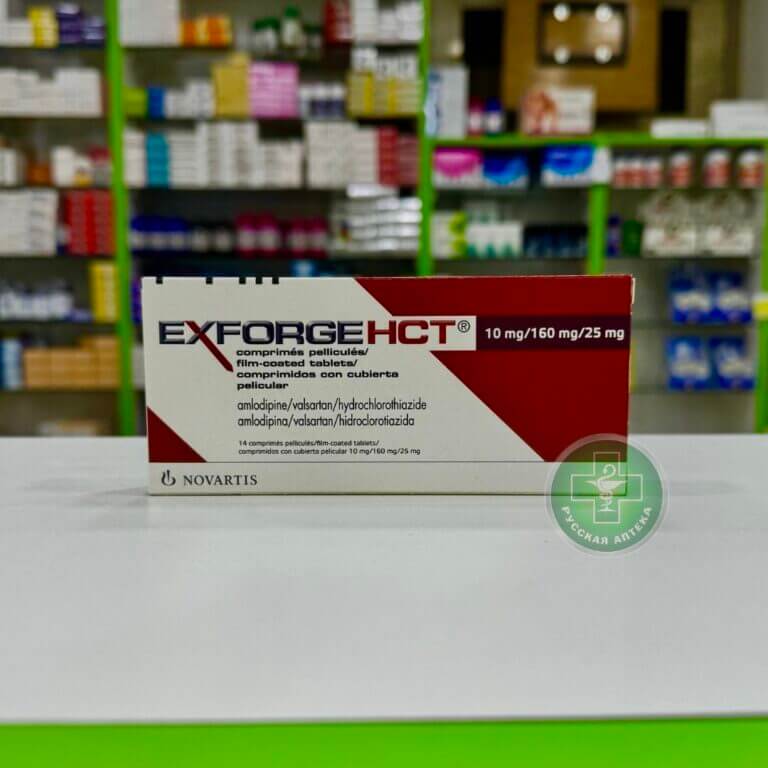
Exforge HCT 10/160/25 mg 14 tablets
Composition
Each tablet contains:
10 mg of amlodipine (as 13.87 mg amlodipine besylate),
160 mg of valsartan,
25 mg of hydrochlorothiazide.
Description
Exforge HCT is a combination antihypertensive medication that includes a calcium channel blocker (amlodipine), an angiotensin II receptor antagonist (valsartan), and a thiazide diuretic (hydrochlorothiazide). This combination offers additive blood pressure reduction via complementary mechanisms: vasodilation, suppression of the renin-angiotensin system, and enhanced diuresis.
Indications for Use
Treatment of essential hypertension in adult patients whose blood pressure is adequately controlled with the combination of amlodipine, valsartan, and hydrochlorothiazide, taken either as three single-component formulations or as a dual-component and a single-component formulation.
Dosage and Method of Administration
Recommended dose: one tablet per day, preferably in the morning.
Patients should be stabilized on the individual components before switching to Exforge HCT.
Maximum recommended dose: 10 mg/320 mg/25 mg.
Oral use, with water, with or without food.
Certain strengths may not be available in all countries.
Special populations:
-Renal impairment: contraindicated in severe renal impairment (GFR <30 ml/min/1.73 m²), anuria, or dialysis.
-Hepatic impairment: contraindicated in severe hepatic impairment or cholestasis. In mild/moderate impairment, max. valsartan dose is 80 mg.
-Elderly (≥65 years): caution advised, with closer monitoring.
-Paediatric population (<18 years): not indicated.
Contraindications
-Hypersensitivity to active substances, sulphonamide derivatives, dihydropyridine derivatives, or excipients.
-Pregnancy.
-Severe hepatic impairment, biliary cirrhosis, cholestasis.
-Severe renal impairment, anuria, dialysis.
-Concomitant use with aliskiren-containing products in diabetic patients or with renal impairment (GFR <60 ml/min/1.73 m²).
-Refractory hypokalaemia, hyponatraemia, hypercalcaemia, symptomatic hyperuricaemia.
-Severe hypotension, shock (including cardiogenic), left ventricular outflow obstruction, hemodynamically unstable heart failure after myocardial infarction.
Precautions
-Excessive hypotension may occur in sodium- and/or volume-depleted patients.
-Monitor serum electrolytes (especially potassium, sodium, magnesium), particularly in renal impairment or with concomitant medications.
-Avoid concomitant use with potassium supplements or potassium-sparing drugs.
-Hydrochlorothiazide may induce or worsen hypokalaemia or hyponatraemia.
-Renal function should be monitored during treatment.
-Use with caution in renal artery stenosis or post-kidney transplant.
-In hepatic impairment, valsartan exposure increases; use lowest dose of amlodipine when applicable.
Side Effects
Immune system:
Hypersensitivity
Metabolism: Anorexia, hypercalcemia, hyperglycemia, hyperlipidemia, hyperuricemia, hypokalemia, hypomagnesemia, hyponatremia
Psychiatric: Depression, insomnia, mood swings, confusion
Nervous system: Dizziness, headache, tremor, somnolence, paresthesia, syncope, ataxia
Sensory organs: Visual disturbances, choroidal effusion, tinnitus, vertigo
Cardiovascular: Arrhythmias, tachycardia, bradycardia, edema
Skin: Rash, photosensitivity, Stevens-Johnson syndrome, toxic epidermal necrolysis
Musculoskeletal: Arthralgia, myalgia, muscle weakness, spasms
General: Fatigue, malaise, fever
Laboratory findings: Increased lipids, blood urea, uric acid, glycosuria, altered potassium levels
Pregnancy and Breastfeeding
Contraindicated during pregnancy. Not recommended during breastfeeding.
Storage Conditions
Store below 30 °C. Protect from moisture.
Packaging
Carton box contains blisters and a package insert.
 Русский
 English
 عربي
عربي