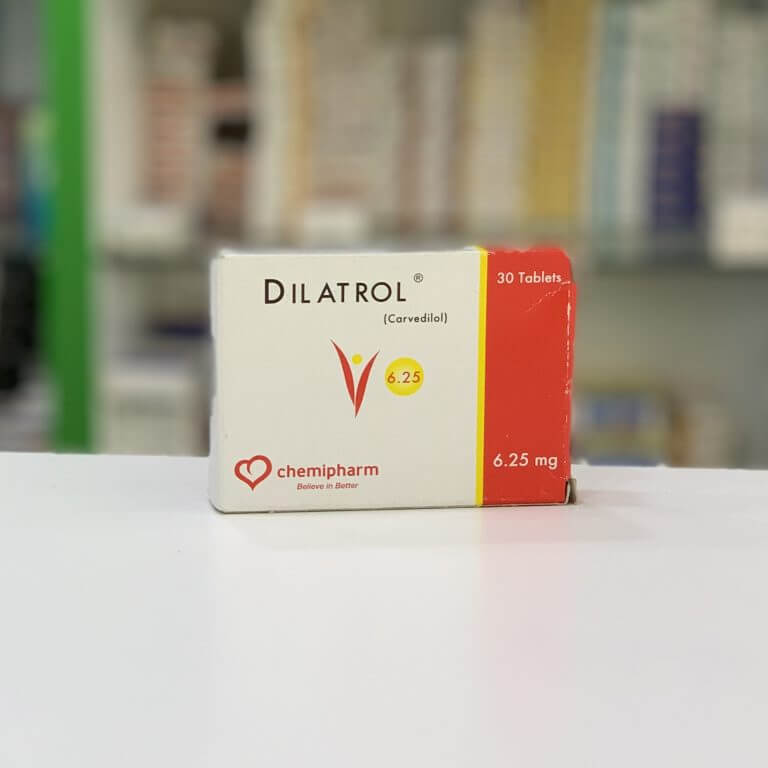
Dilatrol 6.25 mg 30 tablets
Composition:
Each tablet contains:
Carvedilol 6.25mg.
Properties:
Carvedilol is a cardioprotective non-cardioselective drug that blocks the beta-adrenergic receptor (beta-blocker), which has an arteriolar vasodilating effect by blocking the alpha-1 receptor and thus reduces peripheral resistance.
Indications:
-hypertension;
-angina pectoris;
-chronic heart failure;
-left ventricular dysfunction after acute myocardial infarction.
Dosage and administration:
Hypertension: initial dose of 12.5 mg 1 time per day or individually increased after 3 days to the usual dose of 25 mg 1 time per day.
If necessary, may be further increased at intervals of at least 7-14 days to a maximum daily dose of 50 mg administered once daily or in divided doses. The effect appears within 7-14 days.
Angina pectoris: Start with 12.5 mg 2 times a day, increase after 2 days to 25 mg 2 times a day.
Heart failure: Dosage must be prescribed by a physician. The recommended starting dose is 3.125 mg twice daily for 2 weeks. If tolerated by patients, the dose can be increased to 6.25, 12.5 and 25 mg 2 times a day at consecutive intervals of at least 2 weeks. The maximum dose of 50 mg 2 times a day is prescribed for patients with mild to moderate heart failure weighing more than 85 kg.
Left ventricular dysfunction after myocardial infarction. The dosage is prescribed by the doctor.It is recommended to start at 6.25 mg twice daily and increase after 3-10 days, based on tolerability, to 12.5 mg twice daily and then again to the target dose of 25 mg twice daily. You can use a lower starting dose (3.125 mg 2 times a day).
Contraindications:
-Hypersensitivity to carvedilol or any component of the product. -Unstable/decompensated heart failure. -Manifested dysfunction of the liver. -Severe bradycardia (<50 beats per minute) and hypotension (systolic blood pressure <85 mmHg).
-Sick sinus syndrome (including sinoatrial block).
-Cardiogenic shock.
-Bronchial asthma.
-Pregnancy and lactation.
Warnings and precautions:
Do not administer to patients who are not recommended to use adrenergic blocking agents.
Avoid abrupt withdrawal of angina pectoris.
Heart failure should be monitored prior to starting the drug, and the patient should be carefully monitored after each dose increase.
Avoid or use caution in hepatic and renal insufficiency.
Side effects:
Low blood pressure, which can cause dizziness, headache, and fatigue, which is usually mild, occurs early in treatment. Moreover, palpitations, fatigue, and bronchospastic reaction may mask some of the symptoms of palpitations in patients with a tendency to palpitations. Gastrointestinal disorders: nausea, abdominal pain, diarrhea, constipation and vomiting.
Storage:
Keep out of the reach of children at a temperature not exceeding 30 °C.
Package:
The cardboard box contains 1, 2 or 3 blisters of 10 tablets and paper leaflet
 Русский
 English
 عربي
عربي