Русский
 English
 عربي
عربي
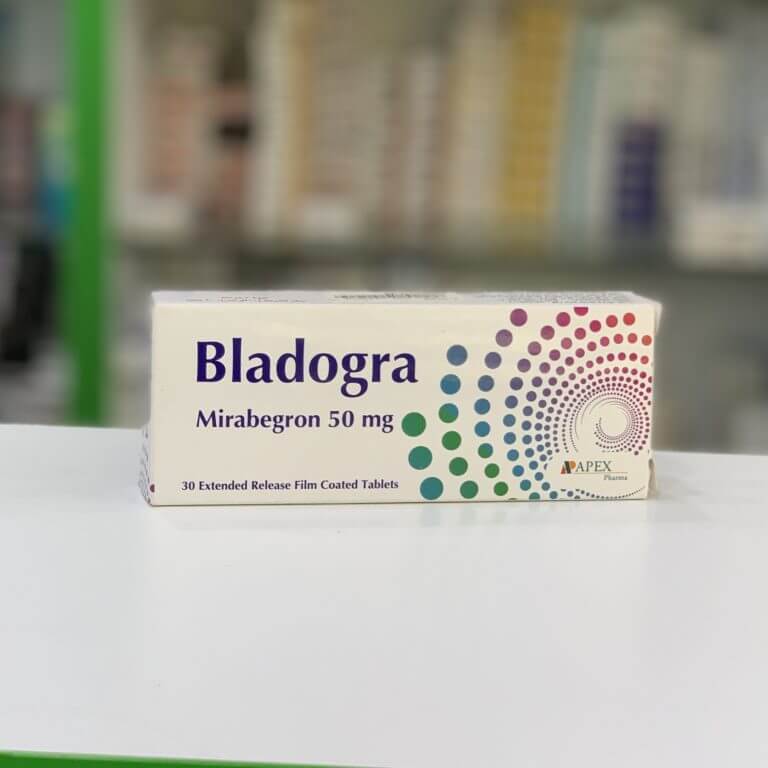
Bladogra 50 mg 30 tablets
357£
View analogsOveractive bladder (OAB) with symptoms of urinary incontinence, frequent urination and urinary urgency.
Buy
Product quantities
Form of Release: Tablets
Product Brand:
Amoun Pharmaceutical Co.S.A.E
About the brand
Product Categories: Kidneys • Urinary incontinence


Bladogra 50 mg 30 tablets
Composition:
Each tablet contains:
Mirabegron 50 mg
Inactive ingredients:
Polyethylene glycol, magnesium stearate, propyl methylcellulose, titanium dioxide, talc.
Properties:
Selective agonist of β3-adrenergic receptors. Mirabegron studies have demonstrated relaxation of bladder smooth muscle in rats and in an isolated human tissue preparation, as well as an increase in cAMP concentrations in bladder tissues in rats. Thus, mirabegron improves the reservoir function of the bladder by stimulating β3-adrenergic receptors located in its wall.
Indications:
Overactive bladder (OAB) with symptoms of urinary incontinence, frequent urination and urinary urgency.
Dosage and administration:
The optimal dosage regimen is determined by the doctor. Compliance of the dosage form of a particular drug with indications for use and dosing regimen should be strictly observed.
Oral intake.
A single dose is 25-50 mg, depending on the function of the kidneys and the therapy used simultaneously. Reception frequency – 1 time / day.
Contraindications:
End-stage renal disease (eGFR <15 ml / min / 1.73 m2 or patients who are indicated for hemodialysis); severe renal failure (eGFR 15-29 ml / min / 1.73 m2) with simultaneous use of strong inhibitors of the CYP3A isoenzyme; severe stage of liver failure (class C on the Child-Pugh scale); severe uncontrolled arterial hypertension, defined as systolic blood pressure ≥180 mm Hg. and / or diastolic blood pressure ≥110 mm Hg; moderate stage of liver failure (class B on the Child-Pugh scale) with the simultaneous use of strong inhibitors of the CYP3A isoenzyme; children’s age (lack of data on efficacy and safety); pregnancy and breastfeeding period; hypersensitivity to the active substance.
Warnings and precautions:
During post-marketing surveillance of the use of mirabegron in patients with infravesical obstruction (IFO) and in patients already taking anticholinergics for the treatment of OAB, cases of urinary retention were noted. A controlled clinical safety study in patients with IFO found no increase in urinary retention in patients treated with mirabegron, however, mirabegron should be administered with caution in patients with clinically significant IFO.
Mirabegron should also be used with caution in patients already taking anticholinergics for the treatment of OAB.
Mirabegron can increase blood pressure. It is recommended to measure blood pressure before starting treatment and periodically during treatment with mirabegron, especially in patients with arterial hypertension.
Side effects:
-Infections and infestations: often – urinary tract infection; infrequently – vaginal infection, cystitis.
-Organs of vision: rarely – swelling of the eyelids.
-Cardiovascular system: often – tachycardia; infrequently – palpitations, atrial fibrillation, increased blood pressure
-Digestive system: often – nausea; infrequently – dyspepsia, gastritis, increased activity of GGT, AST, ALT; rarely – swelling of the lips.
-Skin and subcutaneous tissue: infrequently – urticaria, rash, macular rash, papular rash, itching; rarely – leukocytoclastic vasculitis, purpura, angioedema.
-Musculoskeletal system: infrequently – swelling of the joints.
-Reproductive system: infrequently – vulvovaginal itching.
Storage:
Store at a temperature not exceeding 30 degrees.
Package:
The carton box contains 3 blister of 10 tablets and paper leaflet
Tags, Keywords:
Active Ingredients:
No comments yet. Be the first to write one.
Your comment will be published after moderation.
You’ll receive a notification to your email when someone replies.