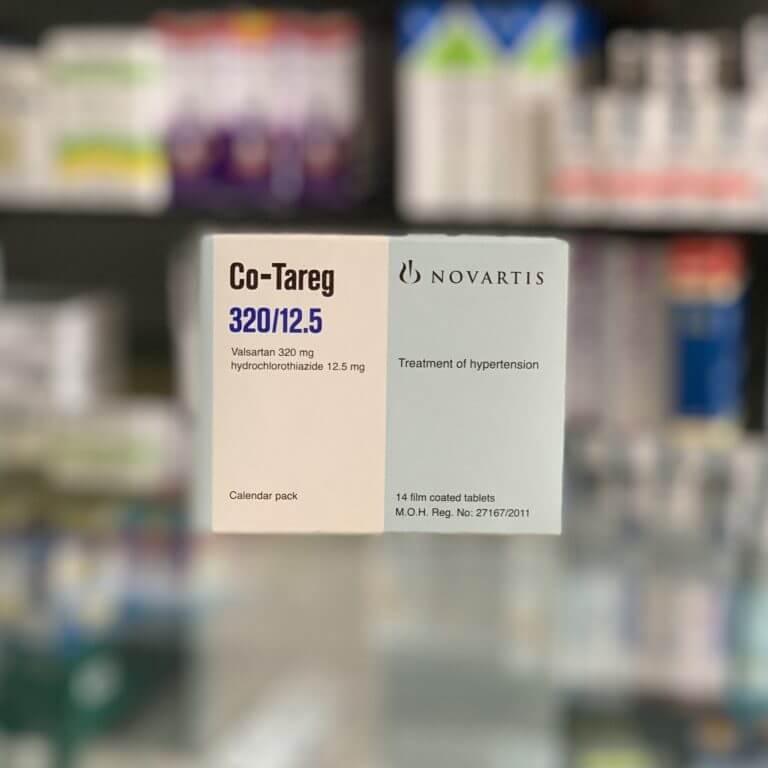
Co Tareg 320/12.5 mg 14 tablets
Composition:
Each tablet contains:
Valsartan 320 mg
Hydrochlorothiazide 12.5 mg
Auxiliary components:
microcrystalline cellulose, croscarmellose sodium, povidone K 25, colloidal silicon dioxide, magnesium stearate.
Properties:
Combined antihypertensive drug, which includes an angiotensin Il receptor blocker and a thiazide diuretic.
Angiotensin Il is an active hormone of the RAAS and is formed from angiotensin I with the participation of ACE. Angiotensin Il binds to specific receptors located on cell membranes in various tissues. It has a wide range of physiological effects, including primarily both direct and indirect participation in the regulation of blood pressure. A potent vasoconstrictor, angiotensin Il induces a direct pressor response. In addition, it stimulates the secretion of aldosterone and promotes the retention of sodium ions.
Valsartan is an active specific angiotensin Il
receptor blocker. It selectively blocks receptors of the ATI subtype, which are responsible for the vasopressor effect of angiotensin ll. An increase in serum angiotensin Il concentration due to blockade of ATI receptors by valsartan can lead to stimulation of unblocked AT2 receptors, which balances the vasopressor effects associated with ATI receptor excitation.
Valsartan does not have any pronounced agonist activity against ATI receptors. The affinity of valsartan for the ATI subtype receptors is approximately 20,000 times higher than for the AT2 subtype receptors.
Because valsartan does not inhibit ACE, which converts angiotensin I to angiotensin Il and causes the destruction of bradykinin, the development of side effects associated with the accumulation of bradykinin is unlikely.
Valsartan does not interact and does not block other hormone receptors or ion channels, which are of great importance for the regulation of the functions of the cardiovascular system.
Hydrochlorothiazide is a thiazide diuretic. The point of application of the action of thiazide diuretics is the distal convoluted renal tubules. When thiazide diuretics act on highly sensitive receptors in the distal tubules of the renal cortex, the reabsorption of sodium (Na +) and chlorine (Cl-) ions is suppressed. Suppression of the Na + and Cl- co-transport system, apparently, occurs due to competition for the binding sites of Cl- ions in this system. As a result, the excretion of sodium and chlorine ions increases approximately to the same extent. As a result of the diuretic action, a decrease in BCC is observed, as a result of which the activity of renin, the secretion of aldosterone, the excretion of potassium by the kidneys, and, consequently, a decrease in the content of potassium in the blood serum, increase.
Indications:
Arterial hypertension (for patients for whom combination therapy is indicated).
Method of administration and dosage:
The optimal dosage regimen is determined the doctor. It is necessary to strictly observe the compliance of the used dosage form of a particular drug with the indications for use and the dosage regimen.
The initial dose is 80 mg of valsartan + 12.5 mg of hydrochlorothiazide 1 time / day. With insufficient effectiveness, a combination of 160 mg + valsartan + 12.5 mg hydrochlorothiazide can be used. In the absence of adequate control of blood pressure, the dose of the combination may be gradually increased. The maximum daily dose is 320 mg of valsartan + 12.5 mg of hydrochlorothiazide or 320 mg of valsartan + 25 mg of hydrochlorothiazide.
Contraindications:
Hypersensitivity to valsartan, hydrochlorothiazide and other sulfonamide derivatives; severe liver dysfunction (more than 9 points on the Child-Pugh scale); biliary cirrhosis of the liver; cholestasis; severe renal dysfunction (GFR <30 ml / min / 1.73 m2); anuria; refractory hypokalemia, hyponatremia, hypercalcemia; symptomatic hyperuricemia; simultaneous use with aliskiren or aliskirencontaining drugs in patients with diabetes mellitus and / or moderate or severe renal impairment (GFR less than 60 ml / min / 1.7 m2); pregnancy and pregnancy planning; lactation period (breastfeeding); children under
18 years of age (the effectiveness and safety of the drug in this category of patients have not yet been established).
Precautions:
Valsartan. With simultaneous use with dietary supplements containing potassium, potassium-sparing diuretics, potassiumcontaining salt substitutes, or with other drugs that can cause an increase in the level of potassium in the blood (for example, with heparin), you should be careful and regularly monitor the level of potassium in the blood.
Hydrochlorothiazide. Thiazide diuretics, due to their ability to reduce the content of potassium and magnesium in the blood serum, should be used with caution in patients with conditions accompanied by electrolyte disturbances: nephropathy, accompanied by loss of salts, and prerenal (cardiogenic) renal dysfunction. In the event of clinical manifestations of hypokalemia (muscle weakness, paresis, changes in ECG indicators), treatment with this combination should be discontinued. Before starting the use of the combination, it is necessary to correct hypokalemia and hypomagnesemia. All patients taking drugs containing thiazide diuretics need regular
monitoring of plasma electrolytes, especially potassium.
When using the combination, the ability of thiazide diuretics to cause hyponatremia and hypochloremic alkalosis should be taken into account, as well as to aggravate the existing hyponatremia. Hyponatremia in these cases is rarely accompanied by neurological symptoms. Regular monitoring of plasma sodium content is required.
Side effects:
From the side of metabolism: infrequently – a decrease in the BCC.
From the nervous system: often – headache; infrequently – paresthesia; very rarely dizziness; frequency unknown – syncope.
From the side of the organ of vision: infrequently – decreased visual acuity.
On the part of the organ of hearing and balance: infrequently – tinnitus.
From the side of the cardiovascular system:
infrequently – a marked decrease in blood pressure, peripheral edema.
From the respiratory system: infrequently cough; frequency unknown – noncardiogenic pulmonary edema.
From the digestive system: infrequently nausea; very rarely – diarrhea.
From the musculoskeletal system: infrequently – myalgia; very rarely – arthralgia.
From the urinary system: the frequency is unknown – impaired renal function.
General reactions: infrequently – increased fatigue.
Laboratory and instrumental data: frequency unknown – increased serum uric acid concentration, increased serum bilirubin, increased serum creatinine, hypokalemia, hyponatremia, increased serum urea nitrog concentration, neutropenia.
Storage method:
At a temperature not higher than 30 degrees.
Packaging:
The cardboard box contains 2 blisters of 7 tablets each, paper instructions.
 Русский
 English
 عربي
عربي