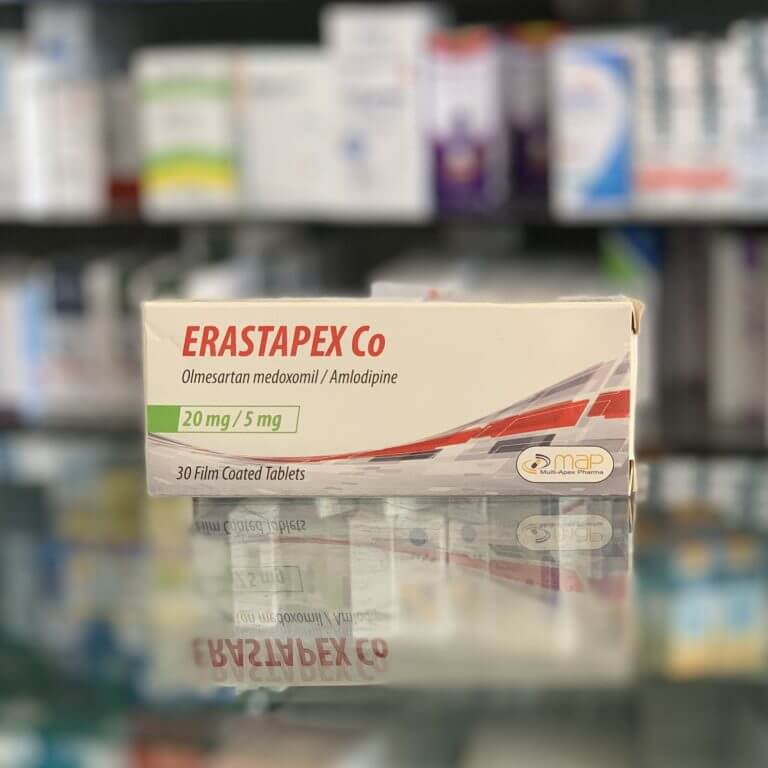
Erastapex Co 20 mg/5 mg 30 tablets
Composition:
Each tablet contains: Olmesartan medoxomil 20 mg Amlodipine 5 mg Auxiliary components: pregelatinized starch, microcrystalline siliconized cellulose, croscarmellose sodium, magnesium stearate.
Properties:
Combined antihypertensive drug, which includes an angiotensin II receptor antagonist – olmesartan medoxomil and a slow calcium channel blocker – amlodipine. The combination of the two active substances has a synergistic antihypertensive effect, as a result of which blood pressure decreases to a greater extent than when each of them is taken separately.
Indications:
Essential hypertension (with the ineffectiveness of olmesartan monotherapy with medoxomil or amlodipine).
Method of administration and dosage:
The drug is taken orally, 1 time / day, at the same time, regardless of the time of the meal, without chewing, drinking a sufficient amount of liquid (for example, a glass of water). Before prescribing a combination drug, it is recommended to pre-select the doses of each of the active ingredients separately (olmesartan medoxomil and amlodipine). The recommended dose is 1 tab. a drug containing 5 mg of amlodipine and 20 mg of olmesartan medoxomil.
Contraindications:
Severe liver failure (more than 9 points on the Child-Pugh scale); obstruction of the biliary tract and cholestasis; renal failure of severe severity (CC less than 20 ml / min, there is no clinical experience); condition after kidney transplantation (there is no clinical experience); conditions accompanied by a pronounced violation of the outflow of blood from the left ventricle (for example, severe aortic stenosis); severe arterial hypotension (SBP less than 90 mm Hg); shock (including cardiogenic); hemodynamically unstable heart failure after myocardial infarction; simultaneous use with aliskiren and aliskiren-containing drugs in patients with diabetes mellitus and / or impaired renal function (GFR less than 60 ml / min / 1.732m of body surface area); pregnancy; breastfeeding period; age up to 18 years (efficacy and safety have not been established); hypersensitivity to olmesartan medoxomil, amlodipine and other dihydropyridine derivatives or to other components of the drug. With care: stenosis of the aortic and mitral valves; hypertrophic obstructive cardiomyopathy; simultaneous use with lithium preparations; hyperkalemia, hyponatremia; hypovolemia (including due to diarrhea, vomiting or the simultaneous use of diuretics), as well as in patients on a diet with limited salt intake; renal failure of mild to moderate severity (CC 20-60 ml / min); primary aldosteronism; renovascular hypertension (bilateral stenosis of the renal arteries or stenosis of an artery of a single kidney); other conditions accompanied by activation of the RAAS; chronic heart failure (III-IV FC according to NYHA classification); chronic forms of ischemic heart disease; acute forms of ischemic heart disease (acute myocardial infarction, including within one month after it; unstable angina pectoris); SSSU; arterial hypotension; cerebrovascular diseases; mild to moderate liver failure (less than 9 points on the Child-Pugh scale); age over 65; use in patients of the black race.
Precautionary measures:
In patients with chronic heart failure in whom renal function may be highly dependent on the activity of the RAAS (for example, in patients with bilateral renal artery stenosis or stenosis of an artery of a single functioning kidney), the use of drugs that affect the RAAS (for example, angiotensin receptor antagonists II), can lead to the development of acute arterial hypotension, oliguria, azotemia, or, in rare cases, acute renal failure. Thus, in patients with heart failure, the drug should be used with caution. Because the drug contains amlodipine, then it, like other vasodilators, should be used with caution in patients with aortic and / or myrtle stenosis, as well as in patients with hypertrophic obstructive cardiomyopathy.
Side effects:
From the immune system: rarely – allergic reactions, hypersensitivity reactions, urticaria. From the side of the nervous system: often – dizziness, headache; infrequently – hypesthesia, paresthesia, postural dizziness, drowsiness; rarely syncope. Mental disorders: infrequently – decreased libido. From the side of the cardiovascular system: infrequently – palpitations, tachycardia, marked decrease in blood pressure, orthostatic hypotension; rarely – “hot flushes” of blood to the face. From the respiratory system: infrequently – cough, dyspnea. On the part of the organ of hearing and balance: infrequently – vertigo. From the digestive system: infrequently – dry mouth, abdominal pain, constipation, diarrhea, dyspepsia, nausea, vomiting. From the urinary system: infrequently – pollakiuria. From the genitals and breast: infrequently – erectile dysfunction / impotence. On the part of the skin and subcutaneous tissue: infrequently – skin rash. From the musculoskeletal system: infrequently – back pain, muscle cramps, pain in the limbs. Others: often – increased fatigue, peripheral edema, soft tissue edema; infrequently – asthenia; rarely – facial edema. On the part of laboratory parameters: infrequently – an increase / decrease in the content of potassium in the blood plasma, an increase in the concentration of uric acid in the blood plasma, an increase in the concentration of creatinine in the blood plasma, an increase in the activity of GGT.
Storage method:
At a temperature not higher than 30 degrees. In a dry place.
Package:
The cardboard box holds 3 blisters of 10 tablets.
 Русский
 English
 عربي
عربي