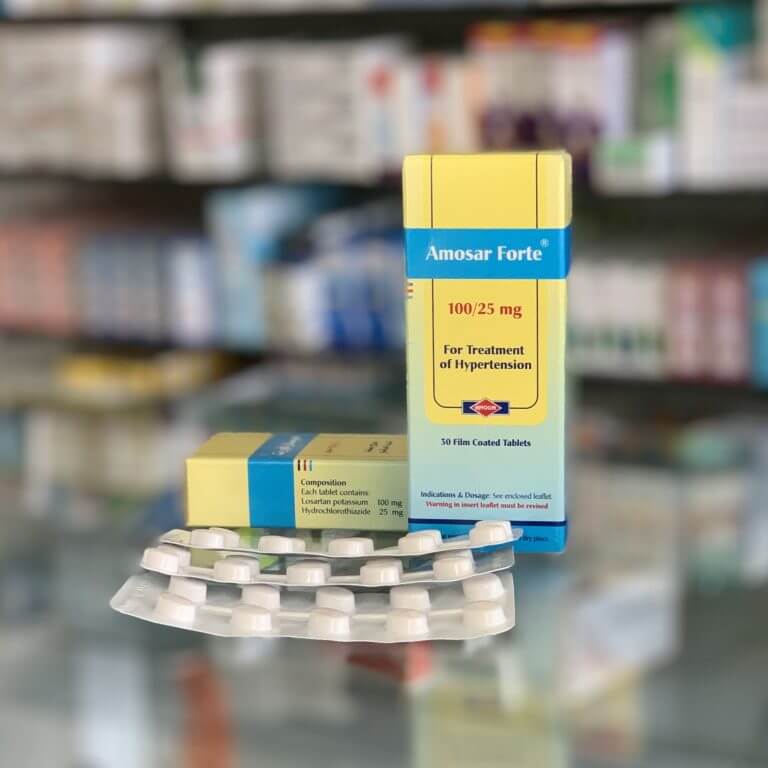
Amosar Forte 100/25 mg 30 tablets
Composition:
Each p/ o tablet contains:
Losartan – 100mg.
Hydrochlorothiazide 25mg
Auxiliary components: lactose monohydrate, calcium phosphate anhydrous, Prosolv 90, croscarmellose sodium, Povidone K30, sodium stearyl fumarate, colloidal silicon dioxide (Aerosil 200).
Properties:
Amosar forte is a combined drug that has an antihypertensive effect. Losartan – is a nonpeptide angiotensin Il receptor blocker. By blocking receptors of the ATI type (with the participation of which the main effects of angiotensin Il are realized), losartan prevents and eliminates the vasoconstrictor effect of angiotensin Il, its stimulating effect on the secretion of aldosterone by the adrenal glands and some other effects of angiotensin ll. It i characterized by a long-term effect (24 hou or more). Hydrochlorothiazide is a thiazide diuretic, the diuretic effect of which is
associated with impaired reabsorption of sodium, chlorine, potassium, magnesium, water in the distal nephron; delays the excretion of calcium ions, uric acid. It has an antihypertensive effect, which develops due to the expansion of arterioles. Has practically no effect on normal blood pressure.
Indications:
arterial hypertension (for patients for whom combination therapy is indicated); reducing the risk of cardiovascular disease and mortality in patients with arterial hypertension and left ventricular hypertrophy.
Mode of application:
the drug is taken orally, regardless of food intake. The tablets are swallowed without chewing with water. Can be combined with other antihypertensive drugs. Arterial hypertension The initial and maintenance dose is 1/2 tab. (50 / 12.5mg) 1 time / day. In the absence of an adequate therapeutic effect, the dose of the drug is increased to 100/25 mg the maximum daily dose. In elderly patients and patients with moderate renal insufficie adjustment of the initial dose is not require Reducing the risk of cardiovascular morbidity
and mortality in patients with arterial hypertension and left ventricular hypertrophy: patients who failed to achieve target blood pressure levels while using losartan at a dose of 50 mg / day require a combination with hydrochlorothiazide (12.5 mg);
Contraindications:
arterial hypotension; anuria; severe renal and liver dysfunction; hyperkalemia; pregnancy; lactation period; age up to 18 years (efficacy and safety have not been established); hypersensitivity to drug components and other sulfonamide derivatives.
Precautions:
Losartan – should be used with caution in arterial hypotension, bilateral renal artery stenosis or stenosis of an artery of a single kidney, with renal / hepatic insufficiency. In patients receiving high-dose diuretic therapy at the beginning of losartan treatment, symptomatic arterial hypotension may occur. In case of impaired renal function, the dose of losartan should be reduced. In patients with liver disease, losartan should be used in 10 doses. With cirrhosis of the liver, the concentration of losartan in the blood plasma increases significantly. During the period of treatment, the level of potassium in the blood should be regularly monitored, especially in elderly patients with impaired renal function. The simultaneous use of losartan with potassium-sparing diuretics should be avoided.
Hydrochlorothiazide can increase arterial hypotension, impair glucose tolerance, reduce the excretion of calcium in the urine and cause a transient, slight excess in the concentration of calcium in the blood plasma. Their use can distort the results of the study of the function of the parathyroid glands, therefore, before the study of the functions of the parathyroid glands, the thiazide diuretic should be canceled. An increase in the concentration of cholesterol and triglycerides in the blood may occur. In some patients, the use of thiazide diuretics can lead to exacerbation of gout. Hydrochlorothiazide can cause the development of acute transient myopia and an acute attack of angle-closure glaucoma.
Side effects:
anemia, itching, rash, urticaria, vasculitis, anaphylactic reactions, edema of the larynx and vocal cords with the development of
airway obstruction and / or edema of the face, lips, pharynx and / or tongue, insomnia, headache, dizziness; anxiety, drowsiness, memory disorders, tremor, migraine, depression, anxiety, loss of consciousness, acute cerebrovascular accident, visual acuity, conjunctivitis, ringing in the ears, bradycardia, atrial fibrillation, tachycardia, angina pectoris, myocardial infarction, fainting, nasal congestion, sinusitis, sinusitis, cough; upper respiratory tract infections, rhinitis, pharyngitis, laryngitis, bronchitis, diarrhea, cramps, abdominal pain, nausea; violation of taste, dry mouth, constipation, flatulence, gastritis, abnormal liver function; hepatitis. Alopecia, dermatitis, dry skin, increased sweating, cramps in the muscles of the lower extremities, myalgia, back pain, chest pain, leg pain; urinary tract infections, impaired renal function, acute renal failure, fatigue, fever.
Storage:
Store at a temperature not exceeding 25C in a dry place out of reach of children.
Packaging:
a cardboard box contains 1, 2, 3, 4 or 5 blis of 10 tablets each, paper instructions.
 Русский
 English
 عربي
عربي