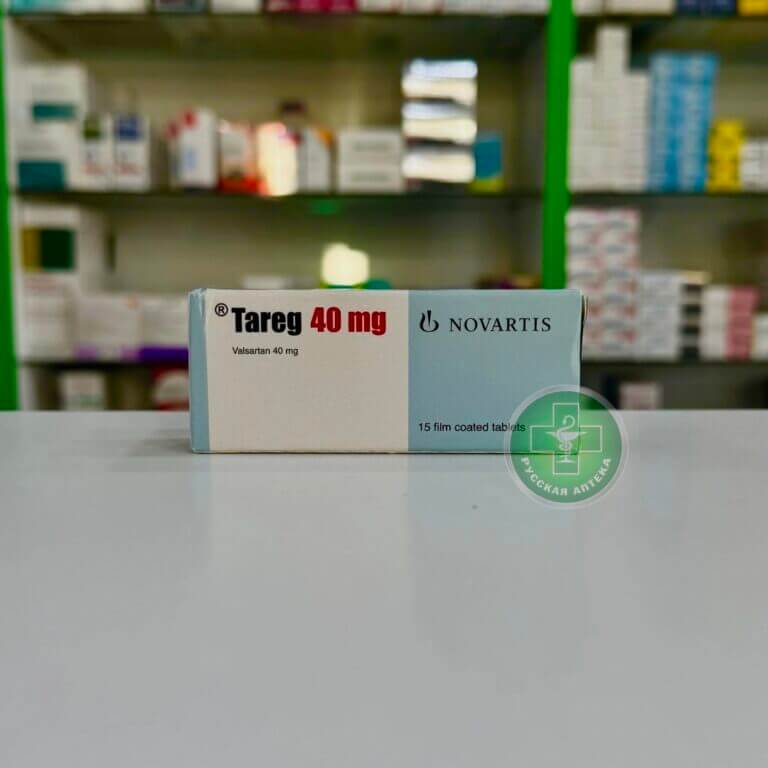
Tareg 40 mg 15 tablets
Structure:
Each p / o tablet contains:
Valsartan – 40 mg.
Auxiliary components: microcrystalline cellulose, crospovidone, anhydrous colloidal silicon, magnesium stearate, hypromellose, titanium dioxide, macrogol 8000, red iron oxide (E 172), yellow iron oxide (E 172), black iron oxide (E 172).
Properties:
Valsartan is an active specific angiotensin II receptor antagonist intended for oral administration. Selectively blocks AT1 receptors, which are responsible for the effects of angiotensin II. The consequence is an increase in plasma concentration of angiotensin II, which stimulates unblocked AT1 receptors. The affinity of valsartan for the AT1 subtype receptors is approximately 20,000 times higher than for AT2. Valsartan does not interact with and does not block other hormone receptors or ion channels, which are important in the regulation of the functions of the cardiovascular system. The likelihood of a cough when using valsartan is very low, due to the lack of effect on ACE (angiotensin converting enzyme).
Indications:
Hypertension in adults and children (6-18 years old), heart failure (slows down its progression). After suffering myocardial infarction. Adult hypertensive patients with impaired glucose tolerance at cardiovascular risk.
The recommended dose for adults is 80 mg or 160 mg once a day. The antihypertensive effect is present for 2 weeks, and the maximum effect is observed after 4 weeks. If blood pressure is not controlled, the daily dose can be increased to 320 mg or a diuretic may be added. Heart failure: The recommended starting dose is 40 mg daily. Increases to 80 mg and 160 mg 2 times a day should be done up to the maximum dose tolerated by the patient. The maximum daily dose is 320 mg in divided doses. After myocardial infarction, treatment begins within 12 hours after myocardial infarction. The initial dose is 20 mg (1/2 tablet) 2 times a day, then it should be increased to 40 mg, 80 mg and 160 mg 2 times a day for the next few weeks. The target dose is a maximum of 160 mg 2 times a day. The recommended dose is 80 mg 2 times a day two weeks after the start of treatment. Adult hypertensive patients with impaired glucose tolerance in cardiovascular disorders: the recommended initial dose is 80 or 160 mg once a day. Patients should start with a dose of 80 mg, take up to 160 mg once a day. No dose adjustment is required for patients with renal or hepatic impairment.
Mode of application:
The dose for children and adolescents weighing less than 35 kg is 40 mg once a day and for those who weigh 35 kg and> – 80 mg once a day or as directed by a doctor.
Contraindications:
Children under 6 years of age; for the treatment of heart failure or recent myocardial infarction in children and adolescents under the age of 18. Hypersensitivity to valsartan and other components in the composition. Severe liver dysfunctions, biliary cirrhosis, cholestasis.
Precautions:
Patients with severe sodium deficiency who receive high doses of diuretics rarely experience symptomatic hypotension after starting treatment. Treatment can be continued after blood pressure has stabilized. Evaluation of patients with heart failure or post-myocardial infarction should always include an assessment of renal failure. In patients with heart failure, caution should be exercised with a triple combination of an ACE inhibitor, a beta-blocker and valsartan.
Side effects:
Decreased hemoglobin, hypersensitivity reactions, vertigo, vasculitis, marked decrease in blood pressure, cough, abdominal pain, impaired renal and liver function, angioedema, skin rash, itching, myalgia, increased fatigue, back pain, diarrhea, dizziness, headache , fainting, insomnia, decreased libido, nausea, peripheral edema, pharyngitis, rhinitis, sinusitis, upper respiratory tract infections, viral infections.
Pregnancy and lactation: should not be used during pregnancy, as well as in women planning a pregnancy. It is not known whether valsartan is excreted in breast milk. Therefore, you should not use the drug during lactation.
Storage:
Keep out of the reach of children.
Packaging:
The package contains 14 or 28 film-coated tablets.
 Русский
 English
 عربي
عربي