 Русский
 English
 عربي
عربي
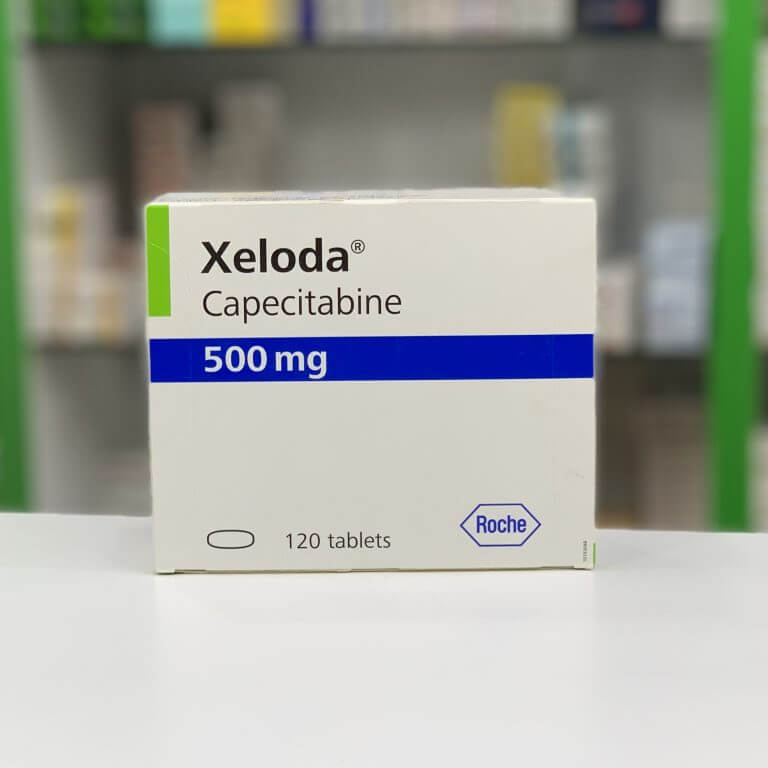
Xeloda 500 mg 120 tablets
6650£
View analogs- Colon and colorectal cancer
- Breast cancer
- Esophageal cancer, cancer of the gastroesophageal junction and gastric cancer.
Buy
Product quantities
Form of Release: Tablets
Product Brand:
Roche
About the brand
Product Categories: Oncology


Xeloda 500 mg 120 tablets
Composition:
Capecitabine
Inactive ingredients:
Lactose anhydrous, croscarmellose sodium, hypromellose, cellulose microcrystalline, magnesium stearate, talk, titanium dioxide, yellow iron oxide, red iron oxide.
Properties:
Capecitabine is a fluoropyrimidine carbamate for oral use and belongs to the group of tumor-activated and tumor-selective cytostatics. It is not itself cytotoxic, but is converted by three enzymatic steps, the final step preferentially in the tumor, into the cytotoxic active substance.
5-FU inhibits cell division by blocking DNA synthesis ( enzyme inhibition), resulting in the formation of structurally defective RNA ( incorporation of 5-FU), which directly affects protein biosynthesis.
The formation of 5-FU from capecitabine is preferentially catalyzed in the tumor by the tumor-associated angiogenic factor thymidine phosphorylase. This keeps the burden on healthy tissue, due to systemic 5-FU, to a minimum. The stepwise enzymatic biotransformation of capecitabine to 5-FU leads to higher concentrations in tumor tissue than in normal tissue.
After oral administration of capecitabine to patients with colorectal cancer (n=8) the ratio between the 5-FU concentration in the tumor and the concentration in the surrounding tissue was 3.2 (between 0.9 and 0.8). The ratio between the 5-FU concentration in the tumor and plasma was 21.4 (between 3.9 and 59.9), whereas the ratio between healthy tissue and plasma was 8.9 (between 3.0 and 25.8). The thymidine phosphorylase concentration was determined and found to be around four times higher in primary colon tumors than in the surrounding normal tissue.
Other studies have shown that the thymidine phosphorylase concentration is higher too in other human tumors such as breast , stomach, cervical and ovarian cancer than in the surrounding tissue.
Indications:
-Colon and colorectal cancer
-Breast cancer
-Esophageal cancer, cancer of the gastroesophageal junction and gastric cancer
Dosage and administration:
Ask your doctor before administering, increasing or decreasing the dose.
Contraindications:
Known hypersensitivity to the active ingredient, to other fluoropyrimidines or to one of the excipients.
Known severe dihydropyrimidine dehydrogenase deficiency.
Pregnancy and lactation.
Severe hepatic impairment.
Concomitant treatment with brivudine or with chemically related substances, such as sorivudine.
Side effects:
Common: diarrhea, nausea, vomiting,stomatitis and hand-foot syndrome, herpes simplex, cystitis, granulocytopenia, hyperkalemia, hypokalemia, dehydration, weight loss,insomnia, lethargy, hypoesthesia, hyperesthesia, conjunctivitis, eye irritation, blurred vision, tinnitus. hypoacusis, vertigo, hypotension, dyspnea, epistaxis, cough. pharyngolaryngeal and oropharyngeal pain, rhinorrhea, dysphonia, pulmonary embolism.
Uncommon: pancytopenia, bone marrow depression, hypertriglyceridemia, encephalopathy, confusion, cerebral signs such as ataxia, dysarthria, impaired balance and abnormal coordination, heart failure, cardiomyopathy, sudden cardiac death, tachycardia, atrial arrhythmias including atrial fibrillation, ventricular extrasystoles.
Rare: lacrimal duct stenosis and corneal disorders including keratitis, local and fatal systemic infections.
Warnings and precautions:
Xeloda should be prescribed only by a suitably qualified doctor with experience in the use of antineoplastic drugs.
Patients with certain heterozygous DPYD variants that may cause partial DPD deficiency have been shown to be at an increased risk of severe toxicity when treated with capecitabine.
Patients with partial DPD deficiency in whom the benefits of Xeloda are considered to outweigh the risks must be treated with extreme caution, initially with a substantial dose reduction and frequent subsequent monitoring and dose adjustment according to toxicity.
Testing for DPD deficiency should be considered, based on local availability and current guidelines.
In patients with unrecognized DPD deficiency treated with capecitabine, as well as in patients who test negative for specific DPYD variants, life-threatening toxicities manifesting as overdose may occur. In the event of grade 2-4 acute toxicity treatment must be discontinued immediately. Permanent discontinuation should be considered based on clinical
assessment of the onset, duration and severity of the observed toxicity.
Hand-foot syndrome: Xeloda can cause hand-foot syndrome (palmar-plantar erythrodysesthesia or chemotherapy induced acral erythema) with a severity of between 1 and 3. Persistent or severe hand-foot syndrome (grade 2 and above) can eventually lead to loss of fingerprints, which may hamper identification of the patient concerned. In patients on Xeloda monotherapy the median interval until first occurrence is 719 days (11 — 360 days). Hand-foot syndrome grade 1 is characterized by numbness, dysesthesia/paresthesia, tingling, erythema or painless swelling of the hands and/or feet. The symptoms do not interfere with normal daily activities. Grade is defined as painful erythema and swelling of the hands and/+ feet and/or discomfort affecting the patient’s normal daily activities. Grade 3 hand-foot syndrome is defined as moist desquamation, ulceration, blistering and severe pain of the hands and/or feet and/or severe discomfort that causes the patient to be unable to work or perform normal daily activity. If grade 2 or 3 hand-foot syndrome occurs, the Xeloda dose should be adjusted.
In the absence of tolerability and efficacy data in patients with hepatic impairment, capecitabine use should be carefully monitored in patients with mild to moderate liver dysfunction, regardless of the presence or absence of liver metastases. In patients with liver metastases and elevations in bilirubin of other liver enzymes, Xeloda should be used with caution.
Xeloda should be used with caution in patients with renal impairment. In patients with moderate renal impairment (creatinine clearance 30 — 50 ml/min) a higher incidence of | grade 3 or 4 side effects was observed, as was also the case with 5-FU. In these patients Xeloda should be reduced to 75% of the recommended starting dose.
The cardiotoxic side effects observed during treatment with Xeloda, such as myocardial infarction, angina pectoris, cardiac arrhythmias, cardiac arrest, heart failure and ECG changes, are comparable to those of other fluorinated pyrimidines. The incidence of such side effects is greater in patients with a history of coronary heart disease. Caution must be exercised in patients with a history of severe cardiac disease, arrhythmias and angina pectoris.
Xeloda can induce hyperbilirubinemia. Administration of Xeloda should be interrupted if treatment-related elevations in bilirubin of >3.0 x ULN (upper limit of normal) or treatment related elevations in hepatic aminotransferases (ALAT, ASAT) of >2.5 x ULN occur. Treatment with Xeloda may be resumed when bilirubin decreases to <3.0 x ULN or hepatic aminotransferases decrease to <2.5 x ULN.
Caution should be exercised when coadministering Xeloda with drugs metabolised by cytochrome P450 2C9 such as wartann or phenytoin. Patients receiving Concomitant Xeloda and oral coumarin-derivative anticoagulant therapy should have their blood coagulation (INR or prothrombin time) monitored closely and the anticoagulant dose adjusted accordingly. Patients taking phenytoin concomitantly with Xeloda should be regularly monitored for increased phenytoin plasma concentrations.
In elderly patients aged between 60 and 79 years treated for metastatic colorectal tumours with Xeloda monotherapy, the incidence of gastrointestinal side effects was similar to that in the overall patient population. Among very elderly patients (80 years and older), there was a higher per cent incidence of reversible grade 3 or 4 gastrointestinal side effects such as diarrhea, nausea and vomiting (see Dosage and administration, Special dosage instructions). Evaluation of the safety data of patients aged > 60 years treated with the combination of Xeloda and docetaxel showed an increased incidence of treatment-related side effects compared with patients under 60 years. Early discontinuation of treatment may be necessary. Xeloda film-coated tablets contain lactose and should not be administered to patients with the rare hereditary problems of galactose intolerance, Lapp lactase deficiency or glucose galactose malabsorption.
Storage:
Store at a temperature not exceeding 30°C.
Package:
The carton holds 60 tablets of 150 mg or 120 tablets of 500 mg.
Tags, Keywords:
Active Ingredients:
No comments yet. Be the first to write one.
Your comment will be published after moderation.
You’ll receive a notification to your email when someone replies.


